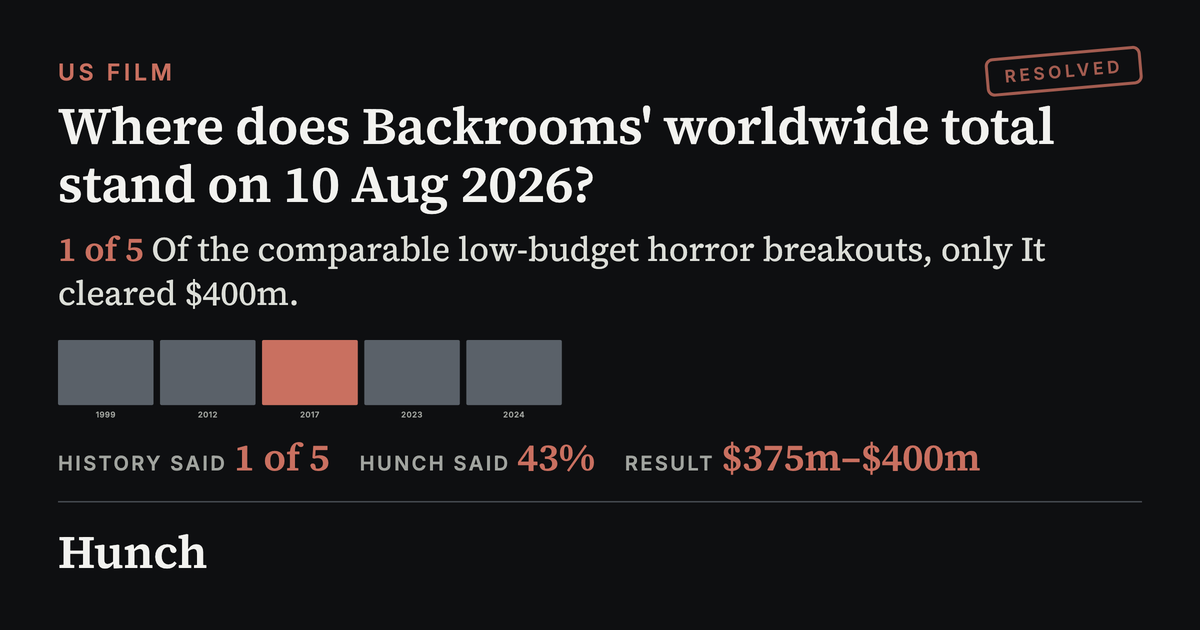
Backrooms cost $10m and took $350m. Few cheap horror hits reached $400m.
Kane Parsons's film of Backrooms opened to $81.4m. At 20, he is the youngest filmmaker ever to top the US box office.
What happened
Backrooms stands at roughly $350m worldwide after six weekends, now A24’s highest-grossing film, having overtaken Marty Supreme.
Backrooms cost about $10m to make and opened to $118m worldwide. It took $81.4m in the US over the weekend of 29 to . That is more than three times A24’s best opening before it, $25.5m for Civil War in 2024. The film comes from Kane Parsons’s popular YouTube series about endless empty rooms under bright office lights.
Parsons is 20. He is the youngest filmmaker ever to open a film at No 1 in the US. The record belonged to Josh Trank, who was 27 when Chronicle opened at the top with $22m in 2012. Chiwetel Ejiofor, Renate Reinsve and Mark Duplass star, well-known names for what began as a teenager’s project in his bedroom.
Of the film’s total by early July, $190m came from the US and $159m from other countries. It is the second-biggest horror film of 2026. Its takings each week are now falling fast. For cheap horror hits, these weeks decide the final number.
Sources: Box Office Mojo, Deadline, Variety (2)
The Pattern
We looked for cheap horror films that became huge hits, and at how much they made in the end. We found five. Films like these earn many times what they cost, but then their takings fall faster than almost any other kind of film. The opening weekend makes the news. The weeks after it decide the final total.
Show the other 3 cases
The Read
History points to a total between $375m and $400m by . By late June the film was adding only a few million dollars each weekend. It took $7.3m in the weekend Toy Story 5 opened. In summer, horror films lose even more ground once schools break up and big family films fill the screens. From $350m in early July, a falling $4m to $6m a week worldwide leaves it short of $400m. Of the films we compared, only It crossed that line.
The doubt is that this film keeps beating the films we compare it with. It opened bigger than any cheap horror film before it, and its takings lasted better than The Devil Inside, which collapsed after its first weekend. 45% of its money comes from outside the US, which horror rarely manages. A late push in cinemas, a longer cut of the film or a strong run in Asia could add $10m to $15m that a steady fall does not allow for.
The sequel question is closer to even, and leans towards no before . A24 will very likely return to a film this profitable, but the studio has usually announced follow-ups on its own timetable. Against that, Parsons’s YouTube series has years of material, and A24 has never had a possible film series this big. That gives it a reason to confirm quickly, while the film is still in cinemas.
Disclaimer
Hunch works only from sources that are publicly available, and publishes on the basis of analysis of that material. We do not form an editorial opinion or take sides, we give a simpler and wider view of news that already exists. If information in a source we used was inaccurate, distorted, or later disputed but had already entered our analysis, Hunch accepts no liability for that. Predictions are not advice. Phase 1 markets use Hunch Points, not money.
Published by Hunch under the Editorial Code. Complaints and corrections: /contact/.