Matt Brittin runs the BBC now. Half its bosses since 1987 left in a crisis.
Matt Brittin became BBC director-general on 18 May after Tim Davie resigned. The BBC charter renewal and the £180 licence fee's future are still open.
What happened
The BBC confirmed former Google EMEA president Matt Brittin as director-general; he took charge on on £565,000, with charter renewal now his defining test.
Matt Brittin, who used to run Google in Europe, the Middle East and Africa, is now the BBC’s director-general, the top job at the corporation. The search began when Tim Davie resigned in over how a Panorama programme was edited. Davie left on . Rhodri Talfan Davies ran the BBC for a short time until Brittin took charge on .
The BBC charter and the licence fee run only to the end of 2027. The charter is the document that sets what the BBC is and what it does. The licence fee, the charge that pays for the BBC, is £180 a year, set in .
The government began a review of the charter on with a green paper, a plan put out for public comment. It puts changes to the licence fee, free licences for some people and money from commercial work all on the table. Public comments closed on .
The first hard test is close. The BBC usually publishes its annual report in July. It will show how much licence fee money came in after another year of people cancelling. It will also list the pay of the best-paid people on air, in the first full year without Gary Lineker’s £1.35 million. And it sets the money position Brittin must defend in the charter talks.
Sources: Deadline (2), Variety, GOV.UK
The Pattern
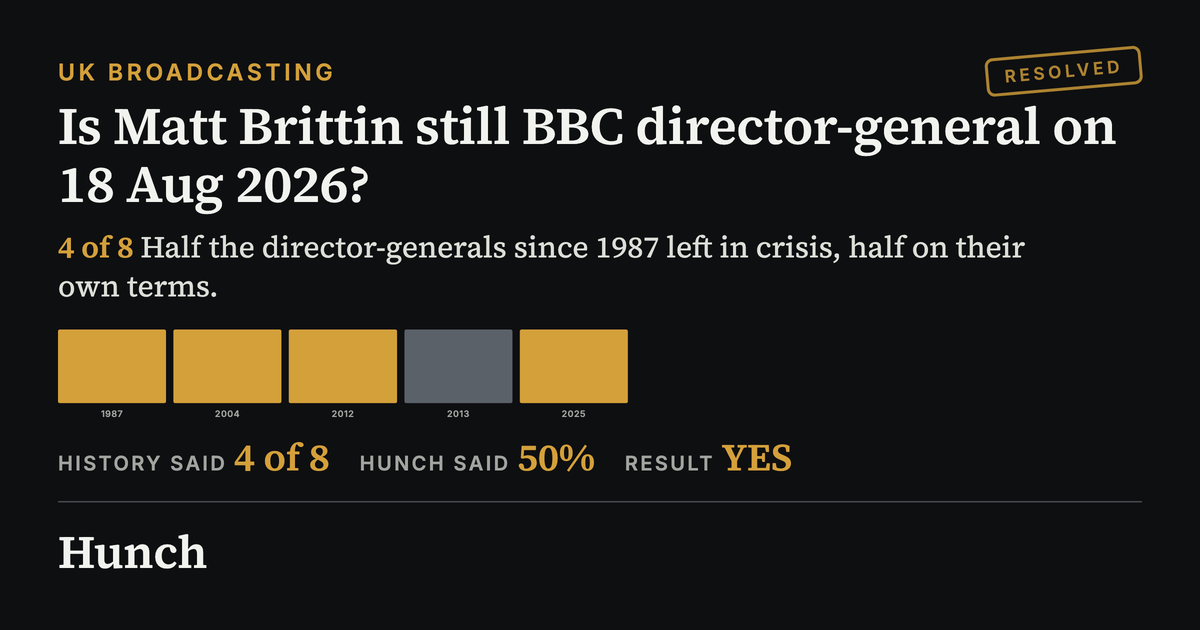
Half of the BBC’s bosses since 1987 resigned under pressure. The BBC has changed director-general eight times in that period. Four left in an orderly way, and four resigned in the middle of a row. What ended a boss’s time early was a crisis over the BBC’s journalism and programmes, and money played no part.
Show the other 3 cases
The Read
Brittin’s own job looks safe for now. The one boss in this record who came in straight after a crisis, Tony Hall in 2013, stayed seven years and left on his own terms. Brittin now has that same place.
History says the annual report will come out in July. The BBC has published it in July in each recent year, on in 2024 and in mid-July in 2025. A new boss also has a reason to publish bad news early, while it still belongs to his predecessor’s time. The doubt is the change at the top. Davie left, a temporary boss ran the BBC, and the new team only settled in during May. The report is signed off by a board that Brittin has only just joined. That gives the BBC a fair reason to push it to September, and a September report would mean no.
The report also carries the list of the best-paid people on air. With Lineker gone since , Greg James of Radio 1 breakfast looks the likely top name, as Zoe Ball’s Radio 2 role has shrunk. The list has surprised before. It covers only jobs paid for by the licence fee, so someone like Fiona Bruce, who presents Question Time and Antiques Roadshow, could come first.
Disclaimer
Hunch works only from sources that are publicly available, and publishes on the basis of analysis of that material. We do not form an editorial opinion or take sides, we give a simpler and wider view of news that already exists. If information in a source we used was inaccurate, distorted, or later disputed but had already entered our analysis, Hunch accepts no liability for that. Predictions are not advice. Phase 1 markets use Hunch Points, not money.
Published by Hunch under the Editorial Code. Complaints and corrections: /contact/.