BBC boss says channels may close. In 7 of 9 such cases, a list of cuts followed.
BBC director-general Matt Brittin said on 25 September that some channels and radio stations may close, as the BBC looks for £500m of savings.
What happened
BBC director-general Matt Brittin said the BBC’s money problems and changing audience habits “may well mean” some channels and radio stations have to close, as it seeks £500m of savings.
Matt Brittin, the BBC’s director-general, spoke to Sunday with Laura Kuenssberg in an interview released on and shown on BBC One on . He said the BBC could not promise that any programme or channel would last for ever. He did not name any channel or station.
The tight financial situation means that we’re having to look at some of those decisions a bit sooner than we might like.
Matt Brittin, BBC News
He gave an example without a name: a channel watched live by 100,000 people while 500,000 watch its programmes on iPlayer, the BBC’s online service. He asked when would be the right time to move such a service fully online.
The BBC has to save £500m, and up to 2,000 jobs could go. Brittin said on his first day in May that tough choices could not be avoided. The BBC’s charter, the document that sets what it does, ends in , and the government is working on the next one.
Programmes have already gone. In July the BBC dropped Blankety Blank, Celebrity Mastermind and Live at the Apollo, and said more savings would be announced in the coming months. In August Brittin said he had not understood how deep the cuts would need to be.
On the trade paper Deadline reported, from BBC sources who were not named, that the BBC could announce closures of TV and radio services as early as the following week, and that BBC Three was seen as at risk. Deadline said nothing was confirmed and the BBC declined to comment. It also reported that Brittin told staff in June the BBC would review its TV channels and radio stations as audiences move online.
Sources: BBC (2, 3, 4), GOV.UK, Deadline
The Pattern
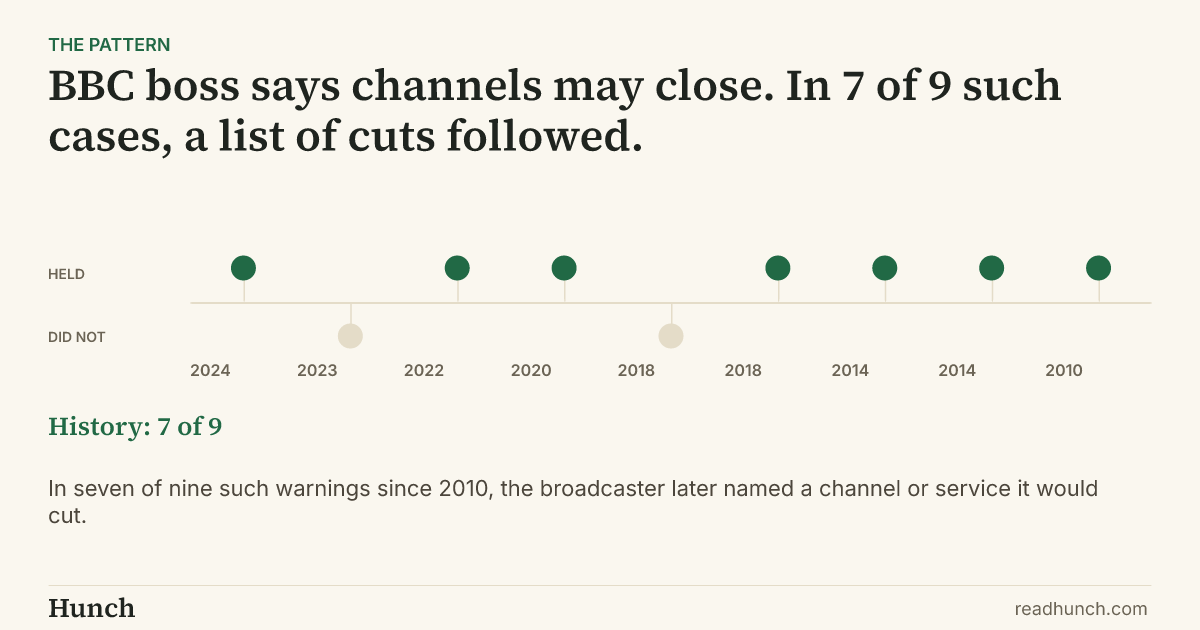
We looked for cases where the head of a large public broadcaster, after the government cut or froze its money, said in public that audiences would lose something: a channel, a station, a language service or a news bulletin. We then checked whether the broadcaster later named what would go. We found nine cases since 2010, and in seven a list of cuts followed. Four of the nine are the BBC. The other five are Denmark’s DR, Australia’s ABC twice, the Dutch NPO and Austria’s ORF, which are paid for by a licence fee or by the state in a similar way.
Show the other 7 cases
The Read
History points to a list of cuts. In seven of the nine cases the broadcaster named what would go, and in every case where the money cut was already fixed when the boss spoke, a list followed. Brittin is in that position: the £500m target was set before he started in May, and he named no other way to find the money.
The list rarely came fast. Only twice did it come within a month: ABC in 2020, whose boss had promised details by the end of that month, and BBC Three in 2014, when the press already expected an announcement. BBC sources told Deadline this week that closures could come as early as next week, but the BBC has not said so itself.
The cut itself came slowly. In the seven cases we could check, only one cut took effect within a year of the warning. BBC Three needed approval from the BBC Trust and went off air about two years after the warning, and the 2022 merger of the BBC news channels went through a review by Ofcom, the media regulator.
Four of the nine cases are the BBC, so the record leans on one broadcaster. Much of what we know about DR, ABC, NPO and ORF comes from their own websites. In the two cases with no list, the broadcaster got something else instead: the BBC changed the free licences for over-75s, and the ORF sports channel was kept on air with government money and then by a 2025 law.
Sources: Deadline, The Guardian, Ofcom
Disclaimer
Hunch works only from sources that are publicly available, and publishes on the basis of analysis of that material. We do not form an editorial opinion or take sides, we give a simpler and wider view of news that already exists. If information in a source we used was inaccurate, distorted, or later disputed but had already entered our analysis, Hunch accepts no liability for that. Predictions are not advice. Phase 1 markets use Hunch Points, not money.
Published by Hunch under the Editorial Code. Complaints and corrections: /contact/.