The Booker Prize longlist comes out in late July. Will a past winner be on it?
The Booker Prize 2026 longlist comes out on 28 July. It follows the International Booker, which Taiwan Travelogue by Yáng Shuāng-zǐ won on 19 May.
What happened
Taiwan Travelogue by Yáng Shuāng-zǐ, translated by Lin King, wins the International Booker Prize 2026 at Tate Modern — the first book written in Mandarin, and the first by a Taiwanese author, to take the prize.
The Booker Prize longlist comes out on Tuesday . It names 12 or 13 novels written in English, a list known as the Booker Dozen. The shortlist of six follows on , and the winner on .
Before that came the International Booker Prize, for books translated into English. On at Tate Modern the £50,000 prize, shared equally by writer and translator, went to Taiwan Travelogue by Yáng Shuāng-zǐ, translated from Mandarin by Lin King. The judges, led by Natasha Brown, chose it from a longlist of 13 books drawn from 128. They had named their shortlist on .
Longlist day matters to the book trade. Publishers plan their paperback print runs around it. The list also sets the story for the autumn: how many first novels, how many small publishers, and whether a past winner is back. Last year Kiran Desai returned 19 years after The Inheritance of Loss and reached the shortlist. The 2025 prize went to David Szalay’s Flesh.
Sources: Booker Prizes (2, 3)
The Pattern
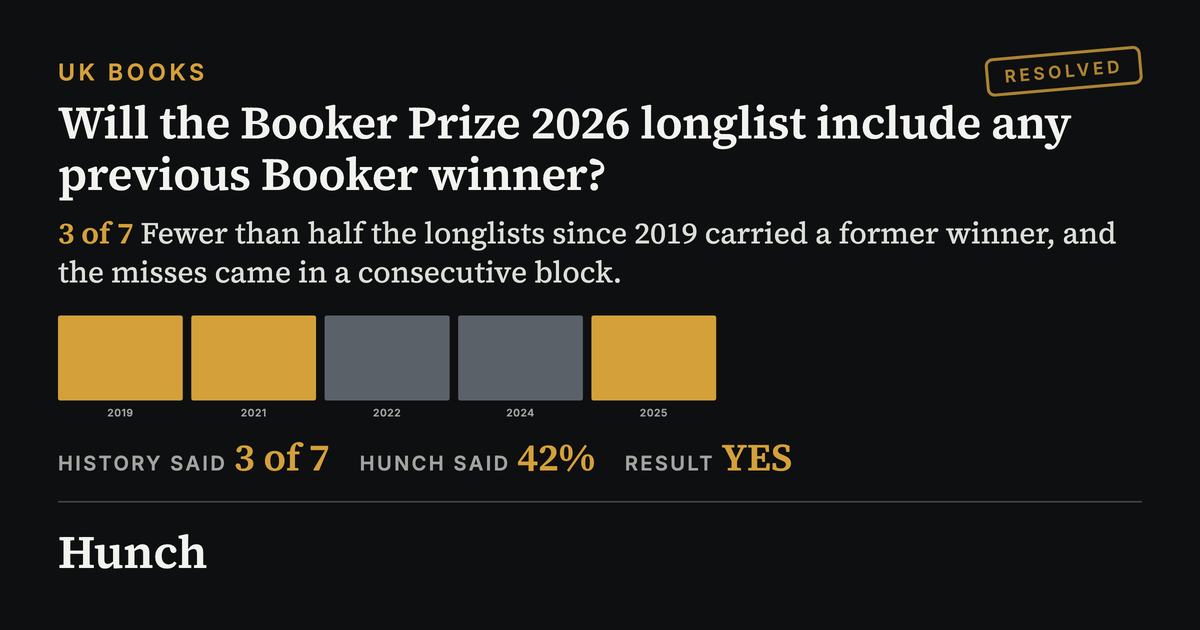
A new panel of judges chooses the list each year, and each panel must decide whether to let a past winner back in. We looked at the lists since 2019. Some panels welcomed back a famous name. Others filled the whole list with writers who had never won.
Show the other 3 cases
The Read
History leans slightly against a past winner. Four of the last seven lists had none. Each of the three that did had a very famous writer who had been away a long time: Margaret Atwood, Kazuo Ishiguro and Kiran Desai. There is no obvious name like that known among this year’s 128 books. Panels that follow a year with a past winner often turn on purpose towards new names.
The first-novel question is on firmer ground. Every recent list had at least two first novels, and two or three is the most common result.
The weak point is that nobody outside the judges’ room knows the facts. The list of books sent in is secret, and one big autumn novel by a past winner would change the answer at once. The 42 per cent price on yes is close to what history says, so there is little edge here. The date is what makes this market worth watching.
Disclaimer
Hunch works only from sources that are publicly available, and publishes on the basis of analysis of that material. We do not form an editorial opinion or take sides, we give a simpler and wider view of news that already exists. If information in a source we used was inaccurate, distorted, or later disputed but had already entered our analysis, Hunch accepts no liability for that. Predictions are not advice. Phase 1 markets use Hunch Points, not money.
Published by Hunch under the Editorial Code. Complaints and corrections: /contact/.