Oasis fixed prices for 22 nights in 2027. Will every date sell out by 28 September?
Oasis will play 22 UK and Ireland stadium nights in 2027. Prices are fixed at £71.50 to £266.60. Only fans who register by 17 September can buy.
What happened
Oasis confirmed on Monday a 38-date tour for 2027, opening with five nights at Celtic Park in May and ending with four at Knebworth in September, with standard prices fixed between £71.50 and £266.60 and a Glastonbury-style registration that closes at 16:00 on before UK sales on 25, 26 and .
Only fans who registered can buy tickets. Registration on the band’s site closed at 16:00 on Thursday . Fans who get through receive a personal code for one of three sale windows a day on 25, 26 and . There is no general sale and no other presale.
Standard prices are fixed at £71.50 to £266.60, fees included. The band says the ballot is meant to cut queues and stop organised touts, people who buy tickets in bulk to resell them at a higher price.
The UK and Ireland run has 22 nights. It starts with five nights at Celtic Park in Glasgow from , then eleven at Manchester’s Etihad Stadium in June and two at Slane Castle in Ireland. It ends with four at Knebworth in September, thirty years after the band’s 1996 shows there.
Europe follows in July and the United States in August. There is no London date. Richard Ashcroft supports every show.
The new rules answer the 2024 sale. When the 2025 tour went on sale on , more than 900,000 tickets went in hours. But standing tickets advertised at £135 cost £350 at the checkout. Five days later the Competition and Markets Authority (CMA), the UK consumer regulator, opened an investigation.
In Ticketmaster made formal promises to the CMA. It must give 24 hours’ notice when tickets are sold at several price levels and show the price range in the queue. It also agreed to avoid misleading labels and to send compliance reports for two years. The CMA found no evidence that a computer program had raised prices with demand.
Sources: BBC (2), Guardian, Independent, oasisinet.com, BBC, GOV.UK
The Pattern
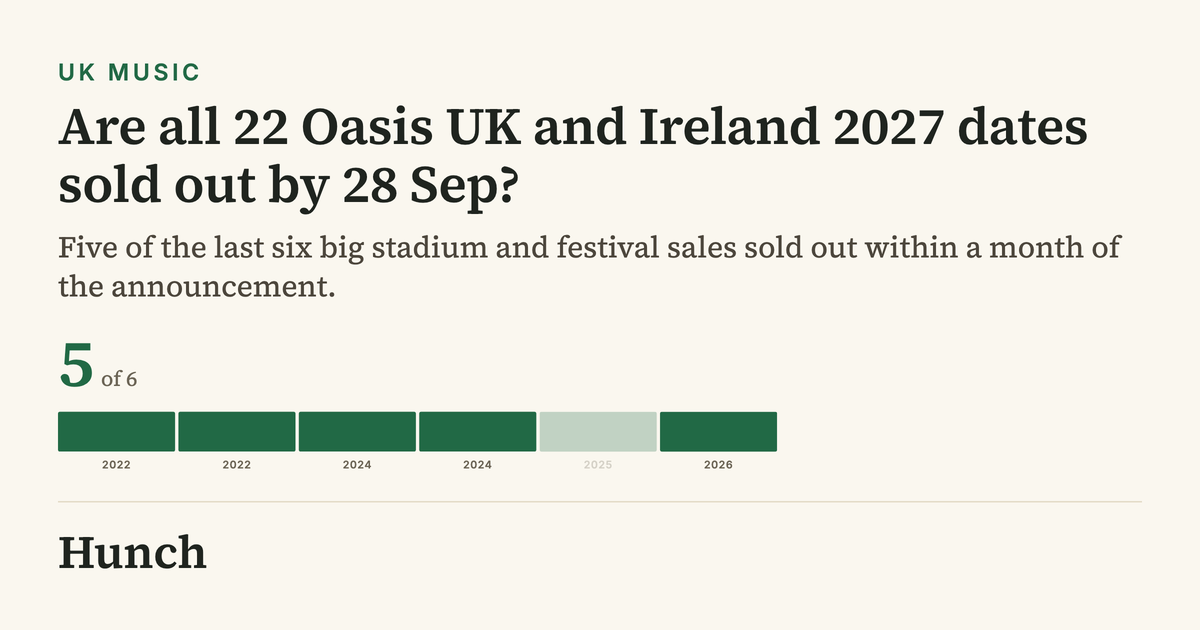
We compared six of the biggest ticket sales since 2022. Five are stadium runs and festival sales in Britain. The sixth is Taylor Swift’s US sale, which changed how Ticketmaster runs sales in Britain. For each we checked one thing: was every date reported sold out, or the sale closed with no tickets left, within 31 days of the announcement?
Show the other 4 cases
The Read
History points to a fast sell-out. Five of the last six sales like this sold out within a month. The two closest, Oasis in 2024 and Harry Styles in 2026, sold out in hours and days. Fixed prices from £71.50 remove the barrier that left Beyoncé’s £950 seats empty in 2025. The band also wants a sale that ends without a regulator. The 2024 sale led to an investigation five days later, and the Irish consumer body began a prosecution over the Dublin sale on . Fixed prices and a ballot copied from Glastonbury are the cheapest way to avoid that.
There are reasons for doubt. Hunch opens at 60, below the record’s 83, because this question closes on , the morning after the last sale window. The run is also bigger: 22 nights against 17 in 2024, with 500,000 Knebworth tickets sold from one site. The Knebworth licence obtained in August covers 125,000 a night, and the ban on reselling above face value is still a draft bill, so touts can list tickets within hours, as they did for Coldplay in 2024. Beyoncé in 2025 is the warning: a busy first day, then unsold seats because the run was long.
The band gives out the ballot codes, so some sale windows may not fill and the last tickets may go after . That resolves NO even if the run sells out in October. It also resolves NO if the band’s site and Ticketmaster never mark the dates sold out and no approved outlet reports it. Hunch puts a new date at 70, because three of the five tours here added dates within a month and London has no show. A statement on sale problems sits at 35, because every apology here followed a website fault the ballot is built to prevent. We will return to this on .
Sources: BBC (2), Guardian, Manchester Evening News
Disclaimer
Hunch works only from sources that are publicly available, and publishes on the basis of analysis of that material. We do not form an editorial opinion or take sides, we give a simpler and wider view of news that already exists. If information in a source we used was inaccurate, distorted, or later disputed but had already entered our analysis, Hunch accepts no liability for that. Predictions are not advice. Phase 1 markets use Hunch Points, not money.
Published by Hunch under the Editorial Code. Complaints and corrections: /contact/.