Spotify put up US prices for the third time. Will subscribers keep growing?
Spotify raised its US Premium price to $12.99 a month from February, its third rise in three years. Every plan went up. Will subscribers stay?
What happened
Spotify raises US Premium to $12.99 a month from February, its third US increase in three years, with Student, Duo and Family tiers all rising.
US Premium goes up from $11.99 to $12.99 a month in February. Every plan rises: Student to $6.99, Duo, the plan for two people, to $18.99 and Family to $21.99. Prices also went up in Estonia and Latvia.
This is the third US rise in three years, after and . Together they add $3 a month to the plan for one person.
Spotify is by far the largest music service. In its latest results, for the third quarter of 2025, it reported 713m monthly users and 281m paying Premium subscribers, 5m more than the quarter before. If nobody cancels, an extra dollar a month from US subscribers is almost all profit.
Sources: Spotify Newsroom, Variety, Variety
The Pattern
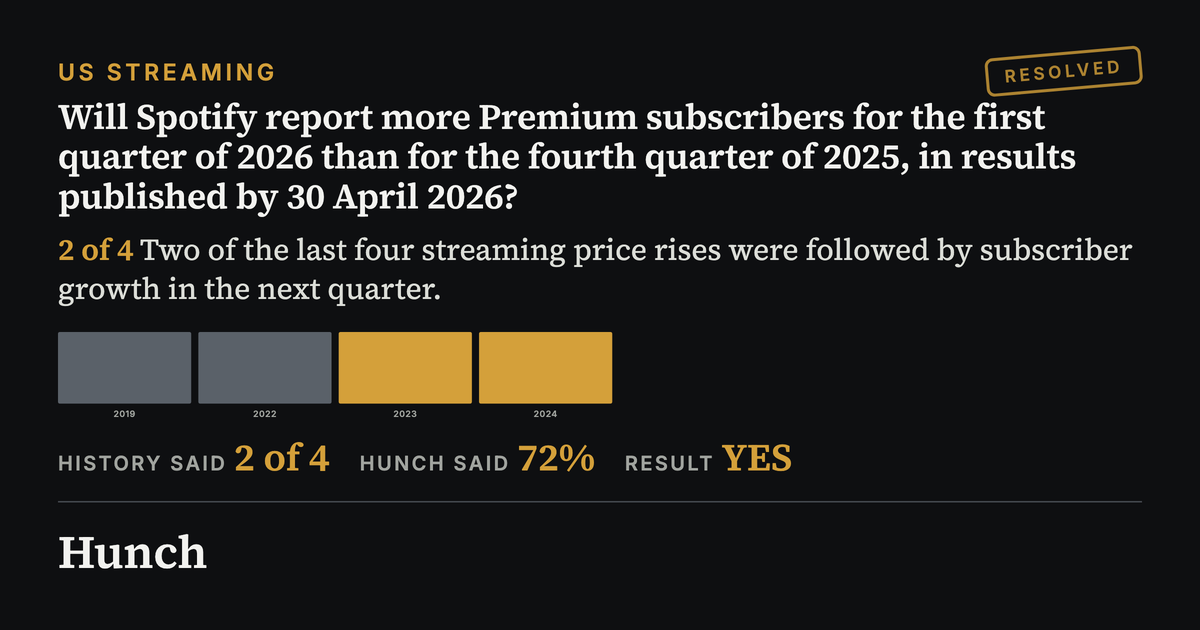
We found four big streaming price rises since 2019. Each raised the main single-person plan of a large music or video service in its biggest market. For each we asked one thing: did the service have more subscribers in the first quarter at the new price than in the quarter before? Spotify’s two earlier rises passed. Netflix’s two did not.
Show the other 2 cases
The Read
History is split, and the split runs by type of service. Spotify grew straight through its two earlier rises, and those are the only music cases there are. The numbers also help: from 281m at the end of September, new subscribers anywhere near the recent 5m a quarter would be enough. Music services offer much the same songs, so switching gains little, and leaving means rebuilding years of playlists. A dollar is also a smaller rise in percentage terms than either Netflix increase that caused trouble.
There are reasons for doubt. The record is only four cases, and a third rise in three years is harder to accept than a first. It comes as prices rise across streaming, with Netflix, Disney and others moving in the same years. Households that check their monthly bills often cut a music subscription without any protest. The first quarter is usually Spotify’s weakest for new subscribers, and if the February start brings cancellations forward, growth could stall while the business stays healthy.
Two results dates settle it. Fourth-quarter figures in February set the starting point. First-quarter results in late April are the first sign of how subscribers reacted to the new prices. The market’s 72% is a confident call that still leaves room for a surprise.
Disclaimer
Hunch works only from sources that are publicly available, and publishes on the basis of analysis of that material. We do not form an editorial opinion or take sides, we give a simpler and wider view of news that already exists. If information in a source we used was inaccurate, distorted, or later disputed but had already entered our analysis, Hunch accepts no liability for that. Predictions are not advice. Phase 1 markets use Hunch Points, not money.
Published by Hunch under the Editorial Code. Complaints and corrections: /contact/.