UK inflation hit 2.9% in July. Will August go higher, a day before a rate vote?
UK inflation rose to 2.9% in July, the first rise since March. The August figure is out on 16 September, the day before the Bank of England votes.
What happened
CPI rose by 2.9% in the 12 months to , up from 2.6% in June, the first rise in the annual rate since March; CPIH 3.1%, core CPI unchanged at 2.6%.
The August figure comes out on . In July, core inflation, which leaves out energy, food, alcohol and tobacco, stayed at 2.6 per cent.
So the July rise came from prices the core leaves out. The main rate moved three tenths of a point while the core did not move at all. The Office for National Statistics (ONS) says housing and household services and furniture pushed prices up most, while transport pulled the other way.
Prices of goods rose faster, from 1.7 to 2.2 per cent a year, while prices of services slowed from 3.6 to 3.4 per cent. Core inflation has now been 2.6 per cent in May, June and July, after 3.1 per cent in March.
The date makes the August figure matter more than usual. On the Bank of England’s Monetary Policy Committee, which sets interest rates, kept its main rate at 3.75 per cent. Six members voted to hold and three voted to raise it to 4 per cent.
The Bank said it expects inflation to rise later in the year as higher energy prices reach shoppers. Its next decision is on , the day after the inflation figures.
The Pattern
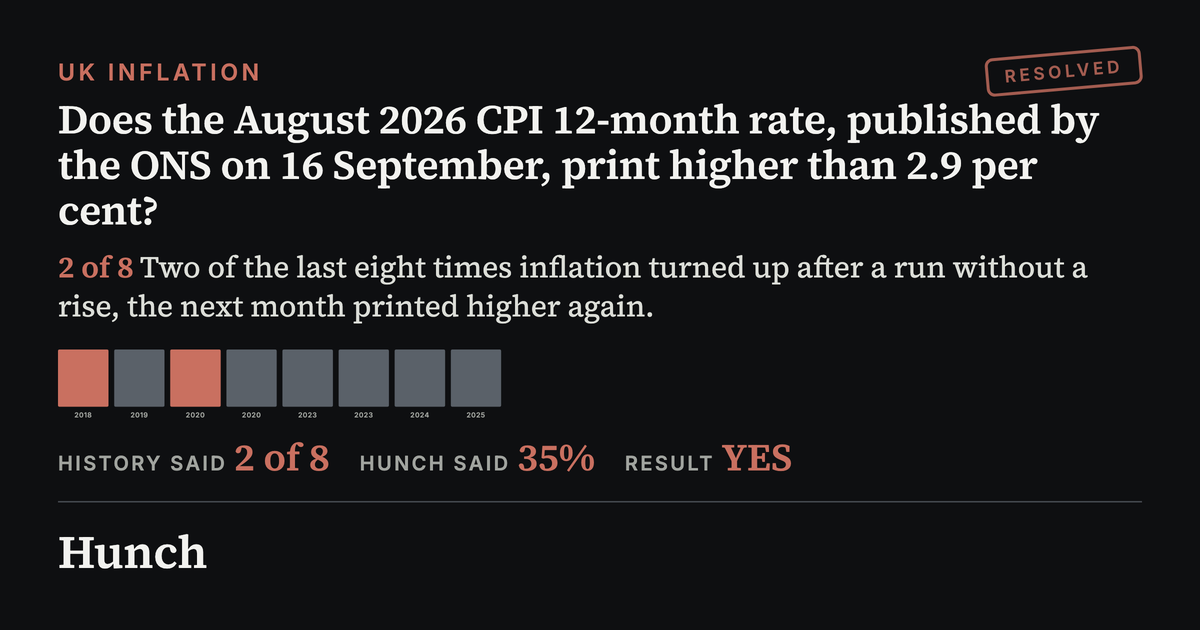
We looked at every month since when UK inflation rose after at least three months without a rise. fits, because the rate fell in April and June and did not move in May. For each case we checked whether the next month was higher again. There are 38 such months. The last eight are shown below, and all 38 are counted.
Show the other 6 cases
The Read
History leans against a second rise. Only two of the last eight rises were followed by a higher figure the next month. Over the full record since 1989 it happened in 16 of 38 cases, a little over four in ten. July’s rise came from prices the core leaves out, and the core has stayed at 2.6 per cent for three months. A higher August needs those same prices to move again.
What the record cannot see is the energy price rise the Bank itself expects. On the Bank said inflation should rise later in the year as higher energy prices pass through, and three of its nine members already wanted higher interest rates. If August comes in at 3.0 per cent or more the day before the vote, those three get a stronger case. If it stays at 2.9 or falls, the majority view stands: prices underneath are cooling, with a short energy bump on top.
Disclaimer
Hunch works only from sources that are publicly available, and publishes on the basis of analysis of that material. We do not form an editorial opinion or take sides, we give a simpler and wider view of news that already exists. If information in a source we used was inaccurate, distorted, or later disputed but had already entered our analysis, Hunch accepts no liability for that. Predictions are not advice. Phase 1 markets use Hunch Points, not money.
Published by Hunch under the Editorial Code. Complaints and corrections: /contact/.