UK banks made £29bn in six months. Will the 28 October Budget tax them more?
HSBC made £7.5bn profit in a quarter, and campaigners want a special tax on bank profits. John Healey delivers his first Budget on 28 October.
What happened
Campaigners renew calls for a windfall tax on UK banks after HSBC reports $10.1bn (£7.5bn) of second-quarter profit, up 60% year on year, arguing the proceeds could fund the government’s cost-of-living plans.
Chancellor John Healey gives his first Budget on . He confirmed the date on and said the Budget is about moving money and power out of Westminster.
Banks now pay 25% corporation tax, plus an extra 3% on profits above £100m, called the bank surcharge. They also pay the bank levy, a tax based on the size of their balance sheets. The question is whether Healey adds a new tax or raises the surcharge again.
HSBC’s profit for the first half of the year reached $19.5bn. Most of it came from fees for managing clients’ wealth and from high interest income. The bank also announced a $1bn share buyback, buying back its own shares from investors.
The big four UK banks, HSBC, NatWest, Barclays and Lloyds, have made £29.2bn in six months. They have promised £13.7bn to shareholders through dividends and buybacks.
Positive Money, the TUC and ActionAid UK want a windfall tax, a special tax on unusually high profits, at 38%, the rate oil and gas companies pay. They say it could raise around £19bn this year. They have costed what it would pay for: an £850m VAT cut on electricity, a £500m cap on bus fares and £100m of business-rates relief for hospitality.
Sources: The Guardian, Bloomberg, HSBC Interim Results, Yahoo Finance
The Pattern
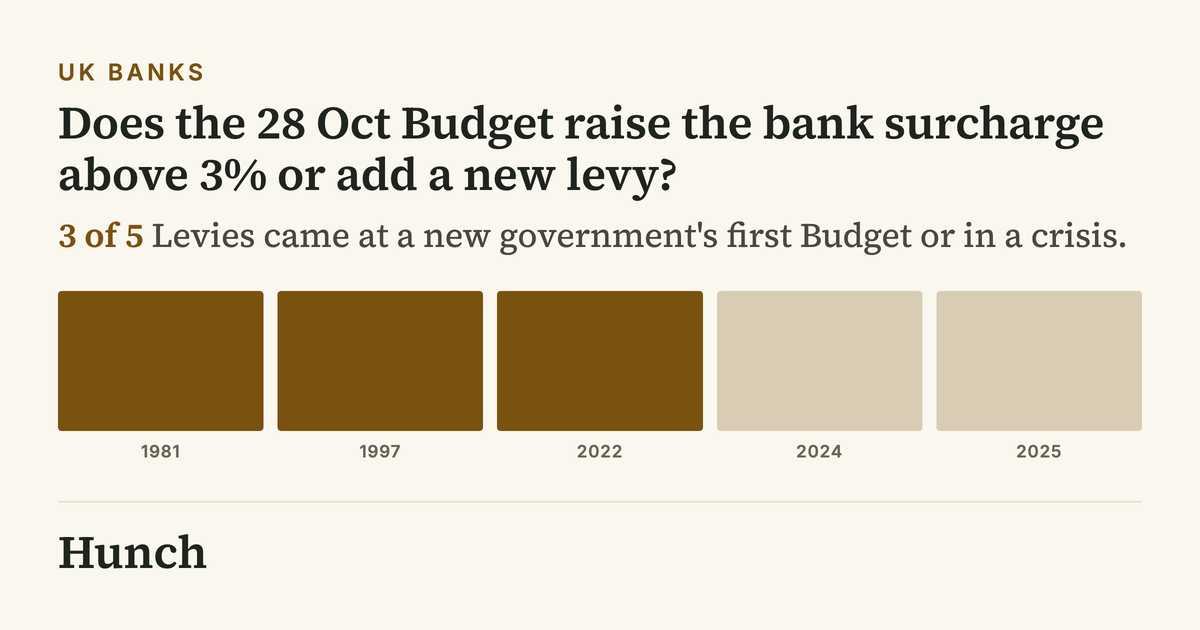
Britain has seen this before. One industry makes very large profits while people struggle with costs, and the chancellor needs money. We found five such cases since 1981, and they split. Three ended in a new tax, which came at a new government’s first Budget or in a crisis. Two ended with no tax, when chancellors in the middle of a term protected the City of London.
Show the other 3 cases
The Read
History leans towards a new tax. The closest case is 1997, when a new government’s first Budget taxed the privatised utilities to pay for a flagship programme. This is also a first Budget, and the government’s cost-of-living plans need money. Bank profits are the easiest money Healey can reach without breaking election promises on income tax and VAT. The surcharge is 3% today and was 8% as recently as 2023, so a rise could be presented as putting it back. That is why a higher surcharge is more likely than a new tax.
The weak spot is that the two most recent cases were both refusals, and both were about banks. Lobbying by the City of London beat this same campaign in 2024 and 2025. The campaign’s figure may also be too high. Most of HSBC’s £19.5bn is earned in Asia, outside the reach of a UK tax, so the real UK amount is closer to the big four’s UK business than the campaign’s £19bn suggests.
The reading fails if the Treasury rules out a new tax on the record before October, or if the government pays for its cost-of-living plans another way. Better growth figures that shrink the gap a tax would fill would work against it too.
Disclaimer
Hunch works only from sources that are publicly available, and publishes on the basis of analysis of that material. We do not form an editorial opinion or take sides, we give a simpler and wider view of news that already exists. If information in a source we used was inaccurate, distorted, or later disputed but had already entered our analysis, Hunch accepts no liability for that. Predictions are not advice. Phase 1 markets use Hunch Points, not money.
Published by Hunch under the Editorial Code. Complaints and corrections: /contact/.