Warren Buffett leaves the Berkshire chair. Where will the shares be in four weeks?
Warren Buffett, 96, gave up the chair of Berkshire Hathaway on 18 September. His son Howard Buffett takes it, and Greg Abel stays chief executive.
What happened
Berkshire Hathaway said Warren Buffett has become chairman emeritus with immediate effect and remains a director. His son Howard Buffett, on the board since 1993, is the new chairman.
Warren Buffett is 96. His new title, chairman emeritus, is an honorary one. Susan Decker stays lead independent director, the senior board member from outside the management.
Greg Abel, chief executive since , keeps day-to-day control of the company and decides how its money is used. Berkshire called the change the last step of a succession plan set out in 2025. It said Howard Buffett’s job as chairman is to protect the company’s culture and values.
In a letter to shareholders, Warren Buffett wrote that he has run Berkshire since 1965 and recently turned 96. He said Abel has fully taken over the chief executive job, so it is the right time to finish the handover. He wrote that age wins in the end, and that he is more confident than ever about the company’s future.
Berkshire class B shares closed at $509.77 on , 0.1% above the day before. This year they have risen 2.6%, against 11.5% for the fund that tracks the S&P 500 index of large US companies.
Reuters also reported the change on and named Howard Buffett as the successor under the company’s long-stated plan.
Sources: The Guardian, Berkshire Hathaway, BBC, Nasdaq, closing prices, Reuters
The Pattern
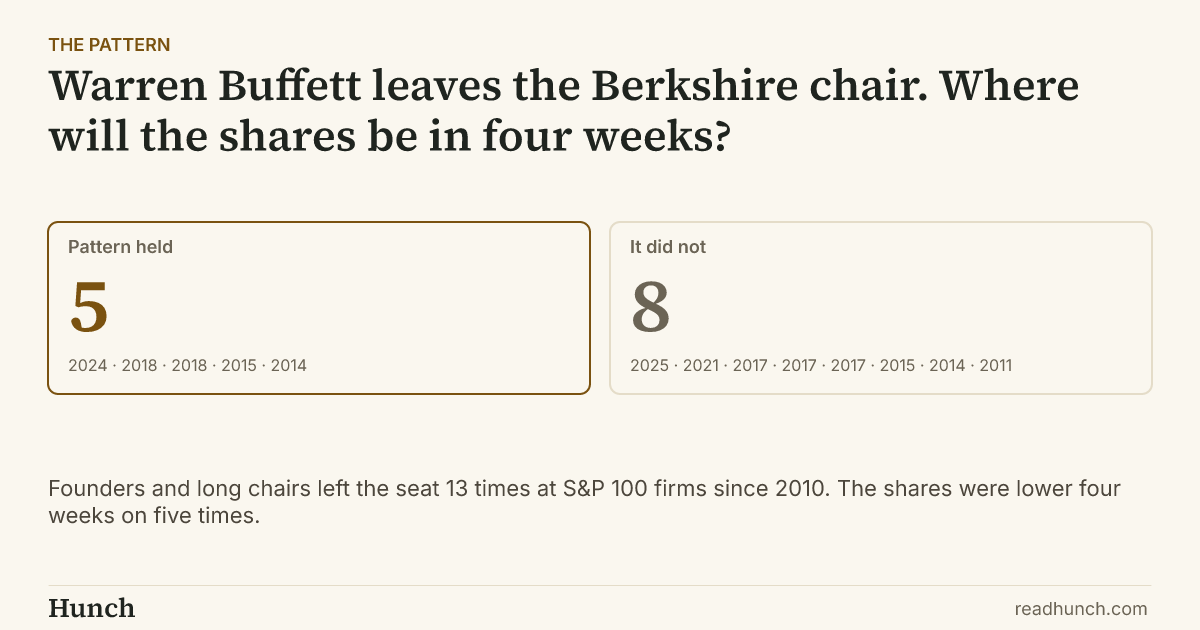
We looked for S&P 100 companies where a founder, or someone who had chaired the board for ten years or more, gave up the chair while another person was already chief executive. We found thirteen cases since 2010 and show them all. For each, we checked whether the shares closed below the announcement-day price four weeks later. In eleven of the thirteen the shares dipped below that price within five days, so the first days say little. At Microsoft and Oracle, both in 2014, a new chief executive was named on the same day, so those price moves were not about the chair alone.
Show the other 11 cases
The Read
History does not treat a new chair as big news for the shares. In the thirteen cases the shares were lower four weeks later five times and higher eight times, close to what any large American share does over four weeks. The two biggest falls came with other news. Oracle changed chief executive and reported quarterly results on the same day in 2014, and Starbucks put out a new plan on , two weeks after Howard Schultz left. Berkshire’s announcement came with nothing else.
The three-month view is less calm. Six of the thirteen were below the starting price after 91 days, and seven did worse than the S&P 500 over that time. Berkshire’s third-quarter report, the first with someone else in the chair, falls inside that window.
The reading breaks if other news moves the shares. A large purchase or a new plan for Berkshire’s pile of cash would move the price for reasons that have nothing to do with the chair. So would a sharp move in one of its biggest holdings, or a fall across the whole market. Four of the six falls in the record came while the S&P 500 itself was going down.
Disclaimer
Hunch works only from sources that are publicly available, and publishes on the basis of analysis of that material. We do not form an editorial opinion or take sides, we give a simpler and wider view of news that already exists. If information in a source we used was inaccurate, distorted, or later disputed but had already entered our analysis, Hunch accepts no liability for that. Predictions are not advice. Phase 1 markets use Hunch Points, not money.
Published by Hunch under the Editorial Code. Complaints and corrections: /contact/.