CVC drops out of the race for Bodycote. Will shareholders back the Veritas deal?
CVC said on 28 September it will not bid for Bodycote. Shareholders vote on the 940p a share offer from Veritas on 21 October.
What happened
On CVC said it does not intend to make an offer for Bodycote, and Bodycote published the scheme document for the 940p a share offer from Veritas, with shareholder meetings on .
Bodycote is a British company that heat-treats metal parts for aerospace, defence, car and energy firms. Under UK takeover rules CVC is now barred from bidding. It can return only in named cases, for example if another buyer makes a firm offer or if the Veritas deal falls away with the board’s agreement.
The same day Bodycote published the document for the shareholder vote. The meetings are on in London. The deal needs a majority of the shareholders who vote, holding at least 75% of the shares voted, and then the approval of a court. The board unanimously recommends a yes vote and says it is now focused on “delivering value and certainty” to shareholders. It expects the deal to take effect in the first three months of 2027, after regulators approve it.
The offer from Veritas, a US private equity firm, is worth 940p a share: 932.8p in cash plus a 7.2p dividend. That is 37.5% above the average share price in the three months before Bodycote first said, on , that it had been approached by Apollo. Apollo later walked away. In August CVC offered 915p and Veritas 914p, and the board backed Veritas after it raised its price on .
While CVC was still weighing its options, Bodycote shares rose as high as 957p on , above the offer. So far only the directors have promised their votes in advance, and they hold about 0.15% of the shares.
Sources: Bodycote (2, 3), Reuters (2)
The Pattern
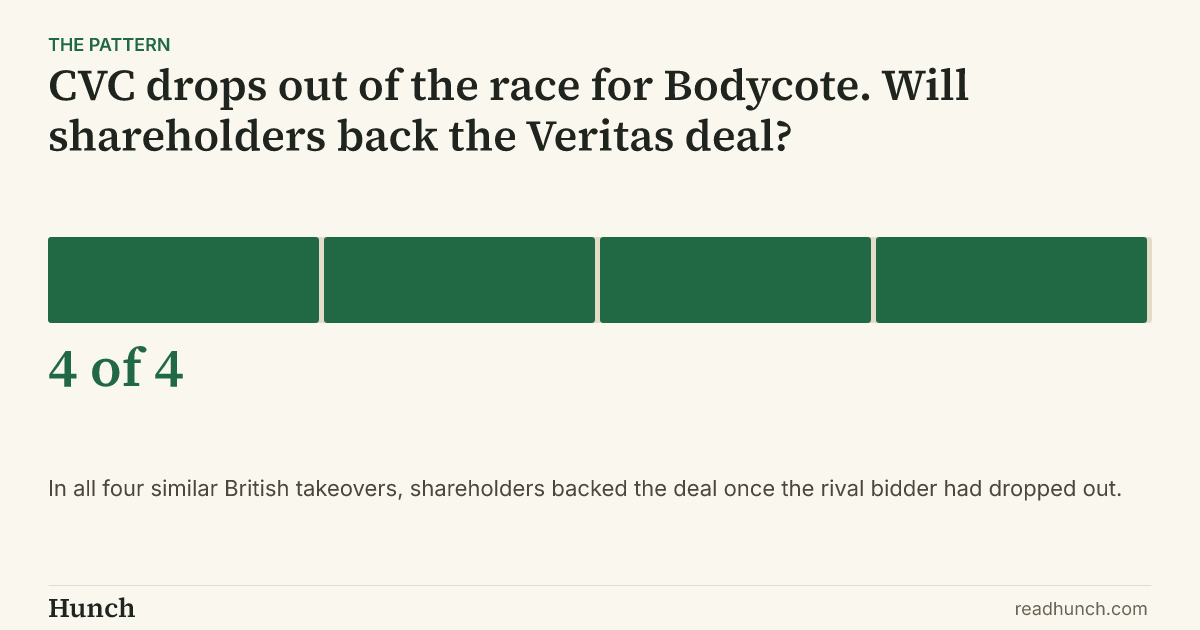
We looked for cases where the board of a British company backed one buyer’s offer, a rival bidder then formally dropped out before the shareholder vote, and takeover rules stopped the rival coming back. We found four since 2021 with official records. In each one shareholders said yes at the vote, and the buyer did not raise its price.
Show the other 2 cases
The Read
History points to a yes. In all four cases shareholders approved at the vote, more than 99.7% of votes were in favour, and the buyer kept its price. The votes came 5 to 23 days after the rival left. At Bodycote the gap is 23 days. The cases split only on the court step. Wincanton got court approval 15 days after its vote, but the others waited three months to a year for regulators, and Bodycote itself expects to finish in early 2027.
The record is small and one-sided. It has four cases and no failed vote, so it does not show what a failure looks like. Bodycote also differs in two ways. Only the directors, with 0.15% of the shares, have promised their votes, and its shares traded above the offer while CVC was still in. A large shareholder saying it will vote against, or a third buyer, would change the picture.
Disclaimer
Hunch works only from sources that are publicly available, and publishes on the basis of analysis of that material. We do not form an editorial opinion or take sides, we give a simpler and wider view of news that already exists. If information in a source we used was inaccurate, distorted, or later disputed but had already entered our analysis, Hunch accepts no liability for that. Predictions are not advice. Phase 1 markets use Hunch Points, not money.
Published by Hunch under the Editorial Code. Complaints and corrections: /contact/.