The Bank of England meets on 17 December. Its governor has warned rates may rise.
The Bank of England raised its rate to 4% on 5 November. Its governor, Andrew Bailey, says rates may have to go higher. It decides on 17 December.
What happened
On the governor of the Bank of England, Andrew Bailey, said interest rates would need to be higher the longer the conflict in the Middle East lasts.
UK inflation rose to 3.6% in October, the highest in a year. The Office for National Statistics (ONS) published the figure on , up from 3.5% in September. The same day the governor of the Bank of England, Andrew Bailey, said in a speech that the longer the conflict in the Middle East lasts and keeps energy prices up, “the higher the level of interest rates will need to be”.
The Bank raised its main interest rate by 0.25 points to 4% on , its first rise in more than three years. Eight of the nine members of the committee that sets the rate voted for that step. The ninth, Catherine L Mann, wanted a rise of 0.5 points. The Bank expects inflation to reach 5% by the middle of 2027.
The committee is divided about the next step. In the minutes of that meeting, four of the nine members wrote that another rise may be needed, and four left the next step open. Huw Pill wrote that one rise of a quarter point “is unlikely to be sufficient”. Alan Taylor wrote that “this is not the start of a hiking cycle”, meaning a run of rises. On The Guardian reported Huw Pill as saying “we have further to go”.
Pay is now rising more slowly. The ONS said on that regular pay grew 3.5% a year in July to September, down from 3.7% in the three months before. Prices of services rose 3.7% in October, a little less than expected. Shop sales rose 0.7% in October, when some economists had expected a small fall.
Two more announcements come before the decision. On the energy regulator Ofgem sets its new limit on household energy bills, and the analysts at Cornwall Insight expect bills to rise 26% from January. On the ONS publishes inflation for November. The Bank announces its rate the next day.
Sources: The Telegraph, BBC (2), Bank of England (2, 3), The Guardian, Office for National Statistics (2)
The Pattern
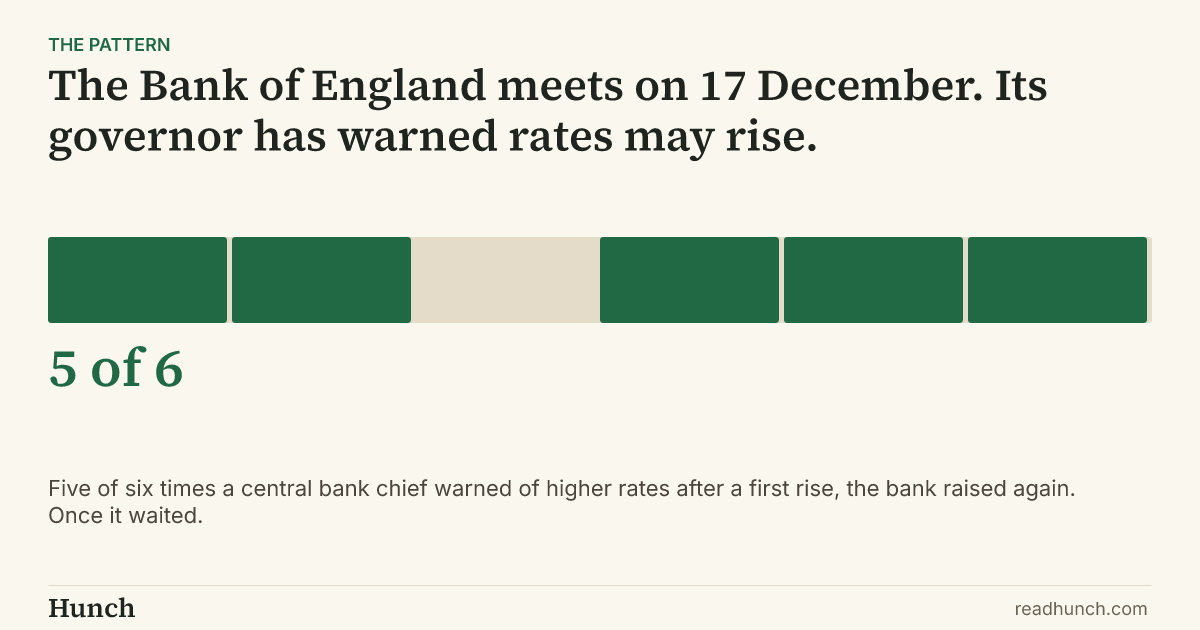
We looked for cases where a central bank raised its rate for the first time in two years or more and its head then warned of higher rates. We found six such meetings since 1994, five at the US Federal Reserve and one at Sweden’s Riksbank. Like the Bank of England, both decide by committee vote on fixed dates and publish each vote. Five times the bank raised again.
Show the other 4 cases
promptly and forcefullyif prices sped up. On it raised the rate to 5.25%. (Federal Reserve)
The Read
Five of the six meetings ended with a second rise, and none with a cut. They came 41 to 63 days after the first rise, and is 42 days after . Each of the six warnings came with a condition or without a date, as Andrew Bailey’s did. The one time the bank waited was . Janet Yellen, then chair of the Federal Reserve, had said rises were “likely to proceed gradually”, and the next one came a year later.
The Bank of England’s committee voted eight to one for the rise in November, and the one vote against was for a bigger step. Four of its nine members wrote in the minutes that another rise may be needed, and four left the next step open. Since then pay growth has slowed to 3.5% from 3.7%. Andrew Bailey said on that policy “is not on a pre-set path” and that there was “limited evidence of knock-on effects on other prices and wages”.
The first question asks whether the Bank will change its rate. A change means any move away from 4%, up or down. At all five past meetings where the bank moved, it raised the rate. The second question is about size. Three times the second rise was 0.25 points. Twice it was 0.5 points, both in 2022, in the US and in Sweden, after the head of the bank had said bigger or further rises were possible. In November one of the nine Bank of England members voted for 0.5 points, and Andrew Bailey has not spoken about the size of the next step.
Sources: Federal Reserve (2, 3, 4, 5), Riksbank, Bank of England (2), Office for National Statistics, Riksbank (2)
Disclaimer
Hunch works only from sources that are publicly available, and publishes on the basis of analysis of that material. We do not form an editorial opinion or take sides, we give a simpler and wider view of news that already exists. If information in a source we used was inaccurate, distorted, or later disputed but had already entered our analysis, Hunch accepts no liability for that. Predictions are not advice. Phase 1 markets use Hunch Points, not money.
Published by Hunch under the Editorial Code. Complaints and corrections: /contact/.