Markets expect a Bank of England rate rise on 5 November. They were usually right.
Investors put the chance of a rise from 3.75% to 4% at 92%. In September three of the Bank's nine rate setters voted for it.
What happened
On investors put a 92% chance on the Bank of England raising interest rates from 3.75% to 4% at its next meeting on .
Investors put the chance of a rate rise on at 92%. The rise would take the Bank of England’s main interest rate, Bank Rate, from 3.75% to 4%. Markets also expect at least three more rises in 2027, to 4.75% by the end of next year.
At the last meeting, on , the Bank’s Monetary Policy Committee voted 6 to 3 to keep the rate at 3.75%. Megan Greene, Catherine Mann and Huw Pill voted for a rise to 4%. Pill wrote that a rise now “sends a clear signal of the MPC’s commitment” to keeping prices stable.
Inflation was 3.1% in August, against a target of 2%. The Bank expects it to reach slightly above 4% early in 2027, mostly because of higher oil and gas prices since the conflict in the Middle East. Mann wrote that the markets’ earlier view of a long pause was “hard to square with achieving the 2% target”.
Borrowing has already become more expensive. The average five-year fixed mortgage rate reached 5.95% on , the highest in three years, and lenders withdrew more than 1,000 deals below 5% in a month. The same day the interest rate on 30-year UK government debt hit 6% for the first time since 1998.
The Chancellor, John Healey, presents his first Budget on , a week before the vote. Higher borrowing costs since the spring are expected to have used up at least half of the £24bn margin the government had kept under its own borrowing rules.
Sources: The Guardian (2), Bank of England, The Independent
The Pattern
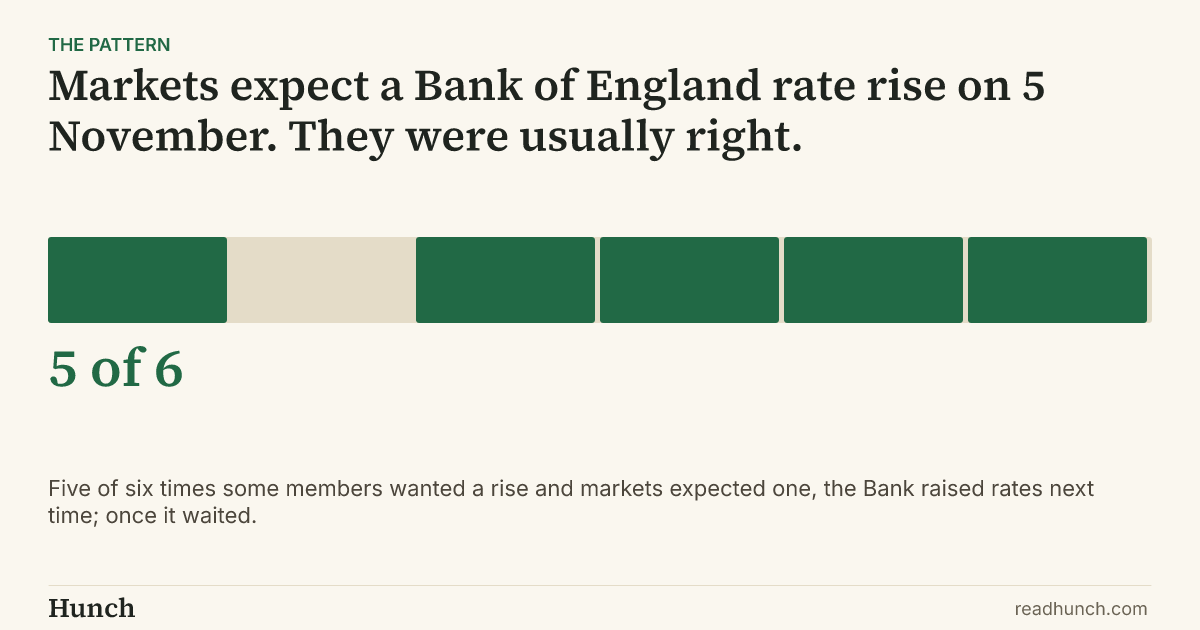
We looked for cases where the Bank of England kept its rate the same while some members voted for a rise, inflation was above target, and before the next meeting markets put the chance of a rise at 80% or more. We found six since 1997. In five the Bank raised its rate at the next meeting. All six were decided by the same committee, so this is the record of one institution.
Show the other 4 cases
The Read
History points to a rise. In five of the six times the Bank held its rate while some members voted for a rise and markets expected one, it raised at the next meeting, always by a quarter point. This time the split is 6 to 3, as in before the August rise, and investors put the chance at 92%. The Bank’s own forecast also shows inflation rising, as it did in only two of the earlier cases, 2006 and 2017, and both ended in a rise.
The one exception is the warning. In spring 2018 markets put a May rise at about 90%, then weak growth figures cut that to about 10% within three weeks, and the Bank waited until August. All six cases are the same committee, and none had a Budget a week before the vote. A calm Budget and steady oil prices would keep the rise on track. A shock in the debt market after , or a sharp fall in oil, would look more like 2018.
Disclaimer
Hunch works only from sources that are publicly available, and publishes on the basis of analysis of that material. We do not form an editorial opinion or take sides, we give a simpler and wider view of news that already exists. If information in a source we used was inaccurate, distorted, or later disputed but had already entered our analysis, Hunch accepts no liability for that. Predictions are not advice. Phase 1 markets use Hunch Points, not money.
Published by Hunch under the Editorial Code. Complaints and corrections: /contact/.