Japan spent 15 trillion yen to lift the yen. Will its central bank now raise rates?
Japan's finance ministry said it bought 15.4 trillion yen between 30 July and 26 August, after the first joint action with the US since 2011.
What happened
Japan’s Ministry of Finance disclosed on foreign exchange intervention of 15,399.3 billion yen for the period to .
The US and Japan acted together to support the yen on . It was the first joint action of this kind since 2011. The yen had fallen to lows not seen in forty years, and it rose to 155.20 per dollar on the news. The ministry said it would not hesitate to act jointly again.
The Bank of Japan meets next on 17–. Its interest rate is 1%, the highest in 31 years, reached in June. At its meeting the Bank kept the rate there but gave its clearest signal yet that a rise could come early.
US Treasury Secretary Scott Bessent said Washington strongly supported Japan’s decisive steps, in the market and on interest rates, to correct the weak yen. He repeated his call for higher Japanese rates.
Sources: Ministry of Finance, Al Jazeera, Bank of Japan meeting schedule
The Pattern
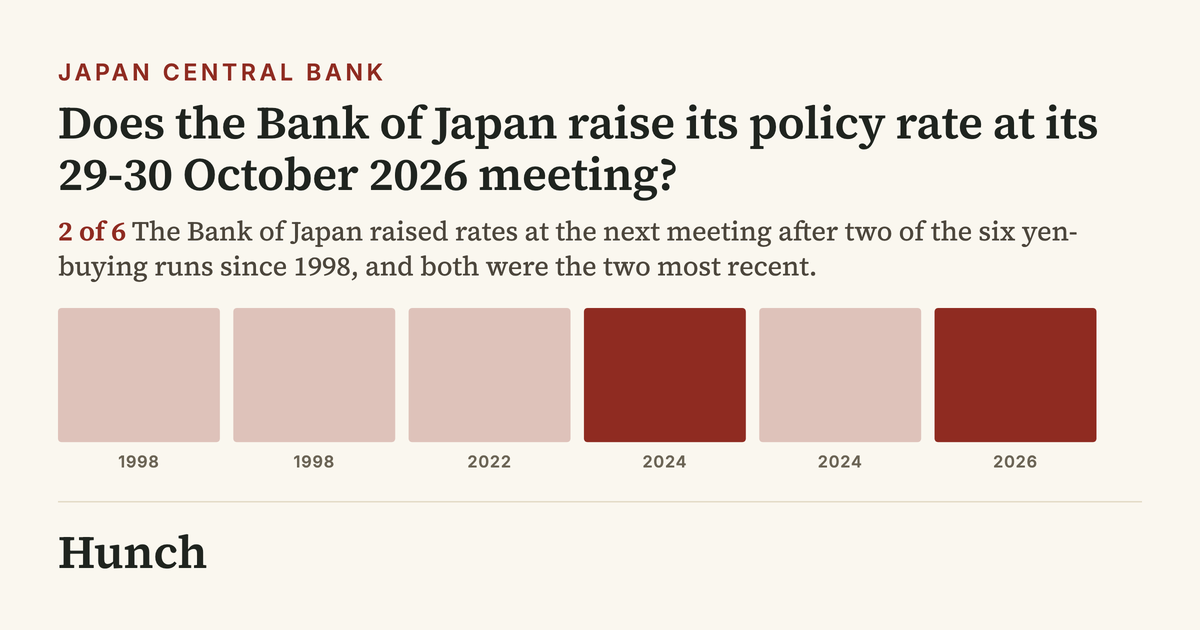
Japan has bought yen in six runs since 1998, counting buying days a month or less apart as one run. For each run we checked what the Bank of Japan did at its next meeting, using the Bank’s own records. It raised rates after the two most recent runs and left them unchanged after the other four.
Show the other 4 cases
The Read
History leans against a rise at the next meeting, but two things are different this time. The Bank is already raising rates. It went to 1% in June and at its July meeting signalled an early rise. The United States has also asked in public for higher Japanese rates. That is why our estimate opens above 70% although only two of the six earlier runs led to a rise.
The case against is the record itself. In 2022 the Bank left the ministry to act alone, and 15 trillion yen in a month suggests the ministry is ready to carry the load again. The forecast fails if the Bank decides the buying has given it time to wait for its October report on the economy. That is how all four earlier pauses came about.
What decides it is the gap between Japanese and US interest rates. Buying yen only buys time, and a smaller gap is what turns the currency round. The Bank’s decision on is the first test of what the ministry’s money has bought.
Disclaimer
Hunch works only from sources that are publicly available, and publishes on the basis of analysis of that material. We do not form an editorial opinion or take sides, we give a simpler and wider view of news that already exists. If information in a source we used was inaccurate, distorted, or later disputed but had already entered our analysis, Hunch accepts no liability for that. Predictions are not advice. Phase 1 markets use Hunch Points, not money.
Published by Hunch under the Editorial Code. Complaints and corrections: /contact/.