Brazil's oil export tax ends on 31 December. Governments usually keep such taxes.
Brazil extended its 12% tax on crude oil exports on 5 November, to 31 December. The tax has raised R$12.86 billion this year.
What happened
Brazil’s trade committee approved on an extension of the 12% tax on crude oil exports until .
Brazil will keep its 12% tax on crude oil exports until . The trade committee of Brazil’s Chamber of Foreign Trade, known as Gecex-Camex, approved the extension on Thursday , and the trade ministry announced it on . The finance ministry asked for it because the war in the Middle East goes on and Brazil needs to keep diesel supplied at home. The new term started on Saturday .
The tax raised R$2.94 billion in September alone and R$12.86 billion so far this year, according to the federal tax office. The Treasury expects R$64.5 billion from oil royalties and taxes this year, against R$39 billion spent on cutting fuel taxes and paying fuel subsidies. Without the oil money, the government would find it harder to keep this year’s deficit to the planned R$67.3 billion. Part of the money pays for cheaper diesel and petrol.
Brazil raised the tax from zero to 12% in March, by a temporary decree. The finance minister at the time, Fernando Haddad, said the decree set as the last day. Congress did not vote on the decree, so it lapsed, and since July the committee has kept the tax with its own decisions: 60 days from , 60 days from , and now 55 more days. If the committee does nothing more, the tax ends on .
Oil producers are fighting the tax in court. On federal judge Diego Câmara in Brasília suspended it for members of ABEP, a group of oil producers, saying the committee was getting around the choice of Congress. On appeals judge Roberto Carvalho Veloso put the tax back after the government appealed. ABEP also has a case at Brazil’s Supreme Federal Court, filed on against court rulings that upheld a similar tax from 2023.
aprovou nesta quinta-feira (5/11) a prorrogação para até 31 dezembro do imposto de 12% às exportações de óleos brutos de petróleo
Brazil’s trade ministry (MDIC), 6 November 2026, in Portuguese
Sources: Brazil's trade ministry (MDIC), g1 (2), Estadão (2, 3), O Globo, Supreme Federal Court of Brazil
The Pattern
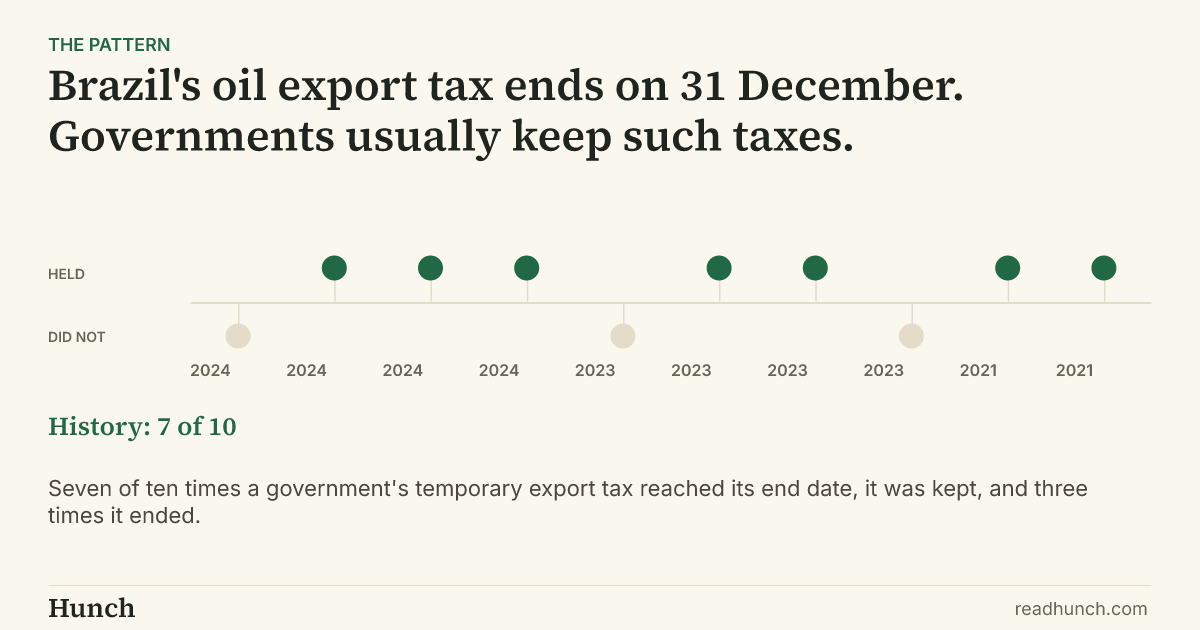
We looked for cases where a government put a temporary tax on exports of a raw material by its own decision, with an end date, and then had to decide whether to keep it. We found ten such end dates from 2021 to 2024, in Brazil, India and Russia. Six of them were in Russia. (g1; Business Standard (PTI); Government of Russia)
Show the other 8 cases
The Read
Seven of the ten taxes went on past their end date without a break, and five of the seven kept the same or a higher rate. Each was kept for five and a half months or more, or with no end date. Two of the three that ended gave a warning first: Brazil’s finance minister said weeks before that the 2023 tax would end, and Russia had paused its tax on two of its three kinds of coal months before. This time Brazil kept the full 12% on . Finance minister Dario Durigan said on , two days before the election runoff, that fuel support would likely stay in 2027 if oil stayed very high, and he did not rule out keeping the tax. President Luiz Inácio Lula da Silva won that runoff, so the same government decides.
There are reasons for doubt. The 2027 budget, sent to Congress on , does not include the tax, because it expects oil prices to return to normal. The government’s idea was to cut the rate step by step to zero if oil got cheaper, and the world oil price, Brent, fell about 13% in the week to , to $98.32 a barrel. Six of the ten past taxes were Russian, three of them on sunflower products, and Brazil’s own oil tax of 2023 ended on time. None of those taxes was extended in steps of about 60 days. Brazil’s tax is also being fought in court.
Sources: g1, Government of Russia, Brazil's trade ministry (MDIC), Reuters via UOL, BBC News Brasil, O Globo, Estadão, Folha de S.Paulo
Disclaimer
Hunch works only from sources that are publicly available, and publishes on the basis of analysis of that material. We do not form an editorial opinion or take sides, we give a simpler and wider view of news that already exists. If information in a source we used was inaccurate, distorted, or later disputed but had already entered our analysis, Hunch accepts no liability for that. Predictions are not advice. Phase 1 markets use Hunch Points, not money.
Published by Hunch under the Editorial Code. Complaints and corrections: /contact/.