Brazil's central bank stopped cutting rates. Will they stay the same on 9 December?
Banco Central do Brasil kept its main interest rate at 13.75% on 4 November, after five cuts in a row. It decides again on 9 December.
What happened
Brazil’s central bank said dearer oil, El Niño, a change to working hours that raises labour costs and a weaker real are pushing prices up, after it kept its rate at 13.75%.
Brazil’s central bank kept its main interest rate at 13.75% on . The rate is called the Selic, and all seven voting members of its rate committee, Copom, agreed. The bank had cut it five times in a row since March, each time by 0.25 percentage point, from 15%. Its statement did not say what it would do next.
Copom decided to maintain the Selic rate at 13.75% p.a. … The Committee will continue to monitor developments in the scenario in order to keep monetary policy adequately restrictive to ensure inflation convergence to the target.
Banco Central do Brasil, Copom statement, 4 November 2026
Prices are rising above the bank’s target. Inflation is above the top of its target range, and economists in the bank’s survey expect 5.2% inflation this year. In minutes published on , the bank named four causes: dearer oil, the El Niño weather pattern, a change to working hours that raises labour costs and a weaker real, Brazil’s currency. It said it would not respond to the first effect of these, but would “react decisively” if they spread to other prices.
The economy is slowing more sharply, the bank said. Diogo Guillen, an economist at the Brazilian bank Itaú, told Reuters that the bar for a rate rise is “particularly high”.
The government wants lower rates. Finance minister Dario Durigan called the rate very high on , and President Luiz Inácio Lula da Silva promised on to create the conditions to bring it down. Planning minister Bruno Moretti said the cuts the government is preparing with the Senate could be worth up to 60 billion reais in 2027. Two of the nine seats on the bank’s board are empty, and the president fills them.
The US dollar rose after Lula won the presidential election in a second round, to 5.65 reais on , the highest since , from about 5 reais before the vote. The bank decides next on .
Sources: Reuters, Banco Central do Brasil (2, 3, 4), g1 (2, 3, 4, 5), Folha de S.Paulo
The Pattern
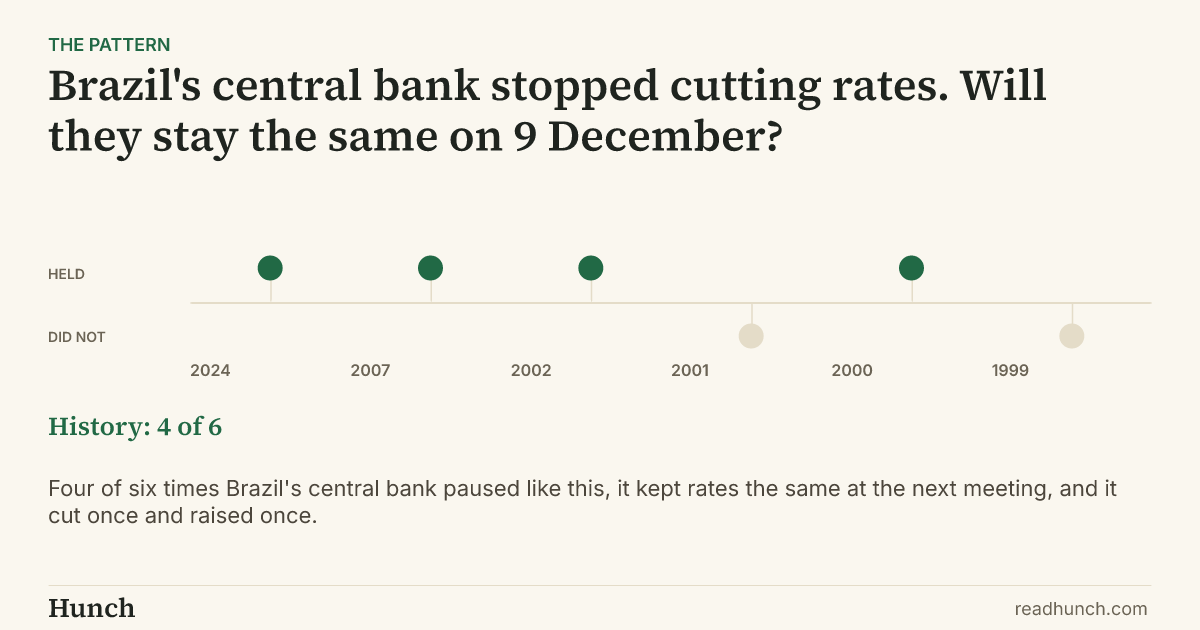
We looked for cases where Brazil’s central bank paused after at least two rate cuts in a row, with no published vote against the pause and no promise of its next step. We found six such times since 1999, four of them between 1999 and 2002. At the next meeting it kept the rate four times, cut it once and raised it once. (Banco Central do Brasil)
Show the other 4 cases
The Read
Four of six times Brazil’s central bank kept its rate the same at the meeting after a pause like this one. Six other pauses since 1999 came with a promise to hold the rate or with votes against, and the rate stayed the same at the next meeting after all six. Economists in the bank’s survey published on also expect 13.75% until the end of the year.
There are reasons for doubt. Four of the six times came between 1999 and 2002, when the bank met every month, and in 1999, 2000 and 2001 it did not publish how members voted. Brazil has used a new system for its inflation target since . This time the bank warned it could react decisively, which it did not say in any of the six pauses. The one rise came in 2001 after turmoil in the currency market, and the dollar now costs more reais than at any time in more than a year.
Sources: Banco Central do Brasil (2, 3, 4, 5), g1, Banco Central do Brasil
Disclaimer
Hunch works only from sources that are publicly available, and publishes on the basis of analysis of that material. We do not form an editorial opinion or take sides, we give a simpler and wider view of news that already exists. If information in a source we used was inaccurate, distorted, or later disputed but had already entered our analysis, Hunch accepts no liability for that. Predictions are not advice. Phase 1 markets use Hunch Points, not money.
Published by Hunch under the Editorial Code. Complaints and corrections: /contact/.