Canada's jobless rate rose again, to 6.7%. Will it still be that high in November?
Statistics Canada said on 6 November that unemployment rose to 6.7% in October. Its figure for November comes out on 4 December.
What happened
The unemployment rate rose 0.2 percentage points to 6.7% in October, as more people searched for work. It was the second rise in a row.
Canada’s unemployment rate rose to 6.7% in October, up 0.2 points, Statistics Canada said on in its monthly Labour Force Survey (LFS). It was the second rise in a row, and it came as 33,000 more people looked for work. The number of people in work hardly changed, down 4,700, after falls of 42,000 in August and 68,000 in September. The rate was 6.9% in April.
Most of the rise came from young people and Alberta. Unemployment for people aged 15 to 24 rose 0.7 points to 13.7%, and in the province of Alberta it rose 0.9 points to 7.3%. For people aged 25 to 54 it did not change. Private companies had 53,000 fewer employees, the first fall since February.
The Bank of Canada raised its main interest rate to 2.5% from 2.25% on . A summary of the debate, published on , said the unemployment rate “remained around 6½%”. Members agreed there was “still some slack in the economy”, meaning more people could work than had jobs, but expected faster growth to take it up over time.
Unemployment in Ontario is 7.3%. On Prime Minister Mark Carney called the closure of the Stellantis car plant in Brampton, Ontario, “a betrayal of the workers”. More than 2,000 workers there lost their jobs in 2023.
The next release of the LFS will be on December 4, 2026. data will reflect labour market conditions during the week of November 8 to 14.
Statistics Canada, Labour Force Survey, October 2026
Sources: Statistics Canada, Bank of Canada, CBC
The Pattern
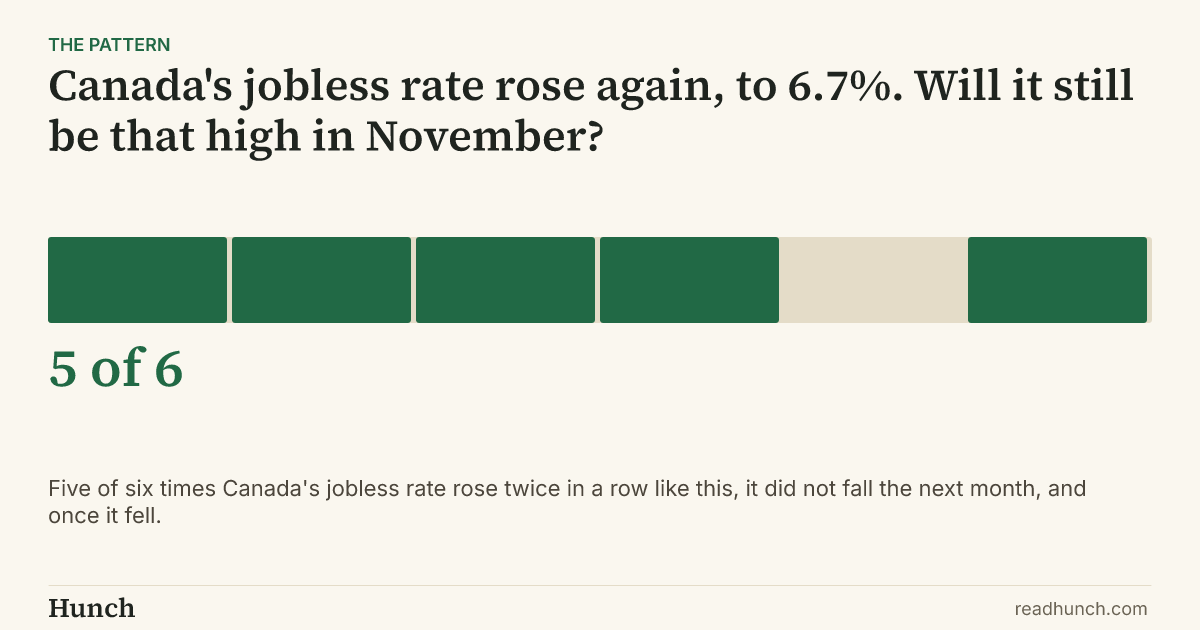
We looked for cases where Canada’s unemployment rate rose for a second month in a row, the last time by 0.2 points or more, because more people looked for work while the number in work stayed about the same. We found six such months since 1995, in the figures Statistics Canada published at the time. Five times the rate did not fall the next month. (Statistics Canada)
Show the other 4 cases
The Read
Five of six times the rate did not fall the next month. Three times it stayed the same, once it rose 0.1 points and once, in , it jumped 0.5 points. The only fall came in , when jobs rose 49,000, almost all of them part-time. After the October figures, Tu Nguyen, an economist at the firm RSM Canada, said she expects the rate “could continue to creep up through the end of the year”.
There are reasons for doubt. All six months come from the same survey, and two of them came only three months apart in 2024. In four other months the rate rose twice in a row while jobs moved a little more, and the next month it fell twice and stayed the same twice. This October most of the rise came from young people and Alberta, where the rate jumps more from month to month, while for people aged 25 to 54 it did not change. Statistics Canada’s monthly reports from before are not online, so earlier years are missing.
Disclaimer
Hunch works only from sources that are publicly available, and publishes on the basis of analysis of that material. We do not form an editorial opinion or take sides, we give a simpler and wider view of news that already exists. If information in a source we used was inaccurate, distorted, or later disputed but had already entered our analysis, Hunch accepts no liability for that. Predictions are not advice. Phase 1 markets use Hunch Points, not money.
Published by Hunch under the Editorial Code. Complaints and corrections: /contact/.