A Kenyan court froze land for Dangote's refinery. It hears the case on 14 October
A court in Malindi told all sides to leave the land for Aliko Dangote's refinery in Lamu as it is until a hearing on 14 October.
What happened
On the Environment and Land Court in Malindi ordered that the land for the Dangote refinery in Lamu stay as it is until a hearing on .
On Justice Jane Onyango of the Environment and Land Court in Malindi ordered that the refinery land in Lamu stay as it is until a hearing on . The order became public on . It covers the land known as LR No. 13061 in the Hindi and Manda Magogoni area.
The case was brought by Salim Tima Swale and 132 other people from Chandavai. They say their families have lived on and farmed parts of this land for generations, with homes, crops and trees, but without formal title. They ask the court to protect their rights to the land before the project goes ahead, and they ask for damages and resettlement.
They are suing the Attorney General, the National Land Commission, the LAPSSET Corridor Development Authority, Lamu County and Dangote Industries. The judge did not treat the case as urgent, gave the other side 14 days to reply, and refused to stop the opening ceremony on .
President William Ruto has said the land needed for the refinery “had been secured”.
The Dangote Group said the court “has not halted the groundbreaking ceremony”, but that “activities at the site may be affected” until the hearing. Aliko Dangote said: “This is normal for us in Africa. … In fact, this is even small.” The refinery is planned to process 700,000 barrels of oil a day, cost $15 billion to $16 billion and be finished by 2030.
Sources: Pulse Kenya, The Star, People Daily, CNBC Africa
The Pattern
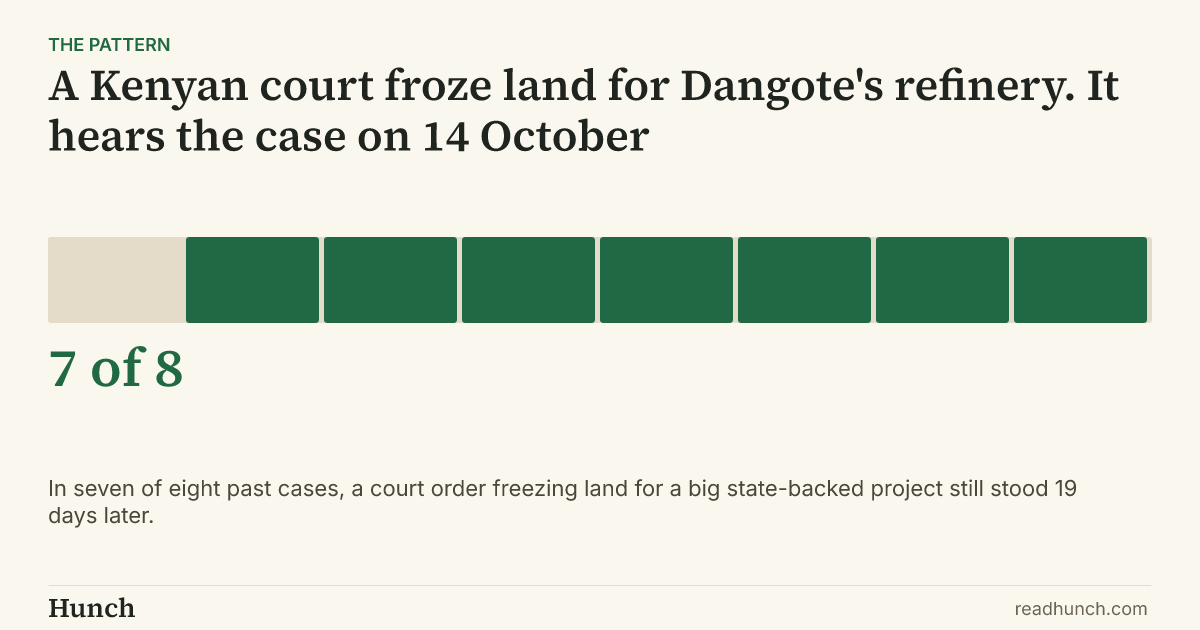
We looked for cases where people living on the land for a big project backed by their government went to court, asked for their land rights to be settled before work began, and got a court order to leave the land as it was until a hearing. We found eight, from 2001 to 2024. In seven, the order was still in place 19 days after it was made, the same gap as between the Lamu order and the hearing. Only two of the eight are from Kenya, and four are from Mexico.
Show the other 6 cases
The Read
History says the order usually stays for now. In seven of eight past cases it still stood 19 days after it was made, and only the Supreme Court of India lifted one sooner. Usually the land’s fate was settled later and by someone else: an investor pulled out, a state buyer ended a contract, a community sold its land, or a top court ruled on the case itself.
The record is thin in three ways. Only two of the eight cases are from Kenya, and four are from Mexico, where judges use a different kind of order. What the court did at the first hearing after its order is known in only three of the eight. And the Lamu order is softer than most: the judge did not treat it as urgent, let the opening go ahead, and covered only the parts of the land where people live.
A higher court is the faster route, but it is rare. It happened in two of eight cases, and in neither Kenyan case. An appeal by the government or Dangote before would make that more likely. A ruling at the hearing that ends the order, or an agreement on payment for the residents, would settle the first question early.
Disclaimer
Hunch works only from sources that are publicly available, and publishes on the basis of analysis of that material. We do not form an editorial opinion or take sides, we give a simpler and wider view of news that already exists. If information in a source we used was inaccurate, distorted, or later disputed but had already entered our analysis, Hunch accepts no liability for that. Predictions are not advice. Phase 1 markets use Hunch Points, not money.
Published by Hunch under the Editorial Code. Complaints and corrections: /contact/.