Australia's David Jones collapsed. Will creditors miss the 10 December deadline?
Australian department store chain David Jones went into administration on 5 November. The law gives creditors until 10 December to decide its future.
What happened
David Jones, a 188-year-old Australian department store chain, went into voluntary administration, and its lender Hilco appointed receivers from FTI Consulting the same day.
David Jones, a 188-year-old Australian department store chain, went into administration on . Its board handed the company to outside managers, McGrathNicol, who will look for a buyer or new money. The same day its main lender, Hilco, sent in its own managers, called receivers, from FTI Consulting to run the shops. The chain has more than 6,000 staff and 38 stores.
The chain lost A$74 million in 2023–24 and A$62 million in 2024–25. The investment firm Anchorage bought it about three years ago for A$100 million. Its main landlord, Scentre, which owns Westfield shopping centres, said David Jones had not paid rent since September and that Anchorage turned down its offer.
Hilco said it will keep the shops open while new owners are found. In a letter to staff, the receivers wrote that the number of shops is likely to be cut soon. Gucci, Valentino and Saint Laurent have taken their goods off the shelves, and one small supplier, Slowdown Studio, is owed A$75,000.
The creditors, the firms and people the company owes money, meet for the first time on . By law a second meeting, where they vote on the company’s future, must take place by . They can accept a deal that keeps the company going, hand it back to its board, or close it and sell what is left, which is called liquidation. A court can give more time, and the creditors can also put off their vote by up to 45 working days.
The meeting must be held within 5 business days before, or within 5 business days after, the end of the convening period.
Corporations Act 2001, section 439A. Here that period of 20 working days ends on 3 December, so the last day for the vote is 10 December
Sources: ABC News (2), The Guardian (2, 3), McGrathNicol, The Sydney Morning Herald, ASIC, Federal Register of Legislation
The Pattern
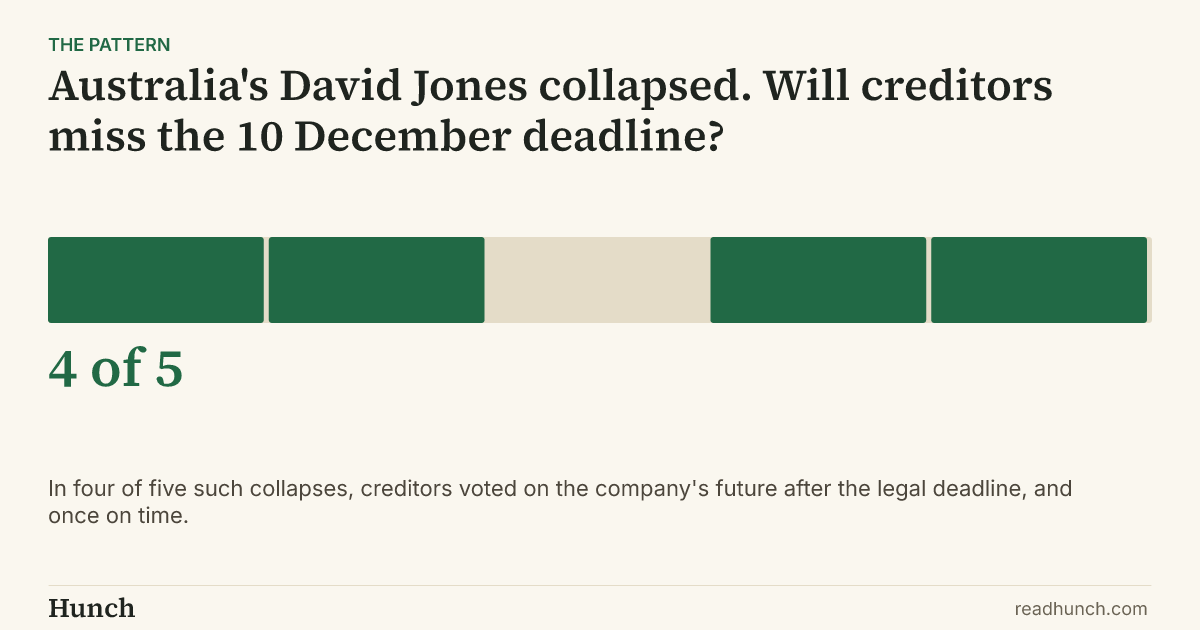
We looked for cases where the board of a big Australian company, with 1,000 staff or more, handed it to administrators while its main lender sent in receivers to run the business. We found five such collapses from 2008 to 2024. Two of them were shop chains. (ABC News; ABC News; ABC News; ABC News; ABC News)
Show the other 3 cases
The Read
In all five collapses, the managers sold or shut the business before the creditors voted. ABC Learning’s centres were sold two days before the vote. In Mosaic’s receivers said no brand could be sold and all shops were expected to close by mid-April, and the vote came in July. At David Jones, Hilco has said it will keep the shops open while new owners are found. The Guardian and The Sydney Morning Herald expect the receivers to keep trading through Black Friday and Christmas, and falls in the middle of that season. The only vote on time, at Forge Group, came after its bank pulled support and receivers cut 1,300 of more than 1,750 jobs within two days. At David Jones the shops still trade, while big brands have taken goods off some shelves.
There are reasons for doubt. Only two of the five were shop chains, and both closed. How the vote was delayed is reported for just two of them: at Mosaic a court gave more time, and at ABC Learning the meeting could be put off. Jason Preston of McGrathNicol, one of the David Jones administrators, also ran Dick Smith’s administration in 2016. At Virgin Australia in 2020 creditors voted after 136 days, and at Arrium in 2016 a creditors’ committee approved the sale after 462 days, both without a lender’s receivers. Three other shop chains with receivers, Colorado, Clive Peeters and Harris Scarfe, all found a buyer or were rescued, though when their creditors voted is not reported.
Sources: ABC News (2, 3, 4, 5, 6, 7, 8, 9), The Guardian, The Sydney Morning Herald, FTI Consulting, SBS News, Technology Partner News, McGrathNicol, SmartCompany
Disclaimer
Hunch works only from sources that are publicly available, and publishes on the basis of analysis of that material. We do not form an editorial opinion or take sides, we give a simpler and wider view of news that already exists. If information in a source we used was inaccurate, distorted, or later disputed but had already entered our analysis, Hunch accepts no liability for that. Predictions are not advice. Phase 1 markets use Hunch Points, not money.
Published by Hunch under the Editorial Code. Complaints and corrections: /contact/.