"Take necessary action": will Germany's watchdog act on the Deutsche Bank leak?
Nearly 15 million internal Deutsche Bank files were made public on 17 November. Germany's finance minister wants the authorities to act.
What happened
Further, Klingbeil said authorities must investigate and “take necessary action” where appropriate.
Nearly 15 million internal Deutsche Bank documents from the past 20 years were made public on . More than 200 journalists, with Der Spiegel, the Financial Times, Le Monde and The New York Times among them, published them as “Inside Deutsche Bank”. The files cover the bank’s dealings with Jeffrey Epstein, Donald Trump and Russian oligarchs, and show the bank repeatedly put business before its checks against money laundering and sanctions.
Deutsche Bank shares closed 6% lower that day, their biggest one-day fall in more than a year. They opened another 1.9% lower on . The bank called the reports old matters with no lasting effect on its finances, and said it had spent €7bn on checks and controls since 2019. The journalists say more reports are planned.
Lars Klingbeil, Germany’s finance minister, said the authorities must investigate and act where needed. By law his ministry oversees BaFin, the German financial watchdog. BaFin did not comment on the leak directly, but said it had made six inquiries involving Deutsche Bank since 2018. The European Central Bank (ECB), which also supervises the bank, declined to comment.
Bafin set new deadlines for Deutsche Bank AG to remedy shortcomings in its data processing systems.
BaFin, notice of 9 October 2026
In BaFin put a special representative into Deutsche Bank to follow its money laundering checks. It widened that job in 2019 and 2021. On it set new deadlines for the bank to fix its systems for spotting suspicious payments. On it fined the bank €8m over a different problem, moving Postbank customers to a new IT system.
On the data protection office of Hesse, the German state where the bank has its head office, opened an inquiry. It is looking at whether the bank protected its data and reported the leak on time. That inquiry is about how the files got out, not about what they show, so it does not settle the questions below. If no watchdog acts, the existing BaFin orders and deadlines stay as they are.
Sources: DW, Reuters (2, 3), Gesetze im Internet, BaFin (2, 3, 4)
The Pattern
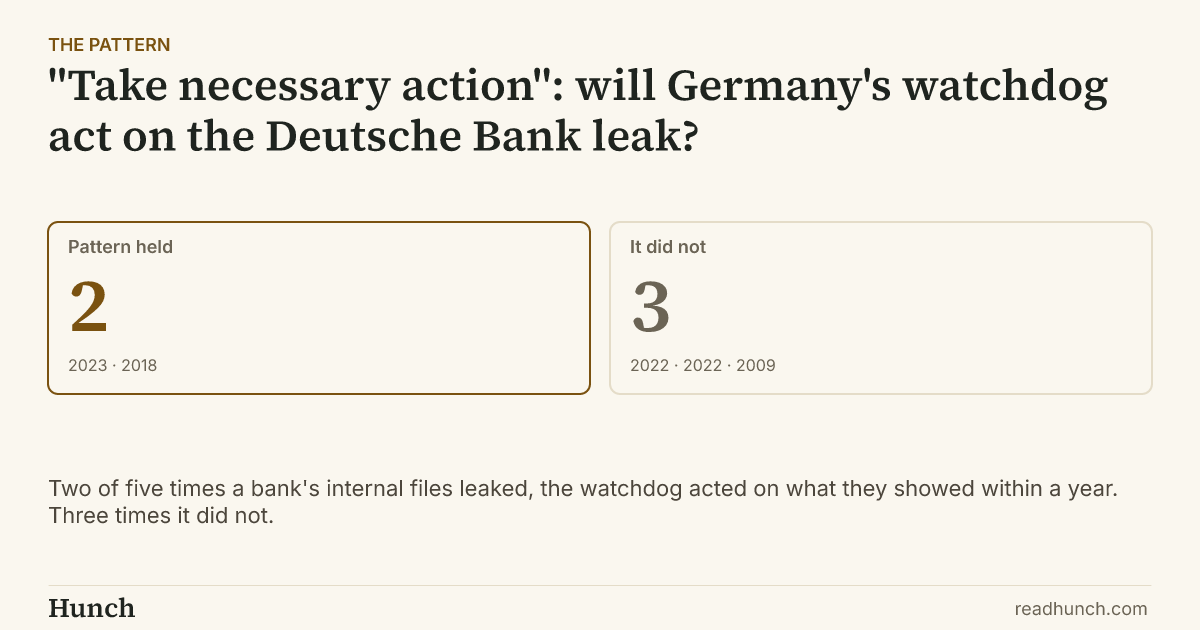
We looked for cases where a bank’s own internal documents leaked to journalists and a financial watchdog then decided whether to act against the bank. We found five such leaks since 2009, in Switzerland, Denmark, Estonia and Britain. None was in Germany. We counted only steps that the watchdog or the bank published about the same problems the files showed.
Show the other 3 cases
The Read
Two of the five watchdogs acted within a year: Denmark’s on day 66 and Britain’s on day 115. In the three others the watchdog said it was in contact with the bank or acted only on other problems, even after politicians spoke up, as in Switzerland in 2022. No watchdog acted within the first 44 days, which this time would mean by . Today BaFin says only that it is following the matter.
There are reasons for doubt. None of the five leaks was in Germany. BaFin also already has an order running on the same checks: in September it set the bank new deadlines to fix its payment monitoring, and a new BaFin order or fine on those checks would count here even if it never names the leak. On the other side, a European supervisory official told Reuters there was no sign of a big new investigation, and the bank says the matters are old.
Sources: Danske Bank, FCA, The Guardian, MLex, BaFin, Reuters
Disclaimer
Hunch works only from sources that are publicly available, and publishes on the basis of analysis of that material. We do not form an editorial opinion or take sides, we give a simpler and wider view of news that already exists. If information in a source we used was inaccurate, distorted, or later disputed but had already entered our analysis, Hunch accepts no liability for that. Predictions are not advice. Phase 1 markets use Hunch Points, not money.
Published by Hunch under the Editorial Code. Complaints and corrections: /contact/.