Weak US jobs sent the dollar down. After big yearly falls, the slide often went on.
Only 57,000 US jobs in June pushed back bets on a Fed rise. The dollar index fell to 100.77 on 3 July, its biggest weekly drop in nearly 3 months.
What happened
The dollar index slid to 100.77, down 0.58% for the week — its biggest weekly drop since early April — after June’s weak jobs report cooled expectations of a Fed hike.
The US added only 57,000 jobs in June, the smallest gain in four months. Markets cut their bets that the Federal Reserve, the US central bank, would raise rates in September. The euro rose to a two-week high of $1.1442 and sterling to $1.3361. The yen climbed from its lowest level in decades to 161.01 per dollar.
The dollar fell 9.4% in 2025, its worst year in eight years. The dollar index measures it against other major currencies. In the index dropped below 97 and touched 95.5, a four-year low.
Then came March. US and Israeli strikes on Iran and the closure of the Strait of Hormuz sent investors into the dollar as a safe place for their money. The oil shock also pushed prices up, so markets stopped expecting the Fed to cut rates.
Sources: Reuters, Bloomberg (2, 3)
The Pattern
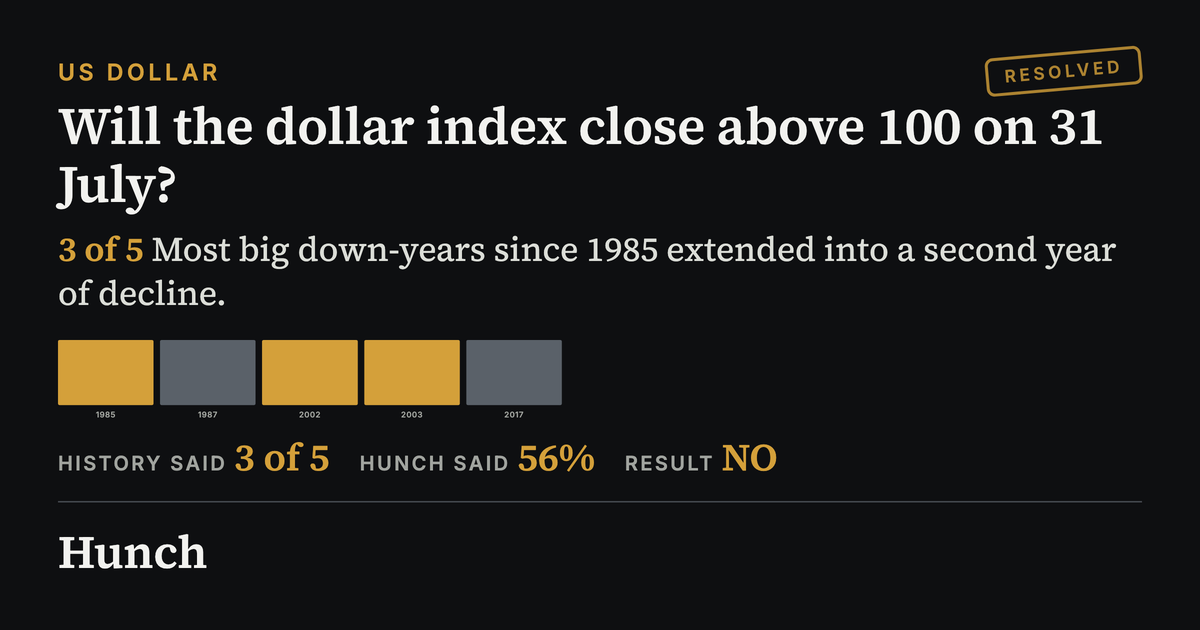
Since 1985 the dollar has lost about 9% or more in a year five times. We used the dollar index. We checked what happened in the following year. In three cases the fall went on, and in two the dollar bounced back. History is close to split.
Show the other 3 cases
The Read
History leans slightly towards a further fall. After three of the five big yearly falls, the dollar fell again the next year. This year’s recovery rested on two things: demand for a safe currency, and a Fed under Kevin Warsh that was ready to raise rates. Hopes of a rate rise faded as soon as June’s job numbers came out. Demand for a safe currency fades whenever the Gulf is quiet for two weeks. The worries behind the 2025 fall, US government debt and central banks abroad holding fewer dollars, were never solved.
History is thin here. It has only five cases, and 2002 and 2003 belong to one long fall. This oil shock also helps the dollar more than past ones did. The US now sells more energy abroad than it buys, and higher prices hit Europe and Japan harder. The euro at $1.14 and the yen at 161 show that.
The Fed still points up. In its June forecasts nine of its 18 officials expected a rate rise this year. The next tests are the minutes of the June Fed meeting, inflation figures in mid-July and the Fed’s meeting on 28–. An inflation reading above 4% would bring back bets on a rate rise, and the dollar with them.
Disclaimer
Hunch works only from sources that are publicly available, and publishes on the basis of analysis of that material. We do not form an editorial opinion or take sides, we give a simpler and wider view of news that already exists. If information in a source we used was inaccurate, distorted, or later disputed but had already entered our analysis, Hunch accepts no liability for that. Predictions are not advice. Phase 1 markets use Hunch Points, not money.
Published by Hunch under the Editorial Code. Complaints and corrections: /contact/.