The Dow hit a record after Alphabet joined. Such strong years mostly ended higher.
The Dow closed at a record 52,900.07 on 2 July, days after Alphabet joined and pushed it past 52,000. The S&P 500 has set 24 record closes in 2026.
What happened
The Dow closed at a record 52,900.07 ahead of Independence Day, days after Alphabet’s index debut pushed it past 52,000 for the first time.
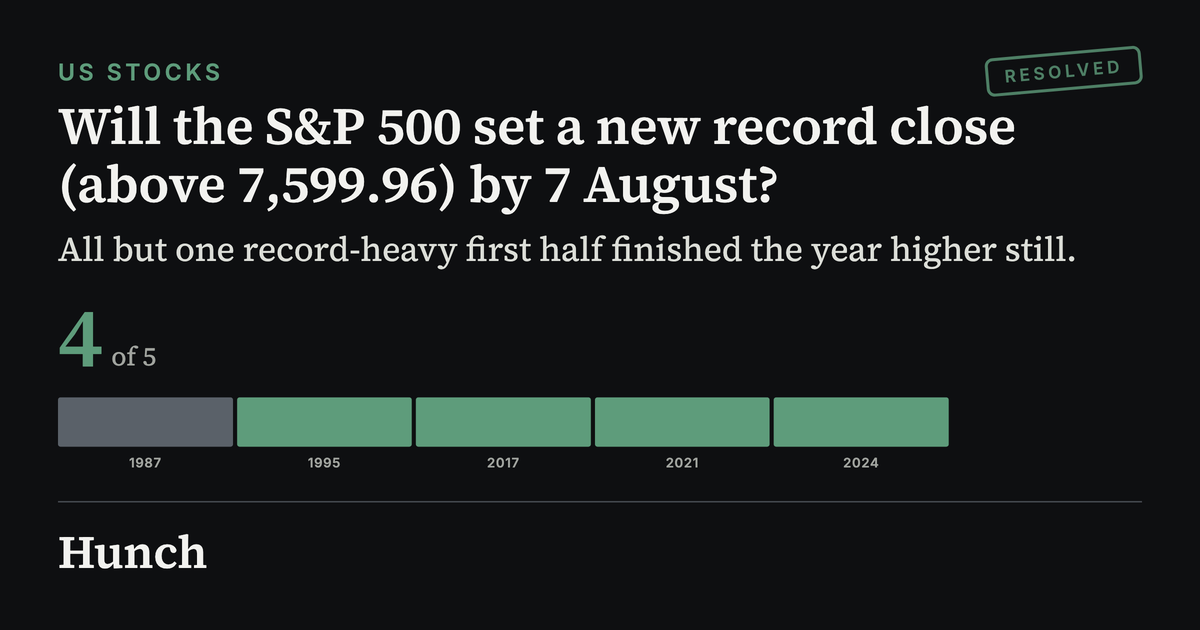
The Dow Jones index tracks 30 large US companies. On it rose 1.14%, ahead of the Independence Day weekend. The wider S&P 500 index ended flat at 7,483.24. The Nasdaq fell 0.8% as Tesla and chip makers dropped. The next question is whether the S&P 500 beats its record of 7,599.96 by .
Alphabet, the owner of Google, joined the Dow on . That day the Dow closed above 52,000 for the first time, at 52,182.74.
The Pattern
Since 1987, five years began with a long run of S&P 500 records. We checked whether the index ended each of those years higher than it stood at midyear. Four did. The exception was 1987, the year of the Black Monday crash.
Show the other 3 cases
The Read
History points to a higher finish. In four of the five years with a strong first half, the S&P 500 ended the year above its midyear level. This year the rise rests on broad profits: 85% of S&P 500 companies beat profit forecasts, well above the five- and ten-year averages. The Dow reached 52,900 with oil high because of the Iran war and inflation at 4.2%. Half of the Fed’s rate-setters also expect a rate rise this year. So the market may have already priced in much of the bad news.
The one failure, 1987, looks a lot like 2026. That year a new Fed chair was raising rates while the dollar was weak. Shares were also expensive after a very steep first half. The same is true now, with Kevin Warsh in the role of Alan Greenspan, who raised a key interest rate in .
The trading also showed a narrow rise. The Dow’s record came partly from the change in its members, while the Nasdaq and chip makers fell. That is weaker support than the number of records suggests. Company profits and the Fed’s next steps will decide which way the second half goes.
Disclaimer
Hunch works only from sources that are publicly available, and publishes on the basis of analysis of that material. We do not form an editorial opinion or take sides, we give a simpler and wider view of news that already exists. If information in a source we used was inaccurate, distorted, or later disputed but had already entered our analysis, Hunch accepts no liability for that. Predictions are not advice. Phase 1 markets use Hunch Points, not money.
Published by Hunch under the Editorial Code. Complaints and corrections: /contact/.