easyJet shareholders backed a £5.7bn sale to Apollo. Can it close by 31 March?
easyJet shareholders approved a £5.7bn takeover by US investment firm Apollo on 11 November. The airline aims to complete it by the end of March.
What happened
easyJet shareholders approve the £5.7bn takeover by Apollo, but the deal still faces regulatory scrutiny in the EU.
Shareholders cast 97.07% of their votes for the deal on . They approved the £5.7bn takeover of easyJet by US investment firm Apollo, at 715p a share. Counted by people rather than shares, 83.29% of those who voted were in favour. The deal would take the airline off the London stock market after more than 25 years.
Apollo can own no more than 49.9% of easyJet. EU rules say the owners of an airline like easyJet must be mostly based in the EU. Founder Sir Stelios Haji-Ioannou and his family, who own about 15%, keep their shares, and Apollo plans for them and other EU-based shareholders to own about half.
Three airline regulators and at least ten other official bodies must agree first. The airline regulators are in the UK, Austria and Switzerland. Competition checks are needed in Austria, Egypt, Germany and the UK, and foreign investment checks in at least six countries. A court must then approve the deal. On only the shareholder votes were done. RTÉ reported the same day that EU officials are preparing a review of airline ownership rules.
The Scheme is expected to become Effective before the end of the first calendar quarter of 2027 and, in any event, prior to the Long Stop Date.
easyJet, result of meetings, 11 November 2026
Sources: RTÉ, London Stock Exchange (2), BBC (2), The Guardian
The Pattern
We looked for cases where shareholders had approved the sale of their listed company through a court-approved plan, as in the UK, and the deal still needed a regulator’s yes under a law that limits foreign owners in that industry. We found four such deals since 2007, all in Canada. Britain had too few, so we also looked at countries that use the same court process. (BCE; BCE; BCE; Shaw)
Show the other 2 cases
The Read
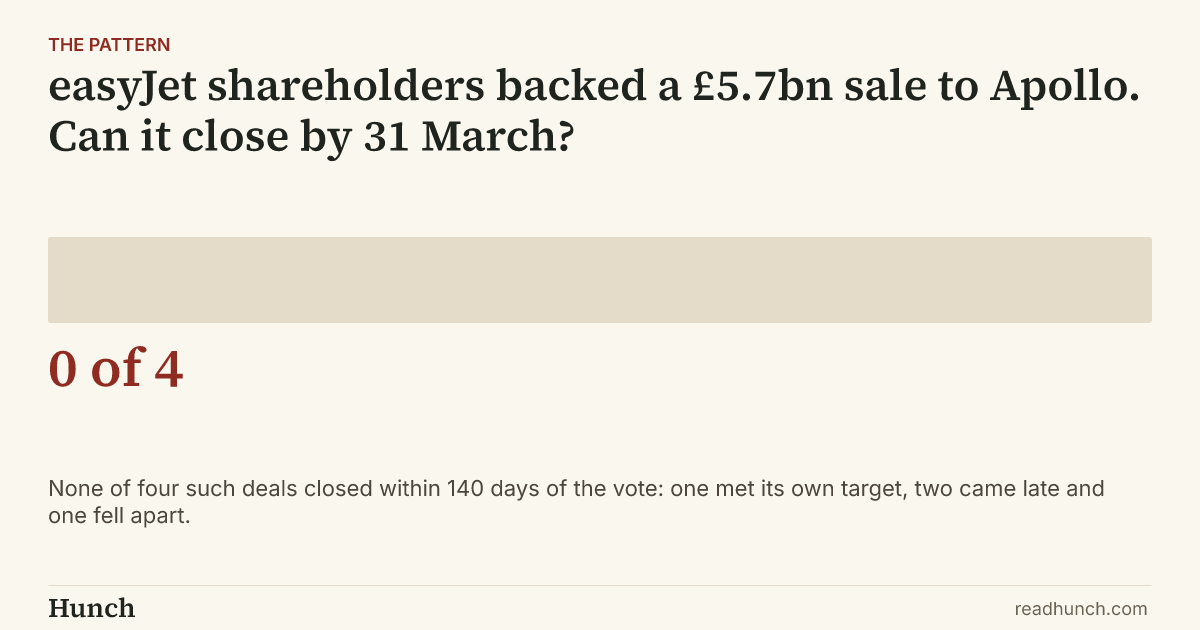
From the vote to the end of March there are 140 days, fewer than the gap from vote to target in each of the four Canadian deals, which ran from 192 to 406 days. Counting from the day the deal was signed does not change the picture. Apollo and easyJet agreed the deal on , 97 days before the vote, and in the Canadian deals the agreement also came 52 to 84 days before the vote. From agreement to the end they took 319 to 751 days, while is 237 days after . The competition checks named in the deal are national ones, in four countries, and Apollo’s buyer committed to “take all necessary steps” to win them. That promise does not cover steps asked of other companies Apollo has invested in, such as Sun Country, Aeromexico and Atlas Air. The last date the deal allows is .
There are reasons for doubt. All four past deals were Canadian telephone and TV companies, and BCE was on one side in three of them. In three the buyer was itself Canadian, so foreign ownership was not in question; only the 2007 BCE buyout involved investment funds. None was an airline, none needed an EU regulator, and the EU is now preparing a review of airline ownership rules. In 2016 BCE and MTS aimed for “late 2016 or early 2017”; read as the end of 2016, that deal was 76 days late as well.
Disclaimer
Hunch works only from sources that are publicly available, and publishes on the basis of analysis of that material. We do not form an editorial opinion or take sides, we give a simpler and wider view of news that already exists. If information in a source we used was inaccurate, distorted, or later disputed but had already entered our analysis, Hunch accepts no liability for that. Predictions are not advice. Phase 1 markets use Hunch Points, not money.
Published by Hunch under the Editorial Code. Complaints and corrections: /contact/.