Energy pushed euro prices up. Will the ECB raise rates a third time in October?
Euro-area inflation rose to 3.3% in August because energy prices jumped 14.3%, the EU statistics office Eurostat said on 1 September.
What happened
Euro-area annual inflation is expected to be 3.3% in , up from 2.9% in July, with energy at 14.3% against 10.3% a month earlier and services easing to 3.0%, according to Eurostat’s flash estimate published on .
Energy is behind the rise. Energy prices were 14.3% higher than a year before, up from 10.3% in July. Prices for services grew more slowly, at 3.0% after 3.3%. Leave energy out and price growth is close to the target of the European Central Bank (ECB). With energy in, it is well above it.
The ECB decides on rates on . Its deposit rate, the rate it pays banks, has been 2.25% since . That day it rose from 2.00%, the first rise since . Reuters reported on that the new figure made a rise in September widely expected.
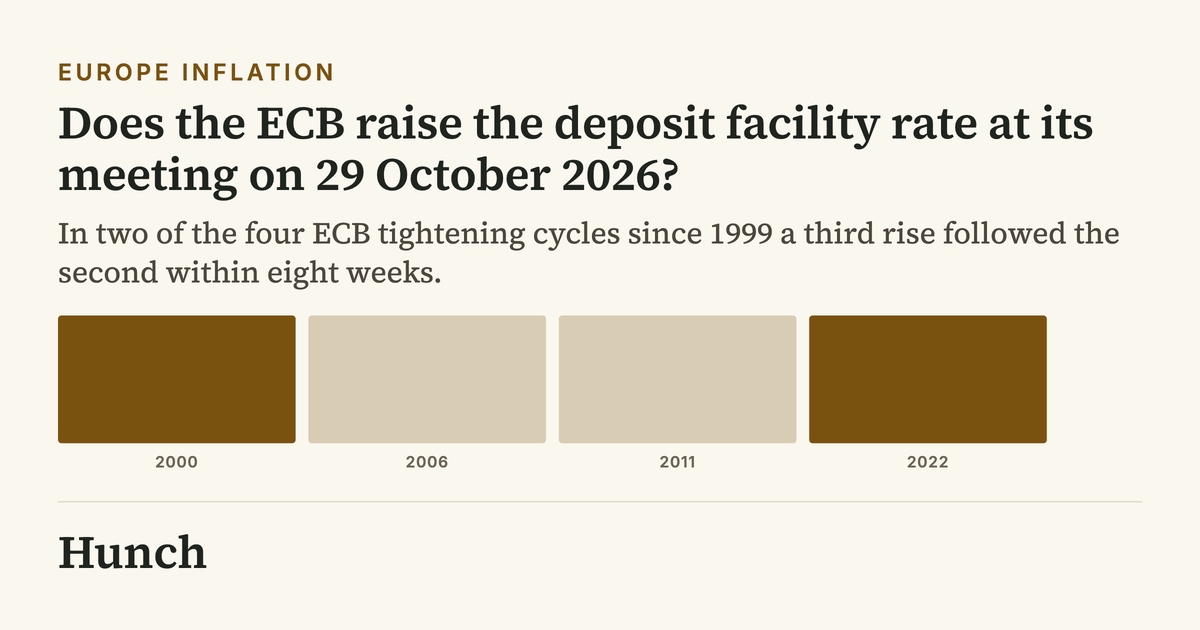
So the open question is what comes after September. The ECB has had four periods of rising rates since 1999. Its own record shows how fast a third rise followed the second in each one.
Sources: Eurostat, ECB meeting calendar (2), Reuters
The Pattern
A quick third rise came in two of four past periods. We looked at every period of ECB rate rises since 1999 and checked whether a third rise came within eight weeks of the second. The dates are the days each change took effect, from the ECB’s own record.
Show the other 2 cases
The Read
For the signs pointed to one small rise. Inflation was above 3% with energy prices rising fast, and Reuters reported that a rise was expected. That is why the market on the September meeting opened above 80%.
October is harder to call, so that market opened at 40%. In 2000 and 2022 the third rise came within seven weeks and rates kept rising for months. In 2006 the ECB waited fourteen weeks. In 2011 it stopped after two rises and cut rates four months later.
Services prices are already rising more slowly. If the ECB decides the August jump is a short energy spike, it will probably wait, as it did in 2011. Four periods is also a short record to learn from. The decision will answer the question.
Disclaimer
Hunch works only from sources that are publicly available, and publishes on the basis of analysis of that material. We do not form an editorial opinion or take sides, we give a simpler and wider view of news that already exists. If information in a source we used was inaccurate, distorted, or later disputed but had already entered our analysis, Hunch accepts no liability for that. Predictions are not advice. Phase 1 markets use Hunch Points, not money.
Published by Hunch under the Editorial Code. Complaints and corrections: /contact/.