Europe's central bank raised rates in June. It rarely raised again straight after.
The European Central Bank raised rates on 11 June for the first time in 3 years. On 23 July it decides whether to raise again or pause.
What happened
The ECB raised all three key rates by 25 basis points, its first hike in three years, as the war in the Middle East pushed eurozone inflation to 3.2%.
The European Central Bank (ECB) raised rates on . Its deposit rate, the rate it pays banks, rose by a quarter of a percentage point to 2.25% from . Its two other main rates rose by the same amount. It was the first rise since , after eight cuts in a row between and .
Energy prices drove the decision. The first estimate of euro-area inflation for May was 3.2%, up from 3.0% in April and the highest since . The war with Iran and trouble in the Strait of Hormuz pushed up fuel and transport costs. ECB staff now expect inflation of 3.0% in 2026, 2.3% in 2027 and 2.0% in 2028.
The next decision is on at 13:45 CET. There are no new staff forecasts at this meeting, so the ECB will decide on the latest data. Since June, calmer relations between the US and Iran have brought the price of Brent oil down from above $120 to about $72 a barrel. That weakens the energy argument that justified the June rise.
The ECB is split. Members from Germany, the Netherlands and Austria are likely to argue that higher prices are already pushing wages up. Others will point to the fall in oil.
The Pattern
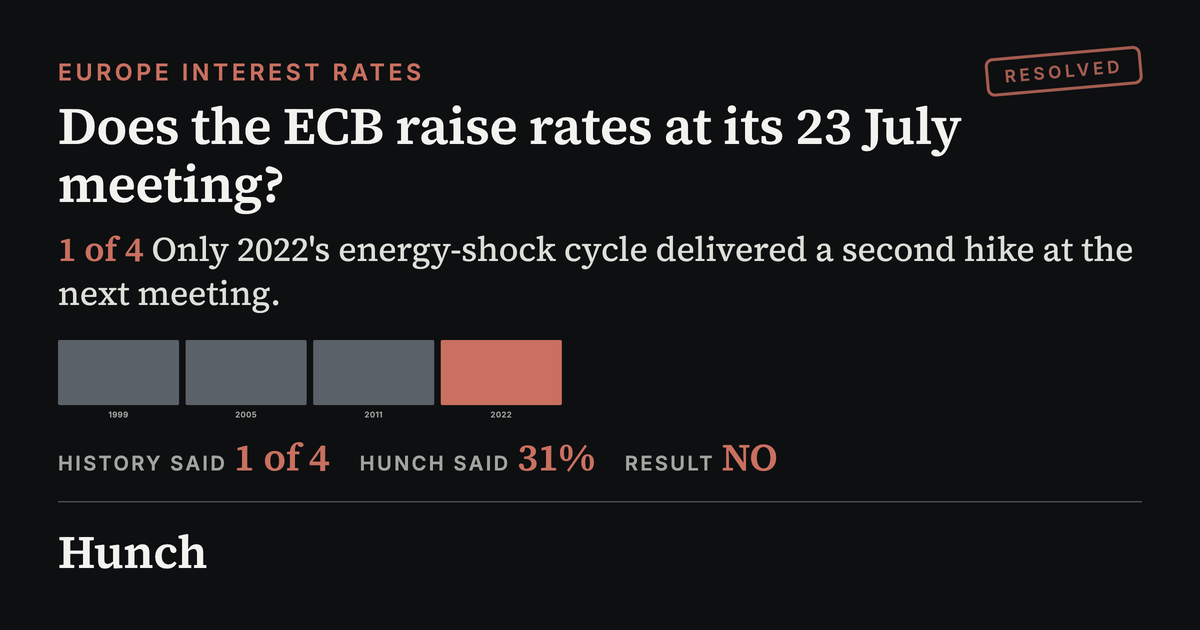
Only once did the ECB raise again at the very next meeting. We looked at the four times since 1999 that the ECB started raising rates. Each time we asked the same thing: did the second rise come at the next meeting, or did the ECB wait to see more data? It moved straight away only in 2022.
Show the other 2 cases
The Read
History and the oil price point to a pause. Brent oil has lost all of its war-time rise since the June decision, so the energy push behind 3.2% inflation is fading. In three of the four past cycles the ECB waited after its first rise. There are no new staff forecasts in July, and this ECB has often preferred to move when new forecasts support it. The next ones come in September.
The case for a rise rests on 2022, the one time the ECB moved at the next meeting. That was also an energy shock that spread into wider prices, as now. Core inflation, which leaves out energy and food, was 2.5% in May, above target. Wage deals in Germany and the Netherlands are settling higher, and an ECB that waited too long in 2021 may prefer to act early this time.
The June core inflation figure, due in mid-July, matters most. If it comes in above 2.5%, the market’s 31% chance of a July rise will look too low.
Disclaimer
Hunch works only from sources that are publicly available, and publishes on the basis of analysis of that material. We do not form an editorial opinion or take sides, we give a simpler and wider view of news that already exists. If information in a source we used was inaccurate, distorted, or later disputed but had already entered our analysis, Hunch accepts no liability for that. Predictions are not advice. Phase 1 markets use Hunch Points, not money.
Published by Hunch under the Editorial Code. Complaints and corrections: /contact/.