E.ON wants to buy OVO Energy. Most such deals passed the watchdog's first check.
The competition watchdog, the CMA, began its first-stage review of E.ON's purchase of OVO Energy on 2 September. It must decide by 28 October.
What happened
The CMA launches its Phase 1 merger inquiry into the anticipated acquisition of OVO Energy Ltd by E.ON SE, with a statutory decision deadline of .
The competition watchdog must decide by . The Competition and Markets Authority (CMA) opened its first-stage review of E.ON’s plan to buy OVO Energy on . By then it must either clear the deal or send it to a longer, full inquiry. The law allows the deadline to be extended only in limited cases.
The CMA first opened the case on and asked for public comments from 8 to . The buyer is E.ON SE, acting through E.ON UK Limited.
Household energy bills are rising. Ofgem, the energy regulator, set its price cap at £1,723 a year for a typical household from October. That is up 4 per cent from £1,663 for July to September and the highest in three years. It follows a 13 per cent rise at the start of July. The cap covers about 22 million households.
The timing is awkward. The deadline falls on the same day as the Chancellor’s first Budget, fixed for , the busiest day of the year for government news. The decision itself turns on one question. With fewer large suppliers, is there still enough competition when most customers pay a capped price and do not switch?
Sources: GOV.UK, Guardian, BBC
The Pattern
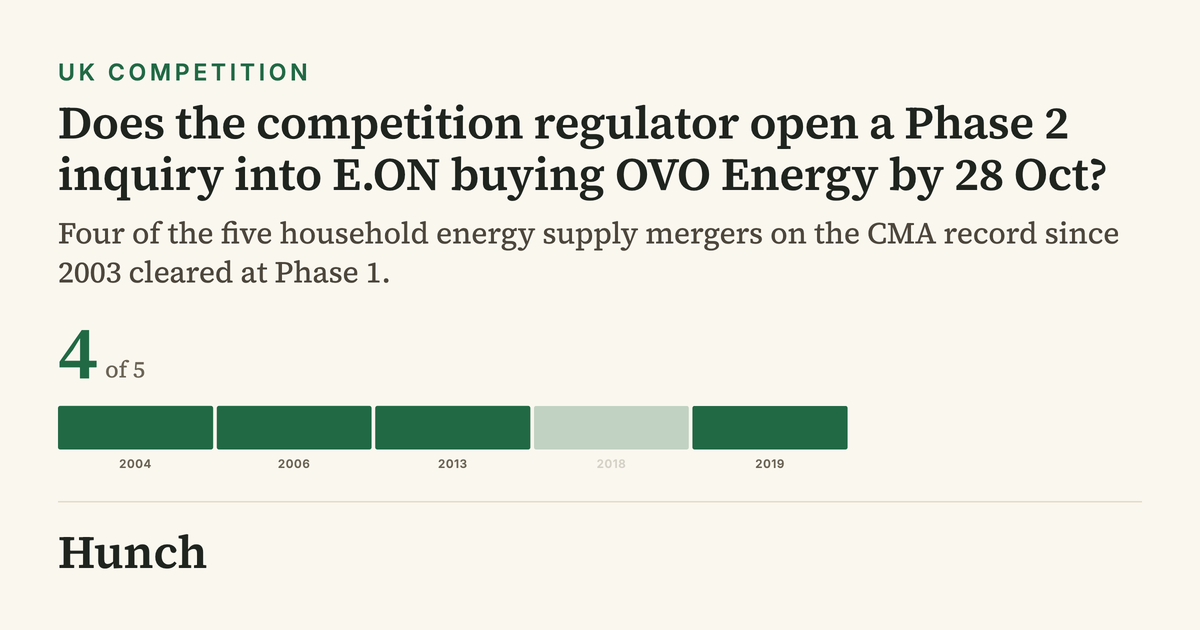
Four of five past mergers cleared at the first stage. We looked at every merger decision on the CMA’s records since 2003 where a supplier of gas or electricity to homes in Great Britain sold that business or its customers. We asked one thing: was the deal cleared at the first stage, or sent to a full inquiry? Deals about networks, power stations or business customers are left out.
Show the other 3 cases
The Read
History points to clearance, which is why the market on a full inquiry opens below even chances. Four of the five past mergers cleared at the first stage, the latest 47 days after the case opened. Most households are now on a capped price, and the cap limits what any supplier can charge them.
The doubts are real. This is the biggest merger of household suppliers since SSE and npower, and that one went to a full inquiry and took eight months. A deal that cuts the number of large suppliers in a winter of rising bills is one the watchdog may prefer to take slowly, with a full published case behind it. Five past deals is also a small record.
Two signs will help. An extension of the deadline usually means the companies are offering changes to win approval, and changes accepted at the first stage mean no full inquiry. The timing is the other sign. A clearance tends to come early, and a full inquiry tends to come on the last day.
Disclaimer
Hunch works only from sources that are publicly available, and publishes on the basis of analysis of that material. We do not form an editorial opinion or take sides, we give a simpler and wider view of news that already exists. If information in a source we used was inaccurate, distorted, or later disputed but had already entered our analysis, Hunch accepts no liability for that. Predictions are not advice. Phase 1 markets use Hunch Points, not money.
Published by Hunch under the Editorial Code. Complaints and corrections: /contact/.