EU asks China to limit hybrid car exports. Four of five agreed within three months.
The EU has asked China to send fewer hybrid cars to Europe, or face its own limits. China said no on 18 September.
What happened
The EU has asked China to voluntarily reduce its hybrid car exports to the EU or face safeguards, likely to be quotas, the Guardian reported on .
The EU has asked China to send fewer hybrid cars to Europe, or face safeguards, likely to be quotas. The European Commission has not published any document with this request. It is known from press reports, and China’s commerce ministry answered those reports on .
Sales of Chinese hybrids in the EU have risen fast. In 2022, 659 Chinese-made full hybrids were sold in the EU. In the first seven months of 2026 the number was 160,662. Sales of Chinese plug-in hybrids went from 56,706 in 2022 to 217,764 from January to July this year. The EU tariffs on Chinese cars from 2024 cover only fully electric cars.
China said no on . Its commerce ministry said: “These so-called voluntary export restrictions seriously violate WTO rules and run counter to the laws of the market economy and the principle of fair competition.”
On the German car industry group VDA said for the first time that it would consider tariffs on Chinese hybrids. Earlier in September, Commission president Ursula von der Leyen said the EU’s trade gap with China, now €1.18bn a day, had reached a “tipping point”.
The EU trade commissioner, Maroš Šefčovič, and China’s commerce minister, Wang Wentao, meet on 8 and . The EU has not opened a formal investigation into Chinese hybrids.
Sources: The Guardian, Xinhua
The Pattern
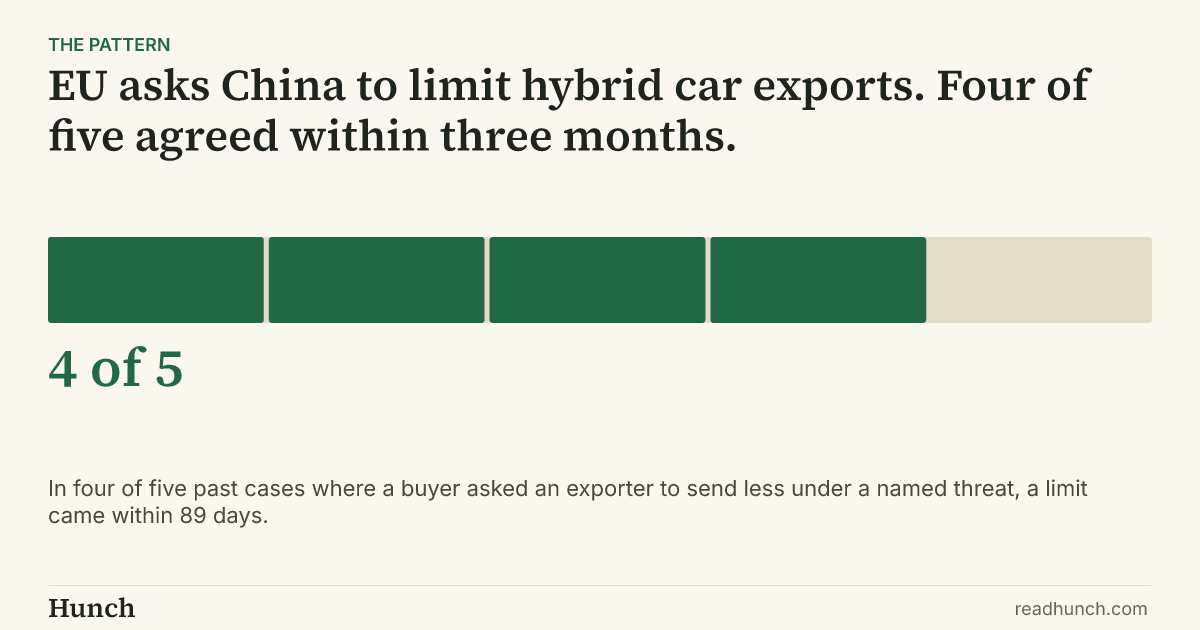
We looked for cases where a country or trade bloc asked another country to send less of a fast-growing product, named the step it would take itself if not, and had not yet opened an investigation into that product. We found five, from 1968 to 2005. In four, the exporter announced a limit within 89 days of the threat. Four of the five exporters were Japan, which relied on the United States for its security.
Show the other 3 cases
The Read
History points to a deal within about three months. In four of five cases the exporter announced a limit within 89 days of the threat, and each time near a set date, such as a deadline or a meeting of the two sides. The next set date here is the meeting of Maroš Šefčovič and Wang Wentao on 8 and . In every case the limit was a cap on numbers or on growth, and only once did the buyer open a formal probe.
The record is narrow. Four of the five exporters were Japan, which relied on the United States for its security, and China has no such tie to the EU. Only the textiles case of 2005 has China as the exporter. No exporter’s government in these cases said no after the threat was made, and China did so on . The request itself is known only from press reports, and the Commission has published no document on it.
Disclaimer
Hunch works only from sources that are publicly available, and publishes on the basis of analysis of that material. We do not form an editorial opinion or take sides, we give a simpler and wider view of news that already exists. If information in a source we used was inaccurate, distorted, or later disputed but had already entered our analysis, Hunch accepts no liability for that. Predictions are not advice. Phase 1 markets use Hunch Points, not money.
Published by Hunch under the Editorial Code. Complaints and corrections: /contact/.