US rates rose for the first time in three years. Will the Fed raise in October too?
Kevin Warsh's Federal Reserve raised US interest rates on 16 September, its first rise in three years. The next meeting is on 27 and 28 October.
What happened
The Guardian reported on that Kevin Warsh’s Federal Reserve raised interest rates unanimously on , the first rise in three years, against a public campaign by the White House for cuts, and that investors now expect a further rise in December.
The US central bank raised rates on . The Federal Reserve raised its main interest rate by a quarter of a percentage point, to a band of 3.75 to 4 per cent. It was the first rise in three years, and no member of the committee voted against it.
Before this the rate had stayed the same for five meetings. Those followed three cuts between September and .
Kevin Warsh, the chair since May, said afterwards that the rise was a start at showing the bank is serious about inflation. Inflation has been above the Fed’s 2 per cent target for more than five years. He did not say what comes next. Since taking the job he has stopped publishing the Fed’s forecast of future rates, and he no longer signals moves to markets in advance.
The White House wants lower rates and says so in public. Donald Trump wrote after the meeting that US rates should be 1 per cent or lower. His economic adviser Kevin Hassett said on television that an independent central bank stays out of the way of elections. Elections to Congress are held in early November.
Markets took the rise calmly. The S&P 500 share index closed 0.4 per cent lower on the day. The interest rate on ten-year US government debt went back above 5 per cent, and the average 30-year mortgage rate reached 6.95 per cent, the highest in more than eighteen months. Investors now expect the next rise in December rather than October.
The Fed’s rate committee meets next on 27 and . Its last meeting of the year is on 8 and .
Sources: The Guardian, Federal Reserve, FOMC calendar (2), The Independent
The Pattern
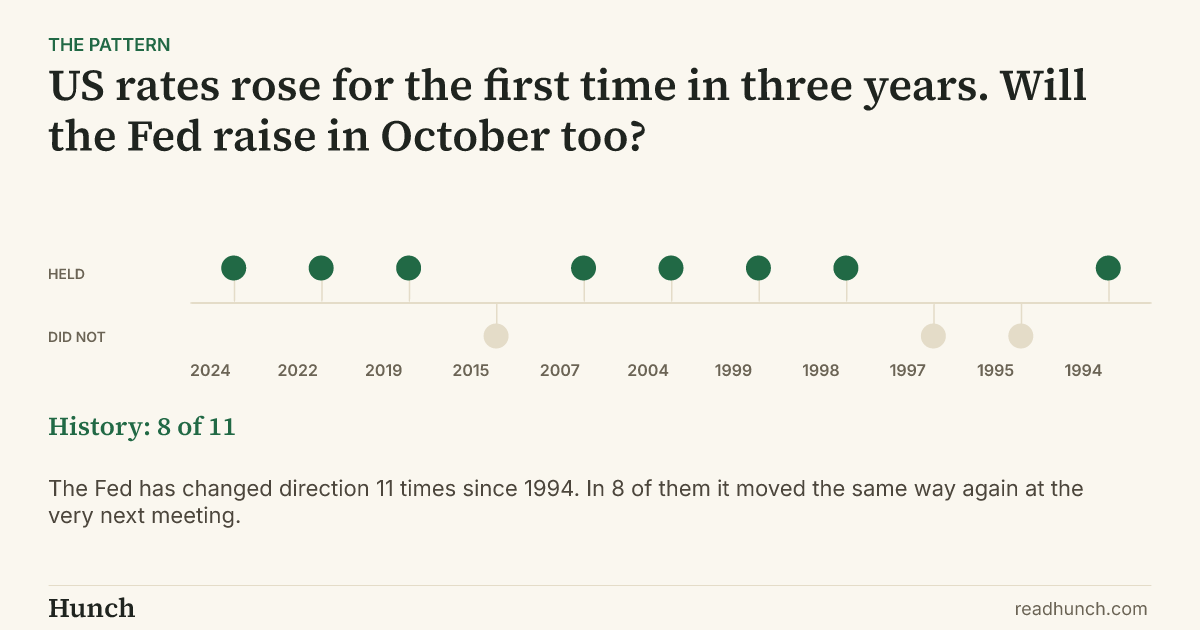
Eight times in eleven, the Fed moved again at the next meeting. We looked at every time since 1994 that the Fed’s rate committee changed direction, from cuts to rises or the other way. 1994 is when it started announcing decisions on the same day. When it moved the same new way again, it did so 41 to 55 days later. When it did not, it waited 166 days or more.
Show the other 9 cases
The Read
History points to another rise soon. When this committee changes direction, it usually moves the same way again at the very next meeting, about six weeks later. When it does not, it waits for months. The record has no case in between.
October is the weak point. Investors left the September meeting expecting the next rise in December. Kevin Warsh has stopped publishing the rate forecast that every earlier committee used to signal its next step. The October meeting also falls in the week before the elections to Congress. The record itself comes from one institution, and six of the eleven turns came under one chair, Alan Greenspan.
Two facts argue the other way. In the committee cut two days after a presidential election. And investors expected no change in September before the Fed raised 12 to 0. The biggest threat to a rise is a fall in the oil price or a sharp slowdown before . Then the Fed might not raise again in October or December, and all three markets would resolve No.
Disclaimer
Hunch works only from sources that are publicly available, and publishes on the basis of analysis of that material. We do not form an editorial opinion or take sides, we give a simpler and wider view of news that already exists. If information in a source we used was inaccurate, distorted, or later disputed but had already entered our analysis, Hunch accepts no liability for that. Predictions are not advice. Phase 1 markets use Hunch Points, not money.
Published by Hunch under the Editorial Code. Complaints and corrections: /contact/.