Kevin Warsh's Fed held rates in June. Most new chairs raised within two meetings.
Kevin Warsh kept US rates at 3.50 to 3.75% at his first Fed meeting as chair on 17 June. 9 of 18 officials expect at least one rise before year end.
What happened
The Fed held rates at 3.50–3.75% at Kevin Warsh’s first meeting as chair, while a raised dot plot showed nine of 18 officials projecting a hike before year-end.
The Federal Reserve’s rate committee voted as one on to keep its main interest rate at 3.50 to 3.75%. It was the first decision with Kevin Warsh as chair. The statement mattered as much as the rate. It was much shorter and no longer hinted at future cuts. It said plainly that inflation remains high compared with the 2% goal.
The officials’ own forecasts turned the hold into a warning. Six of the nine officials who expect a rise this year expect two rises of a quarter point each. Traders came away expecting a possible rise as early as October.
Inflation is a real problem. Prices rose 4.2% in the year to May, the fastest in three years, mainly because energy prices jumped 23.5% after the Iran war closed the Strait of Hormuz. Core inflation, which leaves out energy and food, was a much calmer 2.9%.
The committee meets again on 28 and . Two weeks after the June decision the picture changed. US employers added only 57,000 jobs in June, against 115,000 expected. Markets cut back their bets on an autumn rise, and the dollar had its biggest weekly fall in nearly three months. The Fed’s two goals, steady prices and jobs, now pull in opposite directions.
Sources: Bloomberg (2, 3, 4), Federal Reserve
The Pattern
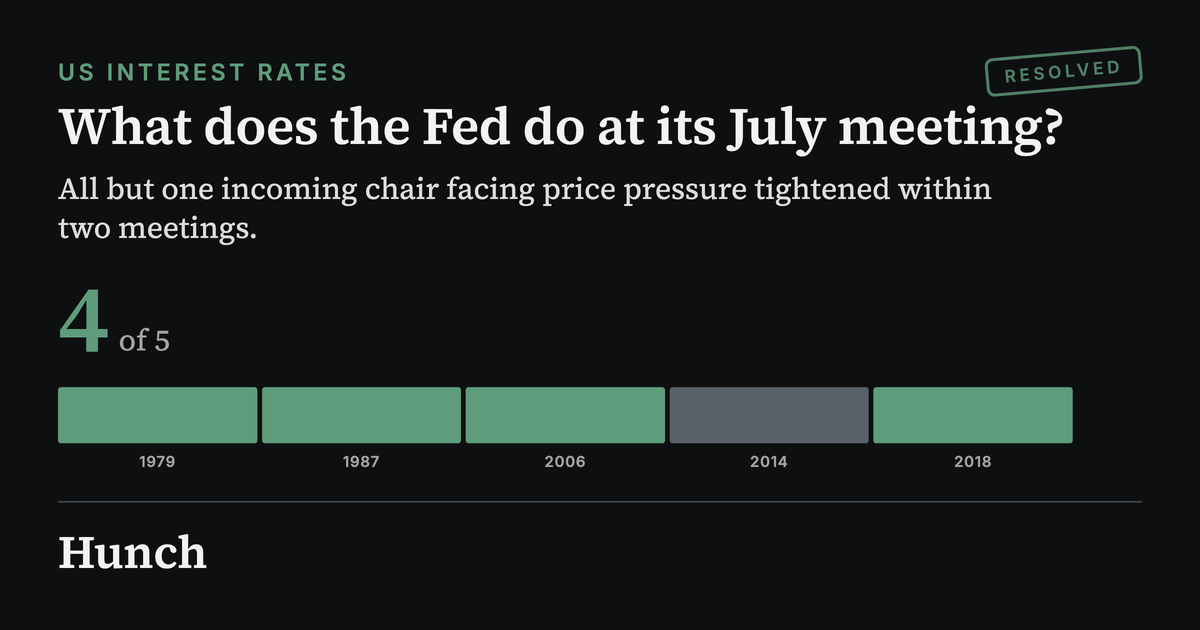
Four of the five chairs before him raised rates within two meetings. We looked at every new Fed chair since 1979 who took over while prices were rising and the next step on rates was open. Kevin Warsh is the sixth. Of the five before him, only Janet Yellen waited.
Show the other 3 cases
The Read
History and the officials’ forecasts point the same way. This committee wants to raise rates, and most new chairs in a similar position moved fast. Inflation at 4.2% gives Kevin Warsh a reason, and his shorter statement, with the hint of cuts removed, reads like a chair preparing the ground. But the case for July in particular is thin. The committee was united in June, markets expect October, and a chair who values trust rarely surprises at his second meeting.
The other risk is that the rise never comes. The jump in prices is mostly an energy shock. Core inflation is 2.9%, not far from target, and price jumps caused by supply can fade fast if oil falls. Employers added only 57,000 jobs, and fewer people are working or looking for work. If the July jobs figures confirm the slowdown, the June forecasts may turn out to be the high point.
Janet Yellen is the reminder. She waited 22 months for her first rise, so what a new chair plans at the start is not a promise.
Disclaimer
Hunch works only from sources that are publicly available, and publishes on the basis of analysis of that material. We do not form an editorial opinion or take sides, we give a simpler and wider view of news that already exists. If information in a source we used was inaccurate, distorted, or later disputed but had already entered our analysis, Hunch accepts no liability for that. Predictions are not advice. Phase 1 markets use Hunch Points, not money.
Published by Hunch under the Editorial Code. Complaints and corrections: /contact/.