Five-year mortgage rates hit a three-year high. Will they rise again by December?
The average five-year fixed mortgage rate is 6.00%, the highest since September 2023, Moneyfacts says. The Bank of England meets on 5 November.
What happened
The average interest rate on a new five-year fixed mortgage deal has hit 6% for the first time in three years, according to Moneyfacts.
The average rate on a new five-year fixed mortgage is 6.00%, the highest since , according to Moneyfacts, a company that tracks loan prices. The two-year rate is 5.98%. Fixed deals below 5% fell from 1,494 at the start of September to nine.
Big lenders raised prices several times in September. Barclays raised some fixed rates four times, and HSBC, Lloyds Bank, Nationwide, NatWest, Santander and TSB three times each. Moneyfacts said the rises were “inevitable” because lenders’ own borrowing costs climbed with the interest rates on government bonds.
The Bank of England has kept its rate at 3.75% since . On investors put a 92% chance on a rise to 4% at the next meeting on , and they expect at least three more rises in 2027.
Home prices are slowing. Nationwide said annual price growth halved to 0.8% in September. Its chief economist Robert Gardner said expected rate rises had kept “upward pressure on the market interest rates which underpin mortgage pricing”.
Sources: BBC, The Guardian (2), Bank of England
The Pattern
We looked for cases where UK lenders were raising fixed mortgage rates while the Bank of England had kept its rate still for at least three months, and markets expected a rise at the next meeting. We found seven since 2003. For each, we compared the Bank’s own average five-year rate in the month before the meeting with the first full month after.
Show the other 5 cases
The Read
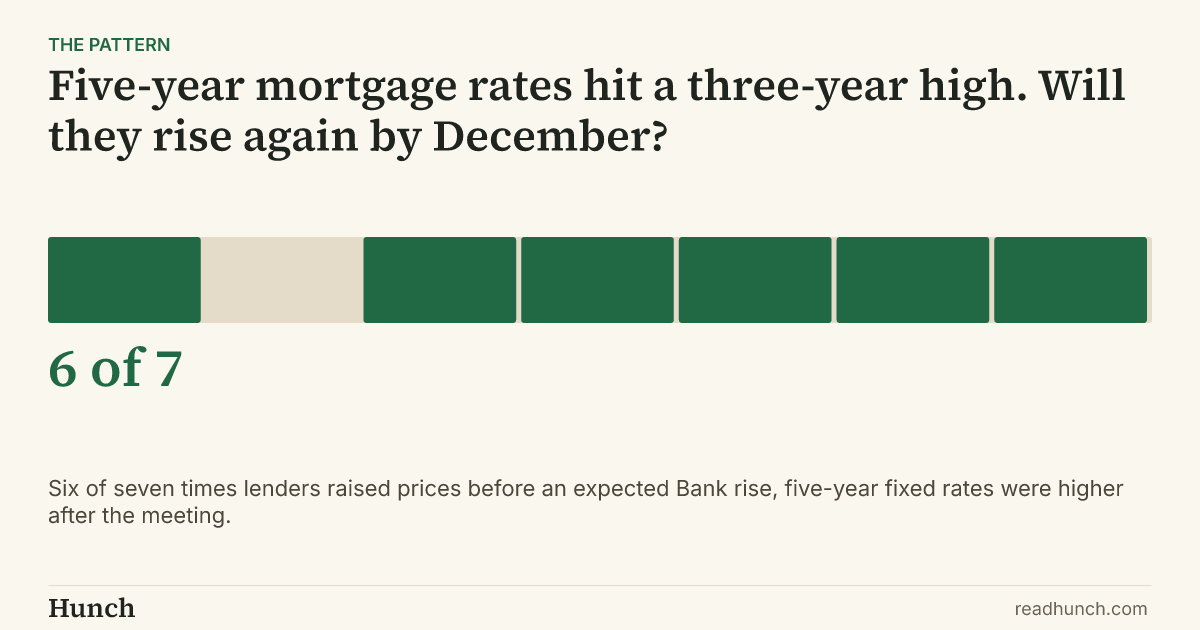
Six of seven times the five-year rate was higher in the month after the Bank met, and it rose even in 2018 and 2021, when the Bank kept its rate still. Today lenders have already raised prices several times, and investors expect more Bank rises next year.
There are reasons for doubt. The one fall came in , when the rise was fully expected and the Bank hinted the next one would wait. This time the October level already includes September’s repeated rises, so December has to beat a high mark. Four of the seven past meetings came with the Bank’s rate at 0.5% or lower, and the Bank’s monthly figures differ from the Moneyfacts average in the news. The rise did not always last. Three months after the meeting the rate was higher only four times in seven, and all three falls came after the Bank had raised its rate.
Disclaimer
Hunch works only from sources that are publicly available, and publishes on the basis of analysis of that material. We do not form an editorial opinion or take sides, we give a simpler and wider view of news that already exists. If information in a source we used was inaccurate, distorted, or later disputed but had already entered our analysis, Hunch accepts no liability for that. Predictions are not advice. Phase 1 markets use Hunch Points, not money.
Published by Hunch under the Editorial Code. Complaints and corrections: /contact/.