Mike Ashley's Frasers has nearly half of Hugo Boss. Past bids often won it control.
Frasers Group's offer closed with 47.9% of Hugo Boss, just short of formal control. German takeover rules now let it keep buying shares.
What happened
Frasers Group increased its shareholding in Hugo Boss to nearly 48% after holders of 17.6% of the shares accepted its €38-a-share offer, a week after the group bought the Harvey Nichols chain out of administration for about £40m.
Frasers is now just short of control of Hugo Boss. Analysts say it is firmly in the driving seat. The road ran through a refusal. In June the Hugo Boss board rejected a €2bn takeover proposal as too low, and Frasers made its offer anyway.
The two boards issued a joint statement on the offer on , and the results were confirmed on . The Hugo Boss chair, Stephan Sturm, has since spoken positively about the relationship.
German takeover law now helps Frasers. Normally a buyer that passes 30% of a listed company must offer to buy all the shares. A completed voluntary offer, like this one, removes that duty. So Frasers can keep buying shares on the market without making a new offer.
In practice 48% already gives Frasers a working majority at most shareholder meetings, because many shareholders do not vote. Two lines remain. The first is 50% of all shares. The second is 75% of votes at a meeting, which would allow a deal giving Frasers direct access to Hugo Boss’s profits.
Hugo Boss is one part of a fast move into luxury. The week before, Frasers bought the Harvey Nichols chain, with 13 stores and 1,200 staff, out of administration, a form of insolvency, for about £40m. Last month it took a 4.2% stake in Burberry worth about £160m. It also holds shares in Mulberry from its earlier campaign there.
Mike Ashley owns 73% of Frasers. Frasers first bought into Hugo Boss in and has pushed for change as a shareholder since.
Sources: The Guardian, Hugo Boss IR
The Pattern
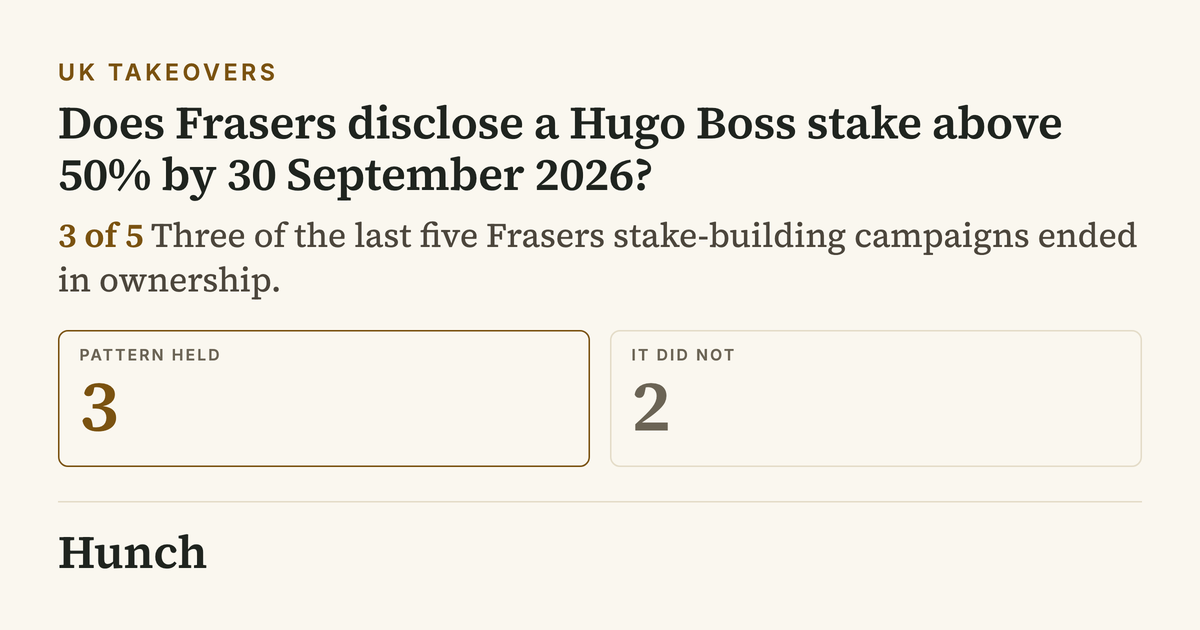
Frasers ended up owning the company in three of five campaigns. We looked at every campaign since 2019 in which Frasers built up a stake in a listed retailer and pushed it to an end. Price never decided the outcome. What mattered was whether a large group of shareholders stood in the way.
Show the other 2 cases
The Read
History points to a stake above 50%. What stopped Frasers before is missing here. There is no majority owner blocking it, as at Mulberry, and no hostile shareholder vote, as at boohoo. Because the offer is complete, further buying needs no new offer, so the shortest way to a majority is simply buying shares on the market. Mike Ashley tends to move within weeks once a position is set, and the Harvey Nichols and Burberry deals both came within two months.
The case against is that 48% may be exactly where Frasers wants to stay. Above 50%, Hugo Boss’s debt would appear on Frasers’ own balance sheet. Staying just below keeps control in practice without that weight, and Ashley has done this with other stakes it has kept for years. If Hugo Boss shares trade above the €38 offer price, buying more also costs more.
The 50% market fails if Frasers pauses to deal with Harvey Nichols first. A seat on the Hugo Boss supervisory board needs a shareholder meeting under German rules, so the calendar is the main thing slowing the October market. That market also fails if Stephan Sturm’s friendly tone turns into informal cooperation and a formal seat is no longer needed.
Disclaimer
Hunch works only from sources that are publicly available, and publishes on the basis of analysis of that material. We do not form an editorial opinion or take sides, we give a simpler and wider view of news that already exists. If information in a source we used was inaccurate, distorted, or later disputed but had already entered our analysis, Hunch accepts no liability for that. Predictions are not advice. Phase 1 markets use Hunch Points, not money.
Published by Hunch under the Editorial Code. Complaints and corrections: /contact/.