London's FTSE 100 reached 10,000. Most earlier milestones were lost within a year.
The FTSE 100 went above 10,000 for the first time on the first trading day of 2026. It closed just under the line at 9,951.
What happened
The FTSE 100 crossed the 10,000 mark for the first time in its history on , the opening session of 2026.
The close was 9,951, just under the line. The FTSE 100 is the index of the 100 largest companies listed in London. It touched 10,000 during trading on the first day of 2026, after ending 2025 at 9,931. It has reached the level during the day, but it has not yet closed above it.
The index first closed above 9,000 in , a level London had failed to clear for years. Interest rates on UK government bonds fell, and a weaker pound made overseas earnings worth more. Investors also moved into cheap large UK companies. London has not seen a climb of a thousand points in under six months since the late 1990s.
The FTSE 250, the index of medium-sized companies, closed 2025 at 22,470, near its own highs. So the part of the market more tied to the UK is rising too. The round number is the first test. A Bank of England decision and many company results follow in the weeks ahead.
The Pattern
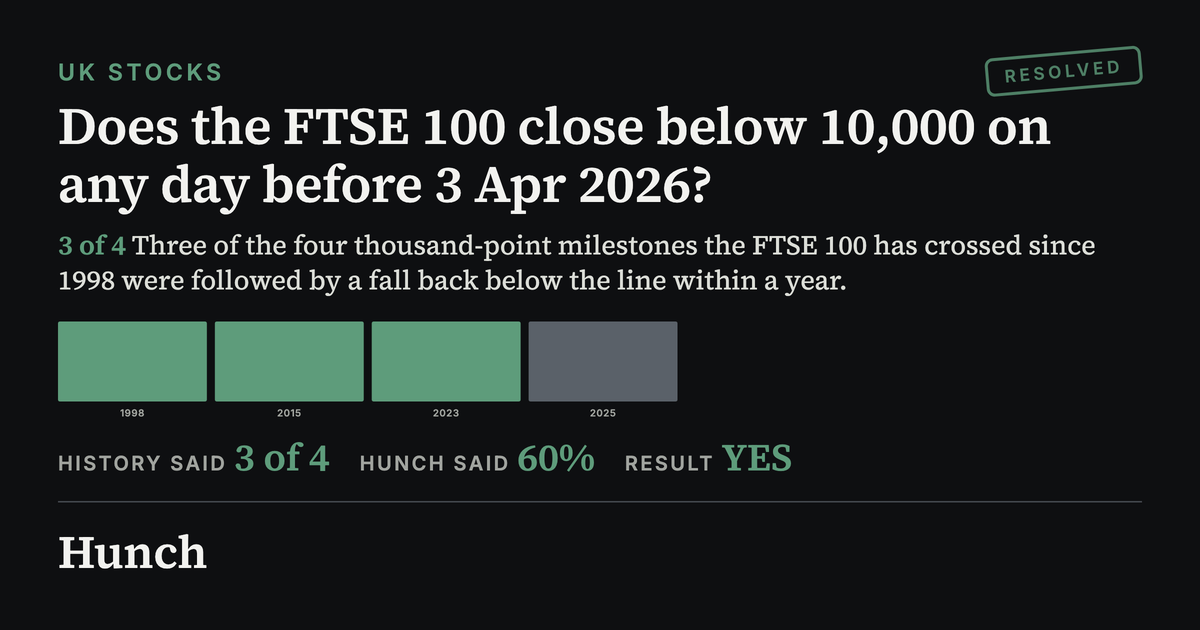
Three of four earlier milestones were lost within a year. We looked at each time since 1998 that the FTSE 100 first passed a new thousand-point level. We asked whether it closed back below that level within a year. Round numbers pull on markets. They bring selling to lock in gains, and they fill the headlines.
Show the other 2 cases
The Read
History points to a fall back below 10,000. Round numbers draw selling to lock in gains, and three of the four times the FTSE 100 passed one, it was back below within a year. This time the index climbed a thousand points in under six months. A run that fast leaves little room above the level when the next shock comes.
The doubt is that the one milestone that lasted is the most recent, 9,000 in 2025. What carried the index from 9,000 to 10,000 is still there. Rates on UK government bonds are falling, and London shares are cheap next to other markets. Many of the biggest companies also earn in dollars. The FTSE 250 near its own highs supports the rise, and four milestones is a small record.
The FTSE 100 does not track the UK economy. It follows the global earnings of big companies listed in London, and those earnings will decide whether 10,000 lasts.
Disclaimer
Hunch works only from sources that are publicly available, and publishes on the basis of analysis of that material. We do not form an editorial opinion or take sides, we give a simpler and wider view of news that already exists. If information in a source we used was inaccurate, distorted, or later disputed but had already entered our analysis, Hunch accepts no liability for that. Predictions are not advice. Phase 1 markets use Hunch Points, not money.
Published by Hunch under the Editorial Code. Complaints and corrections: /contact/.