G7 countries release emergency diesel. Will UK pump prices come down by 19 October?
The G7 will release 100 million barrels of oil and diesel over four months. UK diesel passed £2 a litre for the first time on 2 October.
What happened
On the G7 announced a release of 100 million barrels of oil and diesel from emergency stocks over four months, with a large diesel release in the first 20 days, after Donald Trump threatened to ban US diesel exports.
The G7 group of rich countries will release 100 million barrels of oil and diesel from emergency stocks. The release starts at once and runs for four months, with a large amount of diesel in the first 20 days. It is run through the International Energy Agency (IEA), the energy body of the main oil-importing countries.
The deal followed a threat from Donald Trump to ban US diesel exports unless Europe used its own stocks. After the deal he said a ban was “never really on the table”. G7 members also agreed not to limit energy exports to each other.
UK diesel passed £2 a litre at the pump for the first time on . Over half of the UK’s diesel is imported, and 31% of those imports come from the US. The government’s weekly average was 197.58p a litre on , up from 190.72p two weeks earlier.
The world oil price barely moved. Brent crude briefly fell below $100 a barrel after the news, but was back above $102 by the end of the day after new fighting between Saudi Arabia and the Houthis in Yemen. One analyst, quoted by the Guardian, said that anything short of more oil from the Middle East was “really just shuffling deck chairs”.
This is the second release in this crisis. In March the IEA agreed the largest release in its history, 400 million barrels, after the US and Israeli attacks on Iran. G7 leaders said they would discuss more diesel releases if needed.
Sources: BBC, The Guardian, GOV.UK, weekly road fuel prices
The Pattern
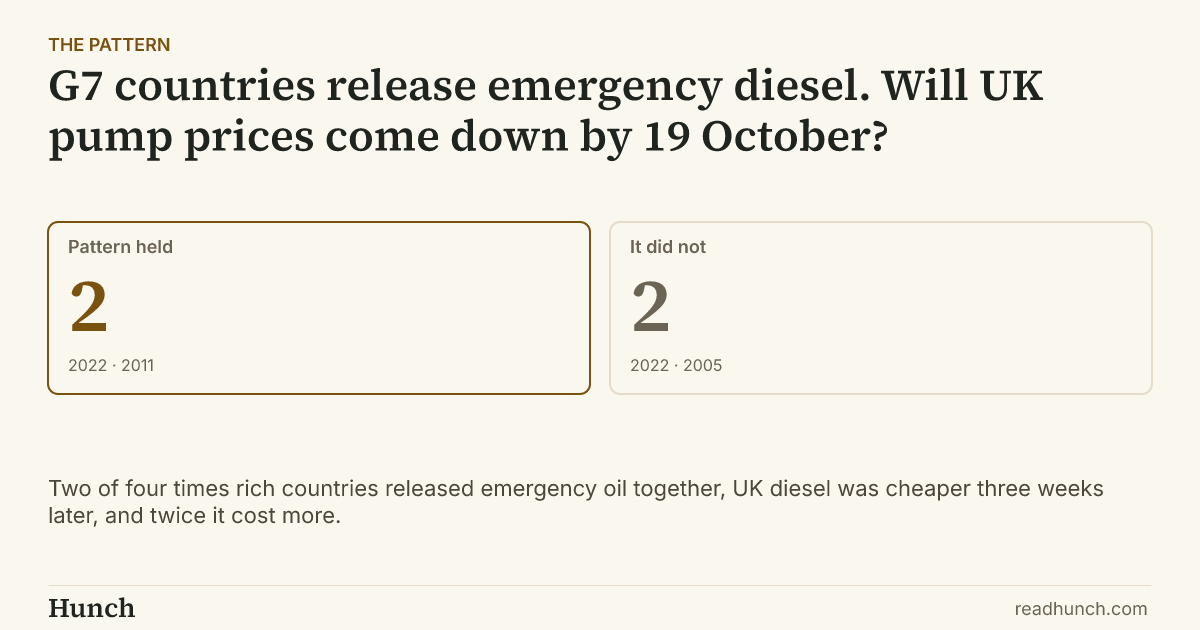
We looked for cases where the main oil-importing countries released emergency stocks together through the IEA, while the supply problem behind the price rise was still going on and UK diesel was at a record or close to one. We found four since 2003. In two, UK diesel was cheaper three weeks later. All four were decisions of the same agency, and two came in the same crisis in 2022.
Show the other 2 cases
The Read
History gives no clear answer on the pump price. In two of four past releases UK diesel was cheaper three weeks later, and the biggest fall was 1.65p a litre. When the price was still rising in the week of the release, as in 2005 and , it kept rising. When it had already started to fall back, as in 2011 and , it dipped a little. This time it was still rising: 190.72p, 195.53p and 197.58p in the last three weeks of September, and over £2 on .
The record is small. All four releases came from the same agency, two of them in one crisis, and none was mostly about diesel, as this one is. The government’s figures are weekly, so the test is three weeks rather than exactly 20 days. A weekly figure on below 197.58p, or a clear fall in oil prices, would point to cheaper diesel. Diesel staying above £2 would point the other way.
Disclaimer
Hunch works only from sources that are publicly available, and publishes on the basis of analysis of that material. We do not form an editorial opinion or take sides, we give a simpler and wider view of news that already exists. If information in a source we used was inaccurate, distorted, or later disputed but had already entered our analysis, Hunch accepts no liability for that. Predictions are not advice. Phase 1 markets use Hunch Points, not money.
Published by Hunch under the Editorial Code. Complaints and corrections: /contact/.