John Healey weighs a higher tax on gaming machines. Past Budgets spared the shops.
Chancellor John Healey is reported to be weighing a rise in the 20% tax on gaming machines in his first Budget on 28 October.
What happened
Chancellor John Healey is reported to be considering a higher tax on high-street gaming machines in his first Budget, and most of the betting industry is urging him not to double it.
John Healey may raise the tax on gaming machines in his first Budget on . The tax, machine games duty, takes 20% of what the machines earn and brought in about £610m last year. The Social Market Foundation, a think tank, wants it doubled to 40%. It says that would raise £275m to £460m more a year.
Prime Minister Andy Burnham has already acted against these venues. On he said the government would scrap the rule that makes councils approve most new betting shops. Venues open 24 hours with slot machines, called adult gaming centres, will also need planning permission from early 2027.
The Treasury is short of room. Healey has not ruled out tax rises, and Labour promised not to raise income tax, National Insurance or VAT. In March the official forecaster said the government would meet its rule against borrowing for day-to-day spending with £23.6bn to spare. Analysts at KPMG think it may now be about £12bn.
The industry is answering with numbers. A study by the accounting firm EY for the Betting and Gaming Council, the industry’s trade body, says a 40% rate could close up to 1,470 of 5,617 betting shops and cost 15,900 jobs. Betfred’s owner Fred Done says he would close about 495 of his shops.
Past warnings were bigger than what followed. Since 2019 Betfred has threatened to close nearly 1,000 shops, and its estate has shrunk by about 330. Adult gaming centres raised their takings from £528m to £613m last year, and one of them, Merkur, has offered to buy some of the shops Betfred put up for sale.
Sources: The Guardian, BBC, Prime Minister's Office
The Pattern
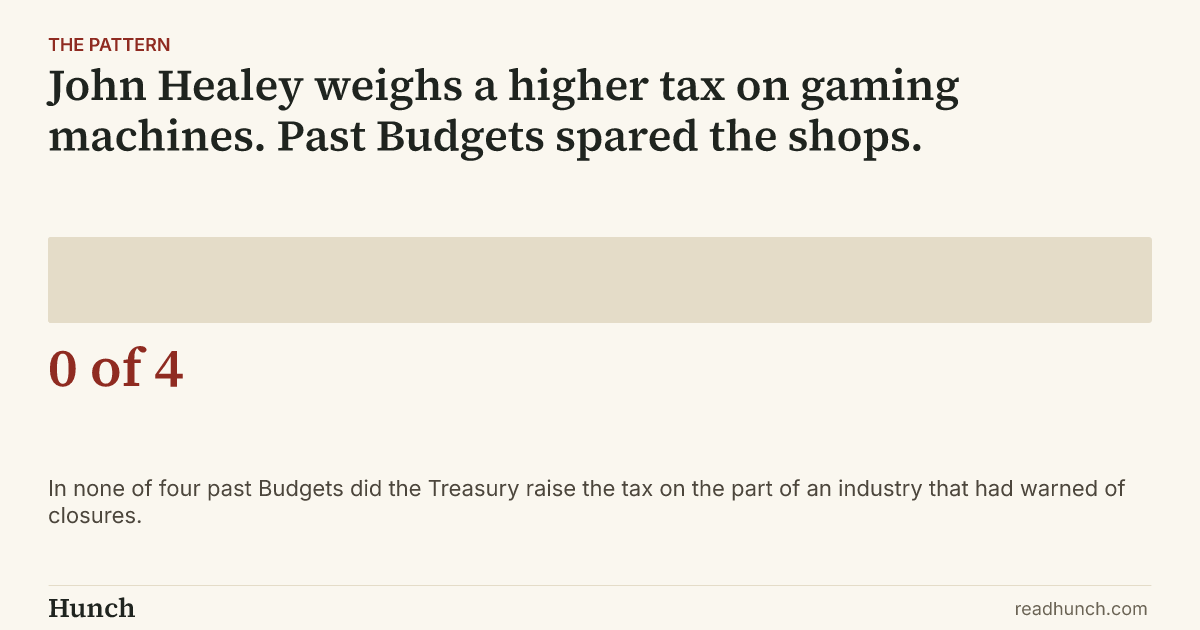
We looked for cases where the Treasury had to decide in a planned Budget whether to raise a tax on one industry. In each, the government had already acted against that industry, money was tight, and the industry had warned in public, with a number, of closures or lost jobs. We found four UK cases since 2013, two about beer and two about gambling.
Show the other 2 cases
The Read
History points away from a rise for the shops. In four Budgets since 2013 the Treasury heard warnings of closures and left that part of the industry alone, and twice it cut the tax there. Each time it raised money next door instead: wine and spirits in 2013, wine in 2014, online casinos in 2018 and online gambling in 2025. This time the proposal hits exactly the shops that are warning, the Prime Minister has already acted against slot machine venues, and the Treasury has less room than in March.
The record is thin. It has four cases, one Treasury and two about beer, and in none of them was a plan to tax shop machines openly discussed before the Budget. George Osborne did raise the tax on betting shop machines to 25% in 2014, but we left that Budget out because we found no public warning with a number before it. The usual nearby source is also used up: the online casino tax rose to 40% this April. A clear Treasury denial before would point to no rise; the Budget papers settle both questions that afternoon.
Disclaimer
Hunch works only from sources that are publicly available, and publishes on the basis of analysis of that material. We do not form an editorial opinion or take sides, we give a simpler and wider view of news that already exists. If information in a source we used was inaccurate, distorted, or later disputed but had already entered our analysis, Hunch accepts no liability for that. Predictions are not advice. Phase 1 markets use Hunch Points, not money.
Published by Hunch under the Editorial Code. Complaints and corrections: /contact/.