UK 30-year borrowing costs hit a 1998 high. Past spikes eased in about two months.
The yield on UK 30-year government bonds hit 5.78% in early May, the highest since 1998, then eased to about 5.45% by mid-June.
What happened
Gilt yields are climbing again as leadership uncertainty builds: the 30-year hit 5.54% and the 10-year 4.78% on , with markets pricing a change at Number 11 as much as Number 10.
On the UK’s 30-year borrowing cost hit 5.78%, its highest since 1998. This is the yield on 30-year gilts, the interest investors ask for lending to the government for 30 years. It rose by as much as 13 basis points that day. A basis point is one hundredth of a percentage point.
Investors expected the Bank of England to raise interest rates. They were also worried about the local election results and high energy prices. The 10-year yield went above 5.10%, and long-term government bonds fell around the world at the same time.
Since then the market has partly calmed. On the 30-year yield was 5.54% and the 10-year was 4.78%, pushed up a little by talk about the government’s future.
The damage to the public finances is already done. Since the Iran conflict began, higher interest costs on government debt have eaten into the room Chancellor Rachel Reeves had under her borrowing rules, which was just under £24bn.
The next month will show if the calm lasts. The Labour leadership contest will settle the change at the top that markets are pricing. The Bank of England’s decision on could confirm or end the fear of rate rises that started the May sell-off. And every sale of long-term gilts before August tests if investors will lend at rates no chancellor has paid since the late 1990s.
Sources: The Guardian, Bloomberg
The Pattern
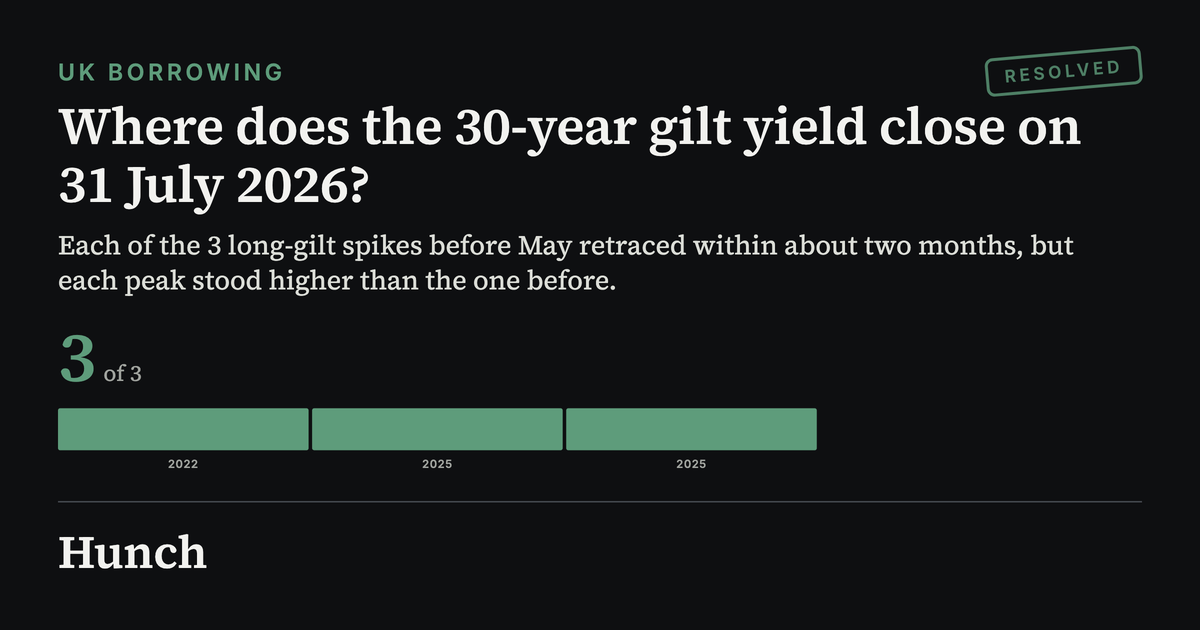
This is the fourth spike in four years. Each time, UK long-term borrowing costs jumped to their highest in decades after a scare about government finances or inflation. The three spikes before this one all eased within about two months. But each peak was higher than the one before, and the level they eased back to keeps rising.
Show the other 1 cases
The Read
History says the calm should last, with the 30-year yield ending July between 5.25% and 5.49%. The three spikes before this one all eased on time. Energy prices are below their highs from the conflict. The June PMI, a monthly survey of businesses, points to a weaker economy, which makes the rate rises feared in May less likely. A settled Labour leadership would also remove one worry.
The risks sit on two dates. If the Bank of England raises rates on , or its new forecasts support the two members who wanted a rise in June, the May sell-off could start again. If the new chancellor signals looser borrowing rules when the £24bn of room is already smaller, long-term investors will want to be paid more for the risk.
The record is also short, three earlier spikes, and each peak was higher than the last. So even when yields ease, they settle at a higher level. That is why the market gives a fall below 5.25% only 12%.
Disclaimer
Hunch works only from sources that are publicly available, and publishes on the basis of analysis of that material. We do not form an editorial opinion or take sides, we give a simpler and wider view of news that already exists. If information in a source we used was inaccurate, distorted, or later disputed but had already entered our analysis, Hunch accepts no liability for that. Predictions are not advice. Phase 1 markets use Hunch Points, not money.
Published by Hunch under the Editorial Code. Complaints and corrections: /contact/.