Gold falls below $4,000. Past big falls led to a new record, or years of decline.
Gold fell below $4,000 an ounce on 24 June for the first time since November 2025. That is nearly 30% below January's record of $5,589.
What happened
Gold fell below $4,000 an ounce for the first time since , extending a slide driven by a hawkish Fed, a stronger dollar and fading war risk.
Gold fell below $4,000 an ounce on , for the first time since . The slide began earlier that week, when investors sold tech shares and then sold gold to raise cash. Gold set its record of $5,589 on , so the June low is nearly 30% below the peak.
Three things pushed the price down. First, the US central bank, the Federal Reserve, now led by Kevin Warsh, kept interest rates at 3.50-3.75% on . But nine of its nineteen officials expect a rise by the end of the year, and traders put the chance of a December rise at about 80%.
The dollar also rose almost 1% in a week, which makes gold more expensive for buyers who pay in other currencies. And the US and Iran eased tensions, with ships moving through the Strait of Hormuz again. That removed the fear that had supported the price since February.
The fall below $4,000 did not hold cleanly. Bank forecasters spent the final week of June cutting their targets for 2026.
The Pattern
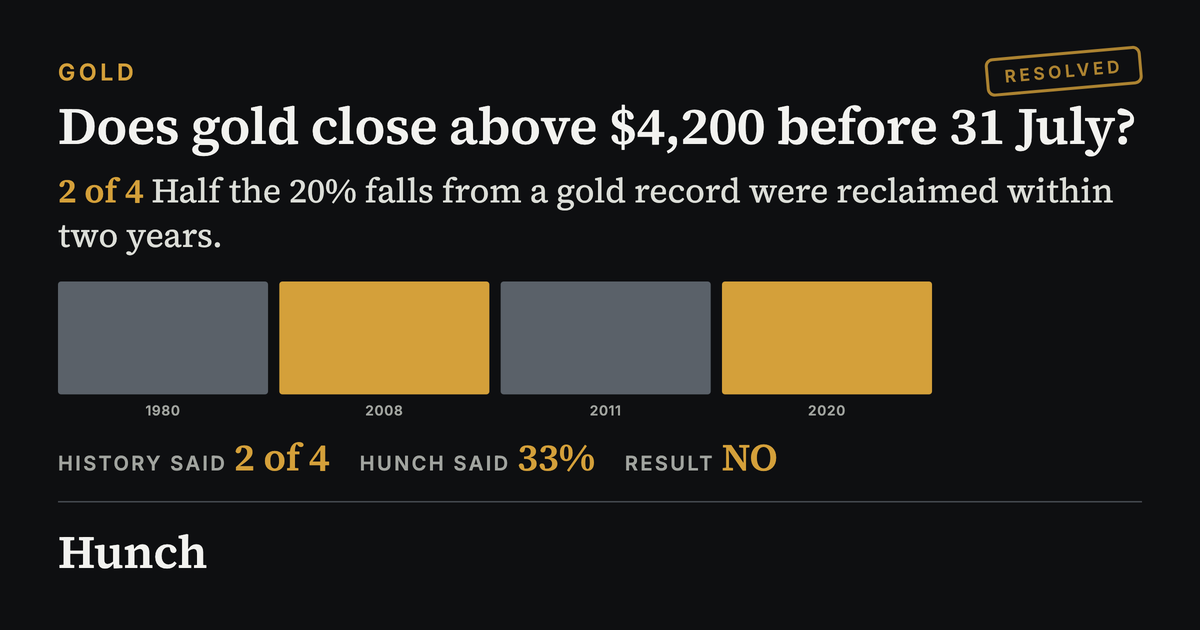
Gold has fallen 20% or more from a record four times in modern history. The results split evenly. Twice gold set a new record within about two years. Twice the peak was followed by a long slump that lasted most of a decade or more.
Show the other 2 cases
The Read
History gives no clear answer, and today’s news does not point to a quick bounce. Everything that pushed the price down is still there. The Federal Reserve points to higher rates, traders see about an 80% chance of a December rise, and the dollar is strong. Tensions in the Gulf keep easing. Rising real interest rates, meaning rates after inflation, are usually the biggest problem for gold. That is why only a third of the market expects gold back above $4,200 this month, and most expect it between $3,800 and $4,200.
The case for a rebound rests on what has not changed. Central banks keep buying gold, and that buying carried the price from $3,300 to $5,589 in a year. It does not depend on the Federal Reserve. In 2008 and 2020 gold recovered quickly after its peak. Gold also closed back above $4,014 on , within a week of the fall, and in the past such failed falls have marked the low.
The record is small and split. The two long slumps, after 1980 and 2011, began just like this one, with interest rates rising after a buying frenzy. A soft US inflation figure or bad news from the Gulf could quickly test $4,200.
Disclaimer
Hunch works only from sources that are publicly available, and publishes on the basis of analysis of that material. We do not form an editorial opinion or take sides, we give a simpler and wider view of news that already exists. If information in a source we used was inaccurate, distorted, or later disputed but had already entered our analysis, Hunch accepts no liability for that. Predictions are not advice. Phase 1 markets use Hunch Points, not money.
Published by Hunch under the Editorial Code. Complaints and corrections: /contact/.