Bank of England warns on prices. Core inflation often rose after such warnings.
Governor Andrew Bailey told MPs on 8 September that energy could push prices higher still. The August inflation figures come out on 16 September.
A warning eight days before the number
Giving evidence to the Commons Treasury Committee on , the governor of the Bank of England warned that war and weather threaten another burst of UK inflation, saying the risks are on the upside and that energy prices could rise further.
Andrew Bailey, governor of the Bank of England, told the Treasury Committee of MPs on that the risks to inflation point upwards. He said energy is the main risk, and that prices that are already high could go higher still.
Bailey also said the Bank is not following a fixed plan towards higher interest rates. He wanted to end the idea that it knew where it was going. The Financial Times summed up the session as a warning that war and weather threaten another burst of UK inflation.
The detailed figures do not yet show what he described. Prices rose 2.9 per cent in the year to July. But core inflation, which leaves out energy, food, alcohol and tobacco, stayed at 2.6 per cent in May, June and July. Food and soft drink inflation, the weather part of the warning, has fallen every month since March and was 1.3 per cent in July.
The test comes eight days after the warning. The ONS, the UK statistics office, publishes the August figures at 7am on . The next day the Bank’s Monetary Policy Committee, which sets interest rates, announces its decision. Bank Rate is the Bank’s main interest rate.
On the Committee kept Bank Rate at 3.75 per cent by six votes to three, with the three wanting 4 per cent. It said prices were expected to rise later in the year as energy costs passed through.
Sources: Financial Times, Independent, ONS series DKO8 (2, 3), Bank of England
The Pattern
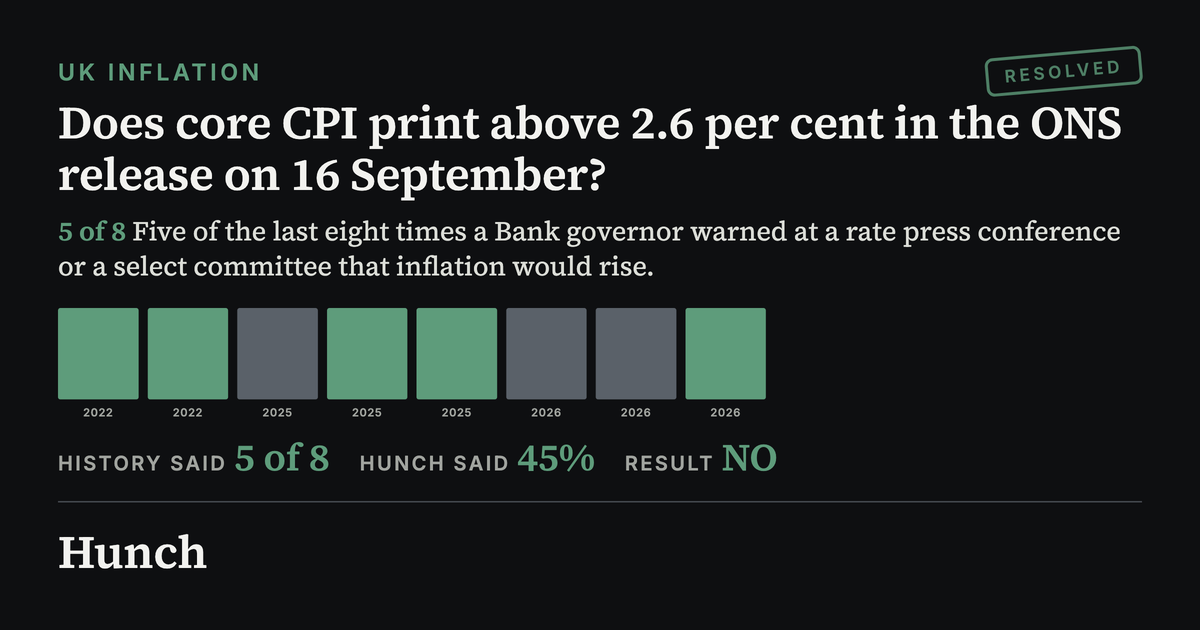
We found nine such warnings since . Each time the governor of the Bank of England said UK inflation would rise, or that the risks pointed up, at the press conference after a rate decision or in evidence to the Treasury Committee. For each one we checked the next official inflation figures. Did core inflation, which leaves out energy and food, go up? The last eight are shown here.
Show the other 6 cases
The Read
History says a governor’s warning often means something. After five of the last eight, core inflation rose in the next figures, and after six of all nine. But the market starts lower, at 45 per cent, because the three misses are the three most recent, all from this energy shock. Core has stayed at 2.6 per cent for three months, and the pressure Bailey described on is in energy, which core leaves out.
The case for a rise is that core is built to catch rises that spread from energy to other prices. At the same hearing, one of the Bank’s outside members argued that waiting for clear proof of this would mean waiting too long. A rise in core on would give the three members who wanted higher rates in July their argument the day before they vote.
The August figures decide it. If prices of services and goods do not follow energy upwards, the warning will not show in core. The question falls away if the ONS delays the release or the decision is moved earlier.
Disclaimer
Hunch works only from sources that are publicly available, and publishes on the basis of analysis of that material. We do not form an editorial opinion or take sides, we give a simpler and wider view of news that already exists. If information in a source we used was inaccurate, distorted, or later disputed but had already entered our analysis, Hunch accepts no liability for that. Predictions are not advice. Phase 1 markets use Hunch Points, not money.
Published by Hunch under the Editorial Code. Complaints and corrections: /contact/.