Will zero VAT on UK heat pumps and solar panels run past March? Most such cuts did.
From 1 April 2027, VAT on fitting heat pumps and solar panels in UK homes goes back from 0% to 5%. Industry groups want it to stay at zero.
What happened
Heat pump and solar groups and the Liberal Democrats ask the government to keep zero VAT on home installs after .
Since 2022, fitting energy-saving products at home has had no VAT. This covers heat pumps and solar panels, among other products, and in Northern Ireland the zero rate began in . HMRC, the UK tax office, says the zero rate runs to , and from the rate goes back to 5%.
The Budget of kept that end date. Its list of tax changes says the rate “will revert to 5 per cent from ”, as planned in 2022, and adds heat batteries to the relief from the same day. The same Budget, from Chancellor John Healey, kept 0% VAT on household electricity until and started Warm Homes loans to help families pay for solar panels and heat pumps.
The Budget also moved money from green heating to defence. The energy department lost more than £3bn, including £741m from the Boiler Upgrade Scheme, which gives grants for heat pumps. In 2022 the government expected the zero rate to cost up to £65m a year in lost tax.
On heat pump and solar groups asked for a change of course. Charlotte Lee, who leads the Heat Pump Association, warned of “a rush of applications ahead of April”. Chris Hewett of Solar Energy UK said: “We will be urging the government to reverse course”. The Liberal Democrats say a home that adds a heat pump and solar panels with a battery could pay up to £1,530 more.
The government has said nothing new about the rate. A spokesperson for the energy department pointed to record heat pump applications and the new loans, and did not mention VAT.
From onwards, supplies of installations of energy-saving materials will revert to the reduced rate of VAT of 5%.
HMRC, VAT Notice 708/6
Sources: The Guardian (2), GOV.UK (2, 3, 4)
The Pattern
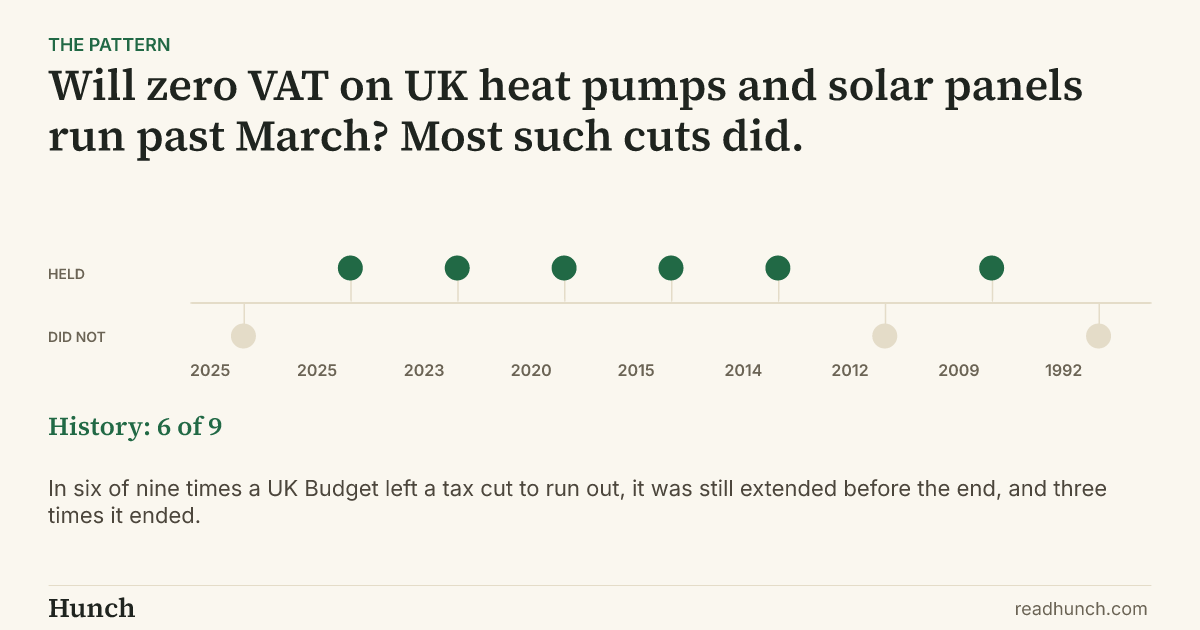
We looked for cases where a UK Budget or autumn statement let a temporary tax cut run to its end date, 60 days or more away, while cutting spending elsewhere. We found fourteen from 1992 to 2025. We left out five: in three the trade spoke about the end date without warning of a rush, and in two the opposition spoke about it without asking to keep the cut. Four of the nine left were stamp duty cuts for home buyers. (Hansard; GOV.UK; GOV.UK; BBC)
Show the other 7 cases
The Read
Six of the nine past tax cuts were extended, and none of those came sooner than 104 days after the Budget that left the end date. Here that would be . Five of the six came in the next full Budget, each time in spring, and the fuel duty cut that also ended in late March was extended in a March Budget, 8 days before the end. Three of the six kept the same or a higher level for at least 12 more months.
There are reasons for doubt. Each time it was the same Treasury deciding. All five Budget extensions came in spring, but since 2024 the government has promised “one major fiscal event a year”, and in spring 2026 it gave only a statement to Parliament. This time the Budget papers also wrote the 5% date down again. In 2011 the autumn statement did the same for the first-home stamp duty cut, and that cut ended. Only one of the four stamp duty cuts for home buyers was extended.
Sources: GOV.UK (2, 3, 4, 5, 6, 7), GOV.UK (2), The Guardian (2), BBC
Disclaimer
Hunch works only from sources that are publicly available, and publishes on the basis of analysis of that material. We do not form an editorial opinion or take sides, we give a simpler and wider view of news that already exists. If information in a source we used was inaccurate, distorted, or later disputed but had already entered our analysis, Hunch accepts no liability for that. Predictions are not advice. Phase 1 markets use Hunch Points, not money.
Published by Hunch under the Editorial Code. Complaints and corrections: /contact/.