UK house prices pick up speed. In past years, such June gains lasted half the time.
Nationwide says UK house prices grew 2.2% in the year to June, the strongest since spring. The Bank of England decides on interest rates on 30 July.
What happened
Annual house price growth edged up to 2.2% in June from 1.7% in May, with the average home at £278,784 and prices broadly flat on the month.
UK house prices are growing faster again. Nationwide’s June index put yearly growth at 2.2%, up from 1.7% in May. Once normal seasonal changes are taken out, prices were about flat from May to June.
Interest rates will decide what happens next. The Bank of England kept its main rate at 3.75% on by seven votes to two. The two members who disagreed, Megan Greene and Huw Pill, wanted a rise, not a cut. Inflation was 2.8% in May, and energy prices were still moving a lot after events in the Middle East.
The Bank decides again on , when it also publishes its full Monetary Policy Report. A signal of higher rates would quickly push up the cost of fixed-rate mortgages.
Halifax’s index, a rival measure, shows a cooler market, with 0.5% yearly growth in May and an average home at £298,806. The next five weeks will show if June was a turn or a one-off. Halifax’s June figure, the Bank’s decision and Nationwide’s July figure all come out in that time.
Sources: Nationwide, Bank of England
The Pattern
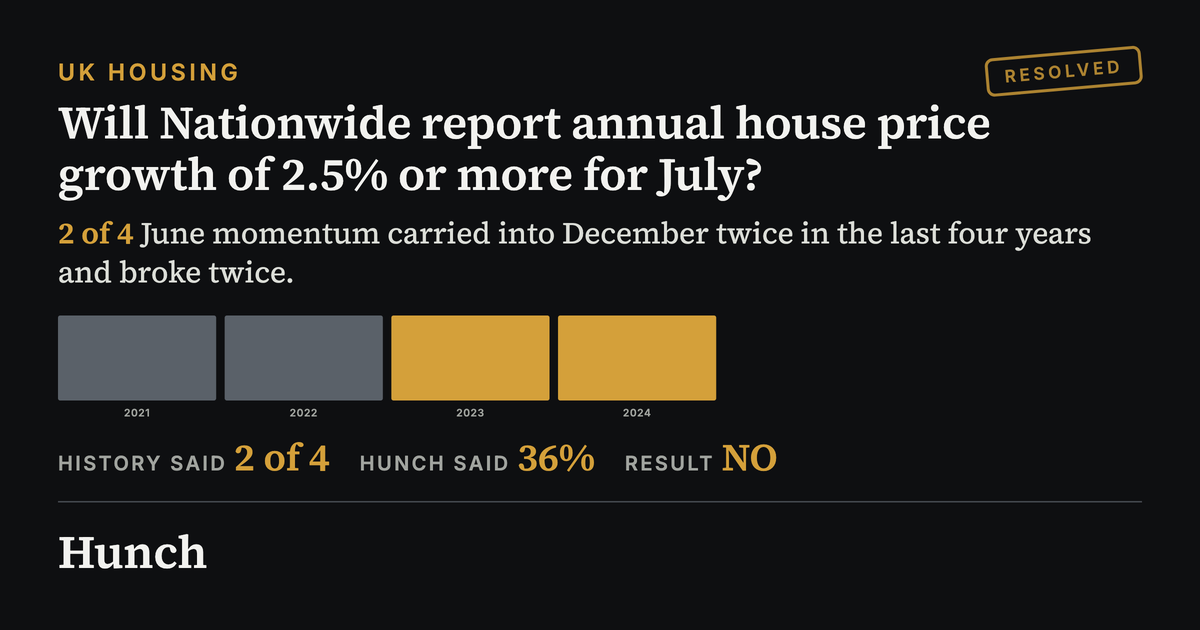
Nationwide’s own figures for the last four years split evenly. We asked whether faster house price growth in June carried on into the second half of the year, comparing each June’s yearly rate with December’s. Twice growth was faster by December, and twice it was slower.
Show the other 2 cases
The Read
The case for the rise lasting starts with June itself. Prices sped up even though mortgage rates were above their lows from the start of the year, which suggests real demand rather than cheaper loans. Wages are still rising faster than prices. The 2024 example shows how quickly yearly growth looks better once weak months drop out of the comparison. A hold at 3.75% with softer words from the Bank would let lenders keep cutting fixed rates into the autumn.
The case against is just as strong. Two members of the Bank’s committee want higher rates, and inflation at 2.8% supports them. Prices were flat from May to June, so the yearly rise comes partly from the maths of the comparison with last year. Halifax’s 0.5% shows how little the two indices agree.
In each of the four years, what happened to mortgage rates in the second half decided the result. So matters most. If the Bank signals higher rates, or raises them, mortgage prices will move within weeks, as they did on a much larger scale in 2022, and 2.5% growth in the July figure becomes hard to reach.
Disclaimer
Hunch works only from sources that are publicly available, and publishes on the basis of analysis of that material. We do not form an editorial opinion or take sides, we give a simpler and wider view of news that already exists. If information in a source we used was inaccurate, distorted, or later disputed but had already entered our analysis, Hunch accepts no liability for that. Predictions are not advice. Phase 1 markets use Hunch Points, not money.
Published by Hunch under the Editorial Code. Complaints and corrections: /contact/.