Ineos halts its Hull plants over gas costs. Will UK help come before the Budget?
Sir Jim Ratcliffe's chemicals group Ineos is stopping its three plants near Hull. It says gas in the UK costs 12 times as much as in the US.
What happened
Ineos Acetyls said on that it is pausing production at its three plants at Saltend, near Hull, because UK gas prices are 12 times the US level, and that the move affects up to 1,000 staff.
Ineos is stopping its three chemical plants at Saltend, near Hull. Two were switched off on and the third will follow in the coming days. The company, Ineos Acetyls, said gas in the UK costs 12 times as much as in the US, and eight times as much as the coal its Chinese rivals use. Up to 1,000 staff are affected, 245 of them working on the site.
The plants make acetic acid, acetic anhydride and ethyl acetate, and Ineos says it is the only European producer of some of them. The BBC reported that workers will be kept on while the company tries to buy liquefied gas straight from the US, which could take up to a year, or waits for prices to fall.
Ineos’s Sir Jim Ratcliffe called the government’s energy policy “economic vandalism on an industrial scale”.
The government answered on the day by pointing to help that already exists. A spokesperson for the Department for Business, Innovation, Science and Trade named £350m for important chemicals producers, paid only if the companies invest as well, and two schemes that cut electricity costs for heavy industry.
The government says further action on bills will come at the Budget. It said this in July, when it cut VAT on household electricity. Chancellor John Healey presents the Budget on . Since July, wholesale gas prices in the UK have almost doubled, after the war in Iran disrupted supply through the Strait of Hormuz.
The Pattern
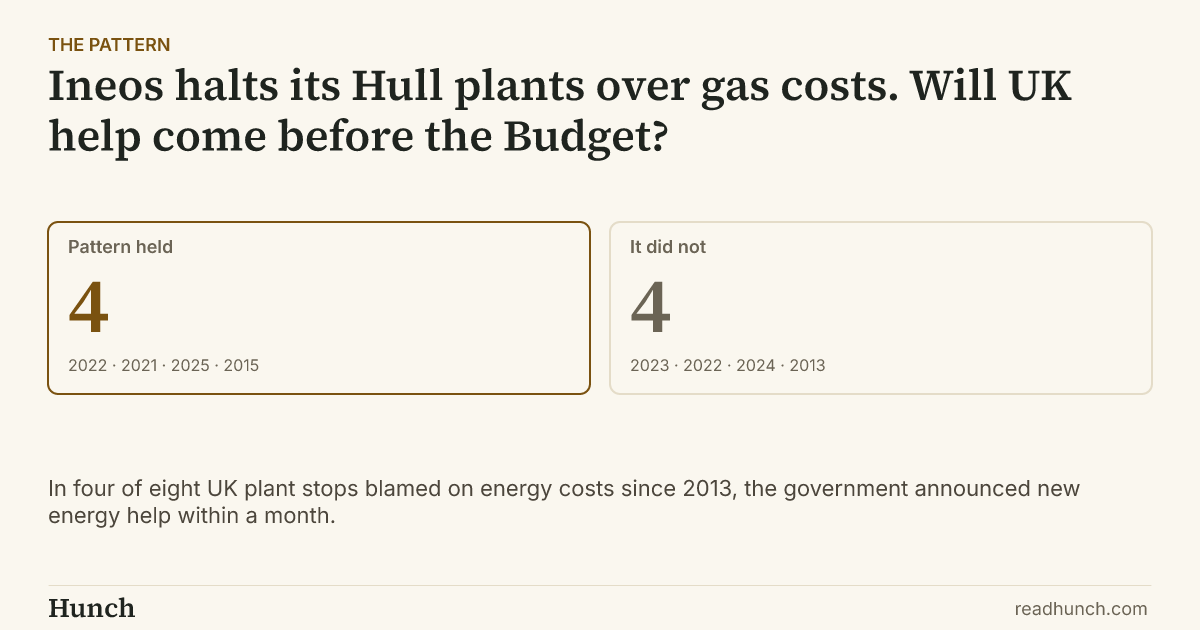
We found eight similar UK shutdowns since 2013. In each, a large factory that uses a lot of energy paused, mothballed or closed, and blamed energy costs. We checked whether the government announced new help with energy costs within 31 days, for that plant, for heavy industry or for all businesses. It did four times. Two of those four were help for every business in 2022, and a plan first promised five months earlier in 2025.
Show the other 6 cases
The Read
The record splits evenly at one month. The four quick answers were an emergency deal over carbon dioxide for the food industry in 2021, payments to heavy industry already being agreed with Brussels in 2015, help for every business during the 2022 price shock, and a plan the government had promised months before in 2025. In each, the help was ready or waiting looked costly for the government. The four slow cases waited between 42 and 410 days, and the two slowest waited for a Budget or a new government.
Two things point to waiting this time. The department answered Ineos by listing help that already exists, and the government has said further action on energy costs will come at the Budget on . That is why the market to sits below the record, and the one to takes in the Budget. Against that, gas has almost doubled since July, and the new Prime Minister has already cut tax on household electricity. A deal for one plant can also be made outside the Budget, as with CF Fertilisers in 2021.
The record has limits. The cases mix short pauses with permanent closures, and closures are harder to reverse. They cover four prime ministers, and before 2021 any help also needed approval from the EU, which no longer applies.
Disclaimer
Hunch works only from sources that are publicly available, and publishes on the basis of analysis of that material. We do not form an editorial opinion or take sides, we give a simpler and wider view of news that already exists. If information in a source we used was inaccurate, distorted, or later disputed but had already entered our analysis, Hunch accepts no liability for that. Predictions are not advice. Phase 1 markets use Hunch Points, not money.
Published by Hunch under the Editorial Code. Complaints and corrections: /contact/.