UK inflation stops falling. After past energy shocks, it rarely climbed again.
UK inflation held at 2.8% in May, with transport prices rising fastest since 2022. The June figure, due 22 July, shows if the energy shock is over.
What happened
CPI rose 2.8% in the 12 months to , unchanged from April, as surging transport costs offset falling food prices.
UK prices rose 2.8% in the 12 months to May, the same rate as in April, the Office for National Statistics (ONS) said on . Two forces cancelled each other out. Transport prices rose 6.8% in a year, the fastest since , while food and soft drinks pulled the rate down most. The wider CPIH measure, which adds housing costs, stayed at 3.0%.
Inflation had been falling back. It reached 3.3% in March, after energy prices jumped following the conflict between Iran and the US. It then fell to 2.8% in April, when a lower Ofgem price cap, the regulator’s limit on household energy bills, and a pause in charges for renewable energy cut bills. May’s figure means the fall has paused, and prices for services are still rising fast.
The June figure, due at 7am on , is the first real test. The Bank of England expects prices could rise later this year as earlier energy increases feed through. The June figure will show whether 2.8% was the low point or only a pause, and it comes out eight days before the Bank’s interest rate decision on .
The Pattern
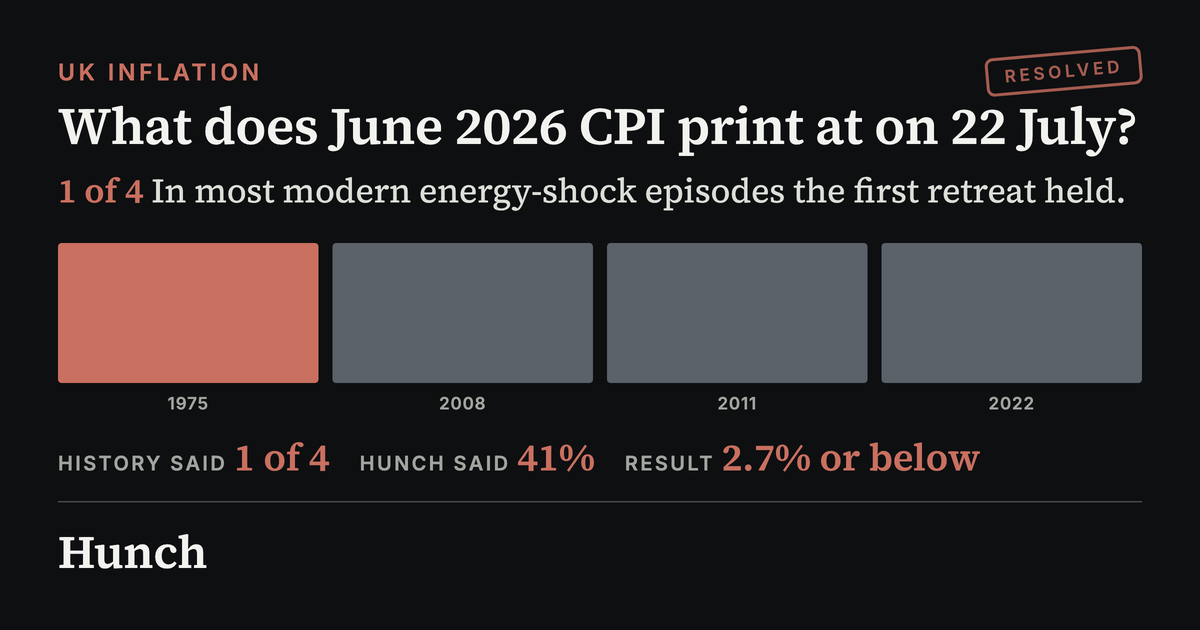
The UK has had four big energy price shocks in modern times. Each time inflation fell back, and the same question came next as now: does the fall last, or does a second rise build? Usually the fall lasted. The one exception, 1975, was very large.
Show the other 2 cases
The Read
History says the fall should last. In three of the four energy shocks, inflation did not climb again after it first fell. The economy is shrinking on the June PMI, a monthly survey of businesses, and food prices are still falling. A cooling jobs market usually brings inflation down. The 1975 second rise needed pay rises linked automatically to prices, which Britain no longer has.
The short-term signs point the other way. The Bank of England expects earlier energy increases to keep feeding through, transport prices are rising faster, and services prices jumped in the May data. April’s cut in energy bills will drop out of the yearly comparison in the coming months, and little except food pulls prices down. That is why the market gives 41% to a June figure of 2.9 to 3.1%. The record is also small, only four shocks.
The June figure on settles it. At 2.8% or below, the case for higher interest rates weakens eight days before the Bank’s decision.
Disclaimer
Hunch works only from sources that are publicly available, and publishes on the basis of analysis of that material. We do not form an editorial opinion or take sides, we give a simpler and wider view of news that already exists. If information in a source we used was inaccurate, distorted, or later disputed but had already entered our analysis, Hunch accepts no liability for that. Predictions are not advice. Phase 1 markets use Hunch Points, not money.
Published by Hunch under the Editorial Code. Complaints and corrections: /contact/.