Italy's budget would tax rich people who move abroad. It must pass by 31 December.
Italy's budget plan taxes people who leave the country with €800,000 or more in investments. A party in Giorgia Meloni's government wants changes.
What happened
Italy’s budget plan taxes the gains of wealthy people who move abroad, and Forza Italia, a party in the government, wants changes.
Italy’s budget plan for 2027 has a new tax on people who move abroad. Article 17 taxes at 26% the growth in value of shares and other investments, even if they are not sold. It applies to people with at least €800,000 in such assets who lived in Italy for six of the last ten years, and they must pay within 180 days of leaving. People who move to another EU country can pay later, but only if they pay half at once and give a guarantee.
The tax brings little money. The government expects €3.37m in 2027, in a budget worth more than €26bn. Former prime minister Matteo Renzi, now a senator, wrote that Meloni is destroying ten years of work to attract investment.
On Stefania Craxi, who leads the Forza Italia senators, asked for three changes. Her party is part of Prime Minister Giorgia Meloni’s government and says it shares the idea of the tax. She wants it to cover only gains made while living in Italy, and to keep the promise made to rich newcomers who chose Italy’s flat tax on foreign income. People moving within the EU should delay all of it with no half paid at once and no guarantee, or the rule may not stand at the EU Court of Justice, she said.
The government says it can change the details. On deputy economy minister Maurizio Leo said he was open to “aggiustamenti” and “semplificazioni”, adjustments and simplifications. On la Repubblica reported that the government is studying a change that would raise the starting level, so that only millionaires pay, and protect rich foreigners on the special flat tax. No one in the government has said the tax will be dropped.
Parliament must pass the budget by . If it does not, Italy runs on a temporary budget, which needs its own law and lasts at most four months. The government approved the plan eight days after the legal date of , and it reached the Chamber of Deputies on . Changes from the parties are expected by . If nothing changes, the tax becomes law with the budget.
La legge di bilancio va approvata entro il 31 dicembre di ogni anno, altrimenti scatta l’esercizio provvisorio.
ANSA, 29 October 2026, in Italian
Sources: la Repubblica (2, 3), ANSA (2, 3), Chamber of Deputies of Italy, Constitute Project
The Pattern
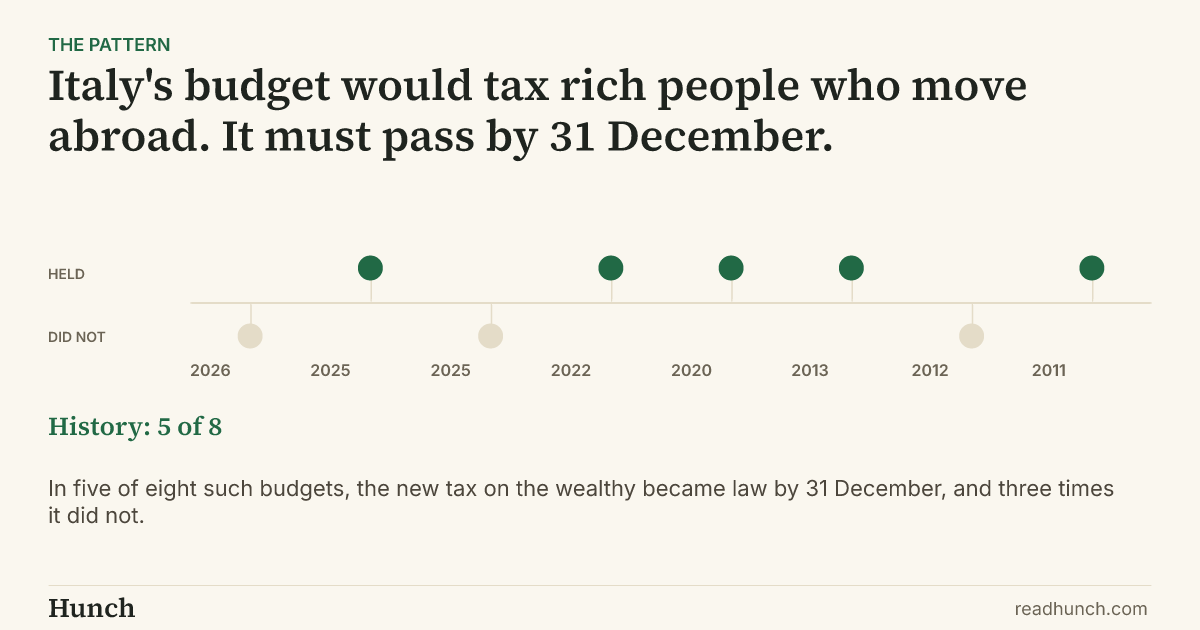
We looked for cases where a government put a new tax that only wealthy people pay into its yearly budget plan, and parliament had to pass the budget by . We found eight such budgets, for the years 2012 to 2026, in France, Italy and Spain. Four of them were French, and two were Italian. (Senate of France; Normattiva; Boletín Oficial del Estado)
Show the other 6 cases
The Read
Five of the eight past taxes became law by , and no government or parliament dropped one. The only removal came from France’s Constitutional Council, which checks laws before they come out. The two that came late were in budgets that were late as a whole: in France in 2024 the government fell, and the budget for 2026 passed without a vote in . Both Italian budgets, in 2013 and 2025, passed in time, and Meloni’s coalition holds a majority in both houses of parliament.
There are reasons for doubt. None of the eight was a tax on leaving the country, and in none did anyone argue that it broke EU law. Four of the eight were French, and two came from the same Spanish government. This time the government said before any vote that it is open to changes, while every past tax that made the deadline came out as planned or stronger. The plan also reached parliament late, 62 days before , and only Spain’s budget for 2021 passed faster, in 61 days.
Sources: Constitutional Council of France, The Guardian (2), Senate of France, ANSA, la Repubblica, Chamber of Deputies of Italy, Boletín Oficial del Estado
Disclaimer
Hunch works only from sources that are publicly available, and publishes on the basis of analysis of that material. We do not form an editorial opinion or take sides, we give a simpler and wider view of news that already exists. If information in a source we used was inaccurate, distorted, or later disputed but had already entered our analysis, Hunch accepts no liability for that. Predictions are not advice. Phase 1 markets use Hunch Points, not money.
Published by Hunch under the Editorial Code. Complaints and corrections: /contact/.