US hiring slows sharply. Past weak months were more often a blip than a recession.
US employers added just 57,000 jobs in June. Unemployment fell to 4.2% only because fewer people looked for work, the lowest share since March 2021.
What happened
June payrolls rose just 57,000 against a 115,000 consensus, and unemployment fell to 4.2% only because labour-force participation dropped to its lowest since .
US employers added only 57,000 jobs in June, the Bureau of Labor Statistics said on . Economists polled by Dow Jones had expected 115,000. May’s figure was cut to 129,000. Together, the changes to April and May removed 74,000 jobs, so over the past year the economy added only 36,000 jobs a month on average.
Unemployment fell to 4.2%, but for a bad reason. Fewer people were working or looking for work. That share, the participation rate, fell 0.3 percentage points to 61.5%, the lowest since .
The gains were uneven. Health care added 22,000 jobs, 9,000 of them in hospitals, while leisure and hospitality lost 61,000 as seasonal hiring was weaker than usual. Average pay rose a steady 0.3% in the month to $37.64 an hour.
Markets read the weak figure as a reason for the US central bank, the Federal Reserve, to hold back. The July report, due on , will show whether June was a stumble or a turn.
The Pattern
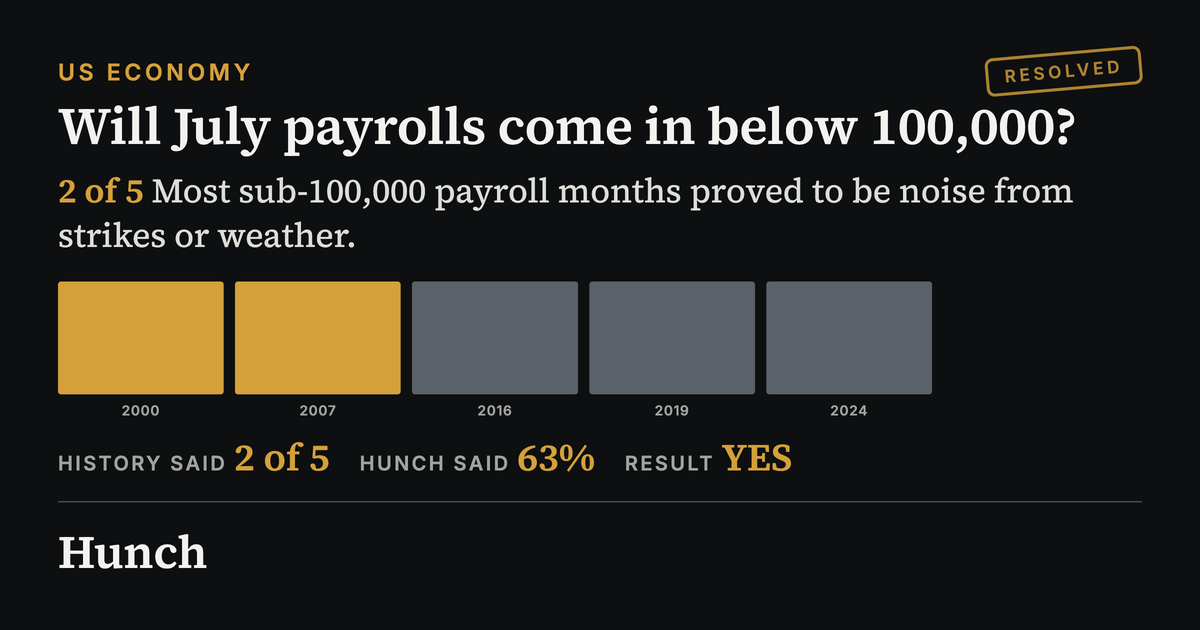
We found five times since 2000 when US hiring fell below 100,000 in a month while the economy was still growing. Twice it was the first sign of a recession within a year. Three times it was noise from strikes, weather or later corrections to the figures, and hiring came back.
Show the other 3 cases
The Read
History leans towards noise. In three of the five cases the weak month was a scare, and hiring came back within a month. Pay still rose 0.3%, layoffs are not rising in the claims data, and the loss of 61,000 leisure and hospitality jobs looks like a seasonal quirk that could reverse in July. If it does, payrolls near 150,000 would quickly bring back talk of a Fed rate rise.
This time looks different in two ways. June’s weakness was broad, with no hurricane or big strike behind it, and the figures have been cut for three months in a row, which in past cycles marked real cooling. Unemployment also fell because people left the job market, a classic sign that a period of growth is ending. That is why the market sees another month below 100,000 as more likely than not.
The record is small, only five cases. The July report on will show which way this one goes.
Disclaimer
Hunch works only from sources that are publicly available, and publishes on the basis of analysis of that material. We do not form an editorial opinion or take sides, we give a simpler and wider view of news that already exists. If information in a source we used was inaccurate, distorted, or later disputed but had already entered our analysis, Hunch accepts no liability for that. Predictions are not advice. Phase 1 markets use Hunch Points, not money.
Published by Hunch under the Editorial Code. Complaints and corrections: /contact/.