UK borrowed more than forecast in July. Such misses usually led to tax rises.
Self-assessment tax receipts hit a July record. The government still borrowed £1.8bn in a month the official forecaster expected to end in surplus.
What happened
The government ran an unexpected £1.8bn deficit in July, a month City economists had pencilled in as balanced, as spending growth outran record self-assessment receipts and John Healey prepared his first Budget for .
The UK government borrowed £1.8bn in July, a month that usually looks good for the public finances. Self-assessment income tax, which people calculate and pay themselves, brought in £17.1bn. That was £1.7bn more than in and the highest July figure since monthly records began in 1999. But spending grew faster still.
City economists had expected the month to balance. The Office for Budget Responsibility (OBR), the official forecaster, expected a £0.5bn surplus in its March forecast. That leaves July £2.3bn worse than forecast for the month alone.
From April to July the government borrowed £56.7bn in total. That is £6bn less than at the same point last year, thanks to stronger tax income, but £2.3bn more than the OBR expected. Government debt stands at about £2,984.9bn, or 94.1% of GDP, the size of the whole economy.
The interest rate on 10-year government bonds has stayed above 5%, as energy-driven inflation keeps borrowing costs high.
The Budget is on . At the March statement the government had £23.6bn of room under its borrowing rules. Higher interest rates, slower growth and inflation are expected to have eaten a large share of it by Budget day. Martin Beck of WPI Strategy noted that higher bond yields add to the interest bill only slowly, and in one direction.
So far the chancellor, John Healey, has answered with words, promising careful spending and help with household costs. The numbers for his first Budget arrive in two steps: the August borrowing figures on , and the OBR’s verdict on .
Sources: The Guardian, ONS
The Pattern
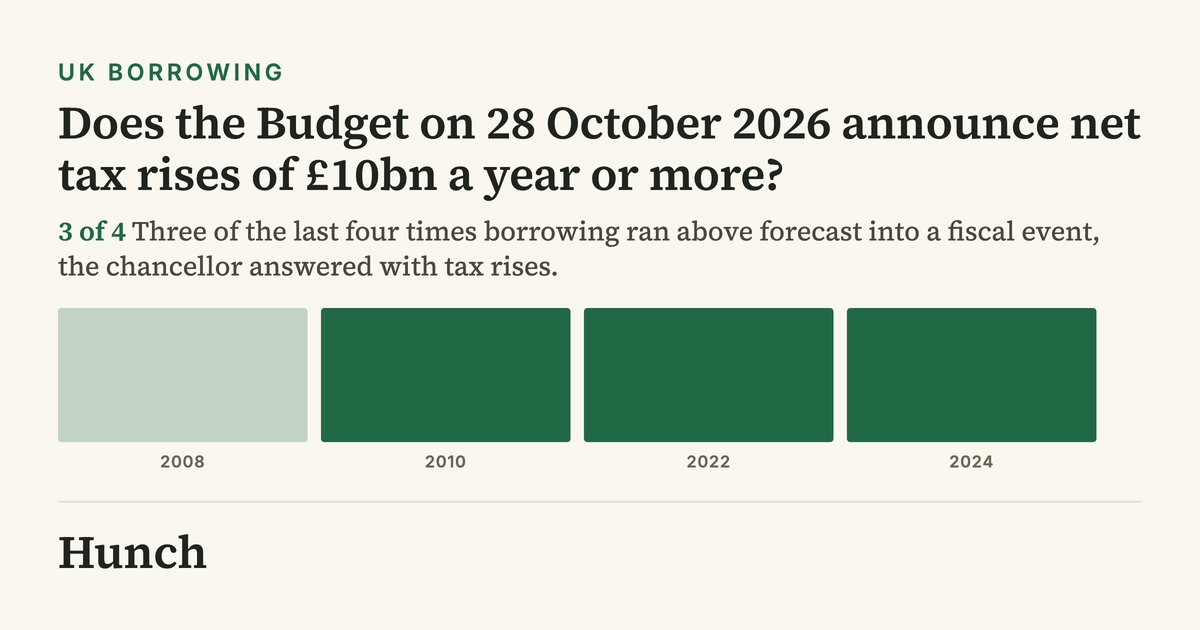
We found four times since 2008 when UK borrowing ran above the official forecast in the months before a chancellor’s next Budget or big statement. For each, we checked whether that event raised taxes overall or set out a plan to cut the deficit. This year’s overshoot is the one being tested, so it is not among the four.
Show the other 2 cases
The Read
History points to tax rises. In three of the four cases the chancellor answered with net tax rises or a plan to cut the deficit. The one exception, 2008, came in a deep recession. This year the damage comes from spending and debt interest while tax income is strong, and that kind of overshoot is the hardest to fix without a Budget measure. The £23.6bn of room from March is shrinking, and with 10-year bond rates above 5% the chancellor has few easy choices.
The case against starts with the size of the miss. £2.3bn over forecast after four months is small next to £56.7bn, and borrowing this year is £6bn lower than last year. The record £17.1bn from self-assessment in July shows tax income holding up. Healey could reach with spending restraint and let tax income close the gap, keeping net tax rises under £10bn. The record is also small, only four cases.
Bond markets can move it either way. If energy-driven inflation eases and 10-year rates fall back below 5%, the room comes back without any new policy. The Budget on answers the question.
Disclaimer
Hunch works only from sources that are publicly available, and publishes on the basis of analysis of that material. We do not form an editorial opinion or take sides, we give a simpler and wider view of news that already exists. If information in a source we used was inaccurate, distorted, or later disputed but had already entered our analysis, Hunch accepts no liability for that. Predictions are not advice. Phase 1 markets use Hunch Points, not money.
Published by Hunch under the Editorial Code. Complaints and corrections: /contact/.