UK economy grew in June after a flat May. Will growth carry on into July?
The economy grew 0.3% in June after a flat May and a fall in April. July's figure lands on 11 September, 6 days before the Bank of England sets rates.
What happened
Monthly real GDP grew by 0.3% in after no growth in May and a 0.1% fall in April, with growth of 0.4% in the three months to June compared with the three months to March.
The figure for July comes out on . June’s growth came from services, which rose 0.4 per cent. Production fell 0.2 per cent and construction fell 0.1 per cent. The Office for National Statistics (ONS) also revised May down, from growth of 0.1 per cent to no growth at all.
Growth over the three months to June was the seventh three-month rise in a row.
These monthly moves are small. The ONS index of the economy’s output, measured against its 2022 level, was 102.3 in January, 102.8 in February, 103.2 in March, 103.1 in April, 103.1 in May and 103.4 in June. Across six months the gap between lowest and highest is about one per cent. June’s rise brings output back close to where it was in March.
The timing matters because of what comes next. August inflation figures come out on , and the Bank of England announces its interest rate on . On the Bank’s Monetary Policy Committee kept the rate at 3.75 per cent by six votes to three. The three wanted a rise to 4 per cent.
A weak July figure and strong inflation in the same week would put the committee’s two sides directly against each other.
Sources: ONS (2), Bank of England
The Pattern
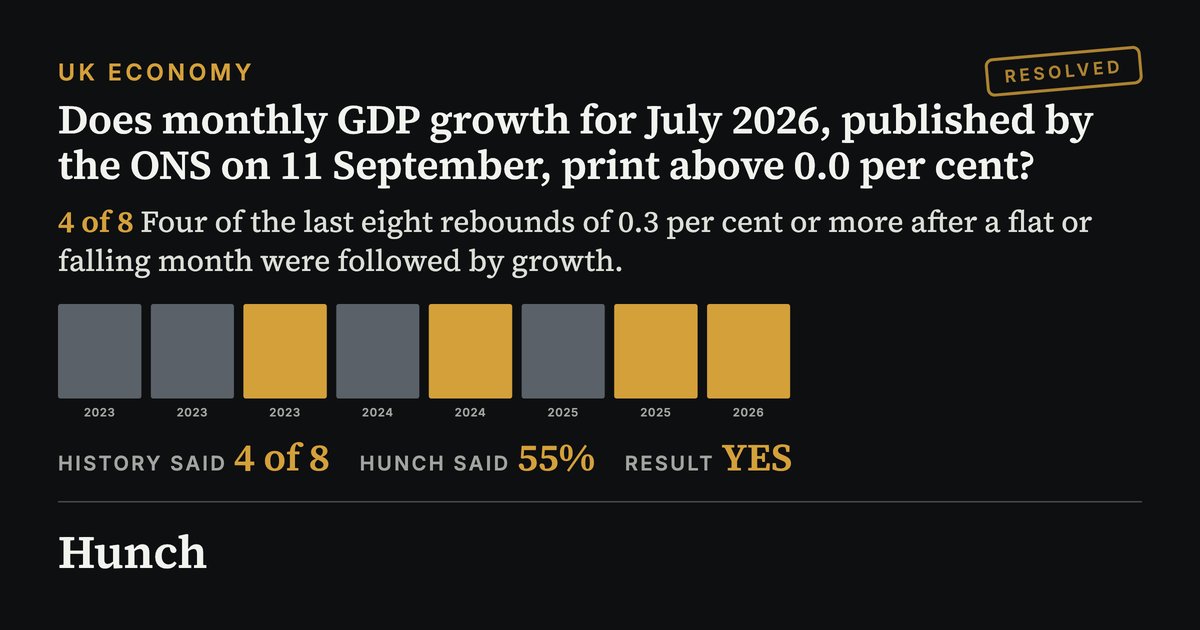
Since 1997 we found 68 months like June. In each, the UK economy grew 0.3 per cent or more straight after a month with no growth or a fall. Then we checked whether the next month grew too, and it did in 40 of them. We left out 2020 and 2021, the pandemic years, when the economy was reopening. The page shows the latest eight.
Show the other 6 cases
The Read
History is split. In the latest eight cases like June, the next month grew four times and was flat or fell four times. Over the whole record since 1997 the next month grew in 40 of 68 cases, just under six in ten. The recent run is choppy. was followed by a fall and by another rise, and for a year the economy has moved between small rises and flat months.
The June figure can also change. The ONS may revise it on , as it revised May this time. So on the Bank may be looking at a smaller rebound and higher inflation in the same week. Three members already voted for a higher rate in July.
The July figure on answers the first question. The bigger question is whether growth figures are being revised down while inflation goes up.
Disclaimer
Hunch works only from sources that are publicly available, and publishes on the basis of analysis of that material. We do not form an editorial opinion or take sides, we give a simpler and wider view of news that already exists. If information in a source we used was inaccurate, distorted, or later disputed but had already entered our analysis, Hunch accepts no liability for that. Predictions are not advice. Phase 1 markets use Hunch Points, not money.
Published by Hunch under the Editorial Code. Complaints and corrections: /contact/.