Courts split on Kalshi. In 5 of 6 cases, the top court first asked the government.
A third US appeals court has ruled on Kalshi's sports contracts, and the courts now disagree. New Jersey has asked the Supreme Court to step in.
What happened
A US appeals court ruled on that Ohio and Tennessee can apply their own gambling laws to Kalshi’s sports contracts, deepening a split among federal appeals courts.
On the federal appeals court in Cincinnati ruled that Ohio and Tennessee can apply their own gambling laws to Kalshi’s sports contracts. The three judges agreed. Kalshi says only the federal regulator can oversee it.
Three appeals courts have now ruled, and they disagree. In April the court for New Jersey sided with Kalshi. In August the court for Nevada ruled against it, and now the court for Ohio and Tennessee has too.
New Jersey asked the Supreme Court on to hear its case against Kalshi. Kalshi’s answer was due on . Kalshi asked for more time, and on the Court moved the date to . A second request from the same dispute, Crypto.com’s trading arm against Nevada, was filed on , with an answer due on .
The federal regulator, the Commodity Futures Trading Commission (CFTC), already backs Kalshi in the lower courts. It argued on Kalshi’s side in the Nevada appeal. In April it told the top court of Massachusetts that federal law overrides state gambling laws for markets it oversees.
The ruling hits the two states differently. In Ohio, Kalshi has had no court protection since , when the appeals court refused to shield it while it appealed. In Tennessee a lower court had shielded Kalshi, and the appeals court has now set that aside.
Sources: Al Jazeera, US Court of Appeals for the Sixth Circuit, US Court of Appeals for the Ninth Circuit, Supreme Court docket 26-299 (2), CFTC
The Pattern
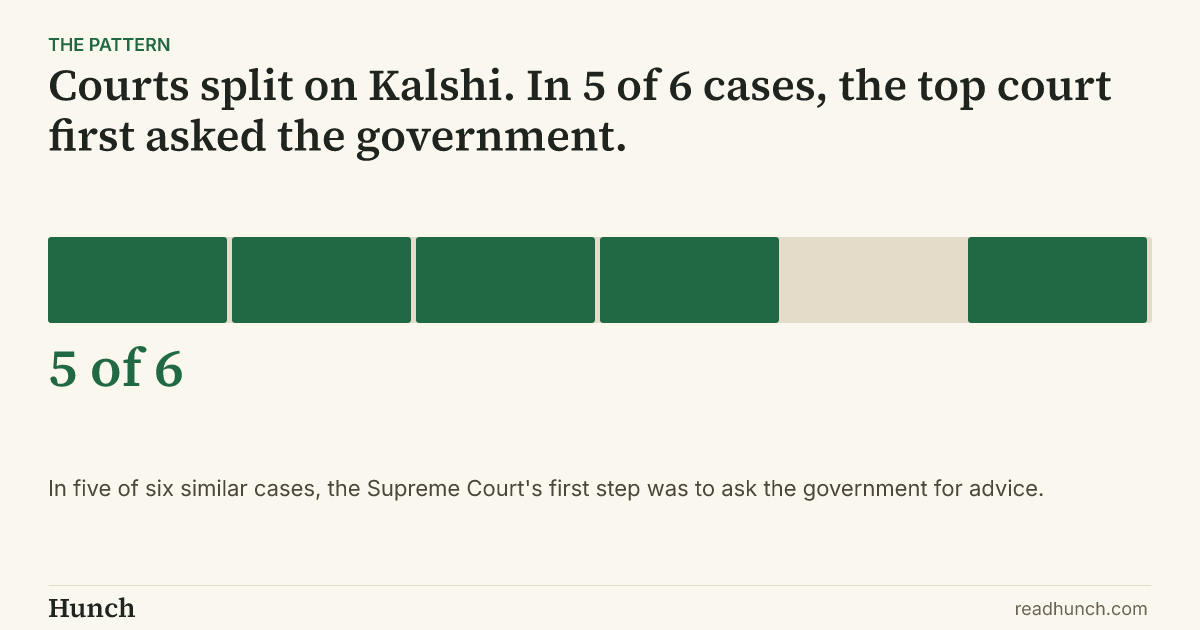
We looked for cases where three or more federal appeals courts disagreed over whether a federal law overrides state law, and one side asked the Supreme Court to hear the case. We found six since 2003. In all six the Court asked the US government for its view before deciding. The judges decide which cases to hear at private meetings. In five of the six they asked at the first meeting where they looked at the case, once both sides had sent in their papers. In the sixth they waited one meeting so that a second, related request could be decided with it. The Supreme Court is the one decider in all six.
Show the other 4 cases
The Read
History points to a request for the government’s advice. In all six cases the Court asked the Solicitor General, the government’s lawyer at the Court, before deciding whether to hear the case. In five it asked at the first meeting on the case, and the order came out the following Monday.
The timing follows the Court’s calendar. Kalshi’s answer is due on . The papers then go to the judges no sooner than 14 days later, unless New Jersey gives up that wait. The next meetings are on , then 8, 15 and , with none in between.
Two things are new. The federal regulator already backs Kalshi in the lower courts, which was not so in any of the six cases. And a second request from the same split, against Nevada, is already filed. In 2009, the one case with a related request, the Court waited one meeting so it could decide both together.
Will Kalshi stop in Ohio or Tennessee? We looked at eight cases where a company offering sports or fantasy contracts without a state licence lost in court or got a regulator’s order. Three stopped within 66 days, and each did so by a deal or a direct order: Crypto.com and Robinhood in Nevada in 2025, and two fantasy sports firms in Nevada in 2015. When Kalshi lost its federal court shield in Nevada in , it kept going for 115 days, until a state court ordered it to stop.
The other cases did not stop in time. Kalshi won a pause from an appeals judge in Massachusetts in February, and two fantasy firms in New York kept running for 101 days after a court order. Kalshi in Nevada after the order, and two other platforms there, stopped at some point, but no listed or official source gives the day, so we count them as not stopping in time. Nevada’s regulator said in June that Kalshi still had not blocked users in the state. The Tennessee ruling takes effect no sooner than .
Sources: Supreme Court docket 21-194 (2, 3, 4, 5, 6), FRAP 41, Cornell LII (2), CFTC, US brief in Level 3, Nevada Gaming Control Board (2, 3), ESPN (2), Bloomberg Law
Disclaimer
Hunch works only from sources that are publicly available, and publishes on the basis of analysis of that material. We do not form an editorial opinion or take sides, we give a simpler and wider view of news that already exists. If information in a source we used was inaccurate, distorted, or later disputed but had already entered our analysis, Hunch accepts no liability for that. Predictions are not advice. Phase 1 markets use Hunch Points, not money.
Published by Hunch under the Editorial Code. Complaints and corrections: /contact/.