UK buyers need smaller deposits again. Past easings usually lifted lending.
One pound in 12 of new UK mortgage lending now goes to buyers with a deposit of less than 10%, the largest share since the second quarter of 2008.
What happened
The Financial Times reported that first-time buyers are taking on larger mortgages relative to their incomes since the loan-to-income lending rules were relaxed, three days after the regulators’ own quarterly statistics put low-deposit lending at its highest share since 2008.
Small-deposit lending is at its highest share since 2008. In the second quarter, 8.4 per cent of new mortgage lending by value went to buyers with a deposit of less than 10 per cent. That is 0.4 points more than in the first quarter.
Loans covering more than 75 per cent of the home’s value reached 47.5 per cent of lending, the most since the fourth quarter of 2007. What has moved is the deposit buyers need.
Buyers are also borrowing more compared with their income. In the same quarter 46.0 per cent of borrowers took a loan at a high multiple of their income. That is 0.9 points more than in the first quarter and 4.6 points more than a year earlier.
The rule behind this changed in . The Bank of England’s Financial Policy Committee said single lenders could go past the 15 per cent limit on loans of 4.5 times income or more, as long as the market as a whole stayed within it. Brokers now offer first-time buyers six, and in some places seven, times their income.
So far this has not brought more buyers. Mortgage approvals, the number of home loans agreed for buying a house, fell to 56,053 in July. That is the lowest monthly figure since and well under the six-month average of about 60,800.
The Bank publishes August’s lending figures on . Nationwide said house prices in August were 1.6 per cent higher than a year earlier, while earnings grew several times faster.
Sources: Financial Times, Bank of England (2, 3), BBC, The Guardian
The Pattern
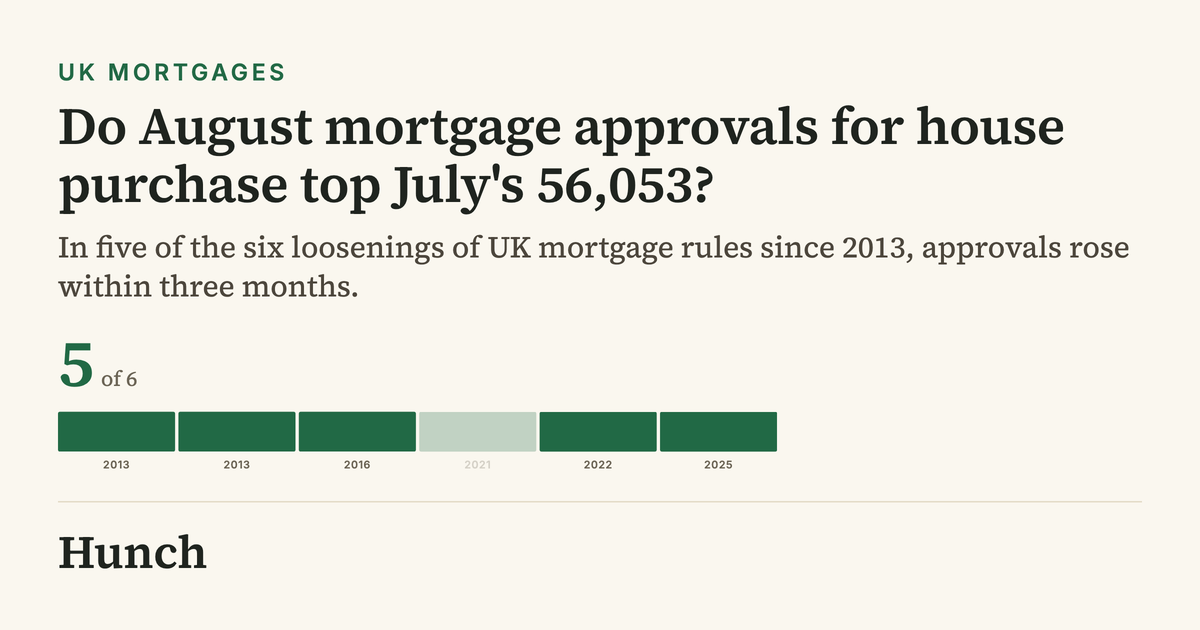
We found six changes since 2013 that made borrowing easier. Each came from the UK government or a UK regulator and let buyers borrow with a smaller deposit or a bigger multiple of their income. For each change we compared mortgage approvals in the three months after it with the three months before. Changes that made borrowing harder are left out.
Show the other 4 cases
The Read
History points to more approvals. After five of the six past easings, approvals rose within three months, and July’s 56,053 is a low figure to beat. Recent signs point the other way. Approvals have fallen in three of the last four months and quoted mortgage rates have been rising. The Bank of England’s rate-setters also meet on , with markets expecting a rate rise by December.
The warning is inside the record. After the change, approvals rose for one quarter and then fell back. The pattern also fails if the deposit was never what stopped buyers. Easier rules can make loans bigger without making them more numerous, which looks like an affordability problem. Overdue payments do not show stress: balances in arrears fell 1.9 per cent in the quarter to £19.7 billion, the lowest since the third quarter of 2023.
The August figure on answers the first question. A rate rise on , or a further rise in quoted mortgage rates, would likely keep approvals down in August and September and push the test into next year.
Disclaimer
Hunch works only from sources that are publicly available, and publishes on the basis of analysis of that material. We do not form an editorial opinion or take sides, we give a simpler and wider view of news that already exists. If information in a source we used was inaccurate, distorted, or later disputed but had already entered our analysis, Hunch accepts no liability for that. Predictions are not advice. Phase 1 markets use Hunch Points, not money.
Published by Hunch under the Editorial Code. Complaints and corrections: /contact/.