Schwartz's owner wants Knorr. Will the UK watchdog order a long review of the deal?
The UK competition watchdog said on 11 November that McCormick buying Unilever's food arm may weaken competition in dry sauces and meal mixes.
What happened
The UK watchdog says the Unilever and McCormick food deal could reduce competition in dry ingredient and sauce mixes.
The UK competition watchdog found a problem on . The Competition and Markets Authority (CMA) said McCormick’s plan to buy almost all of Unilever’s food business may weaken competition in dry mixes for meals, such as chilli con carne, and dry sauces, such as parsley sauce, sold to UK shops. It said the joined firm would be the biggest seller of both “by far”. Rivals such as Maggi and Bisto hold it back only a little.
The two firms have until to offer a fix. McCormick sells mixes and sauces under the Schwartz name, and Unilever sells food under Knorr, Maille and Colman’s. If the firms offer nothing, or the CMA finds the offer too weak, the deal goes to a second, in-depth review. If they do offer a fix, the law gives the CMA until to say whether it might accept it.
The CMA found no problem with mustard. Shoppers do not swap McCormick’s American mustard, French’s, for Unilever’s English Colman’s or French Maille. In August the two firms said Colman’s would be left out of the deal and sold. On Unilever said talks with buyers were “progressing well”.
Unilever still expects the £33.8bn deal to close on time. It spoke of “confidence in a timely closing”. Neither firm has said in public whether selling Colman’s would answer the CMA’s worry about mixes and sauces.
This merger will be referred for an in-depth, phase 2 investigation unless the parties offer an acceptable undertaking to address these competition concerns.
CMA case page, 11 November 2026
Sources: The Independent, GOV.UK, CMA, legislation.gov.uk, BBC, The Observer
The Pattern
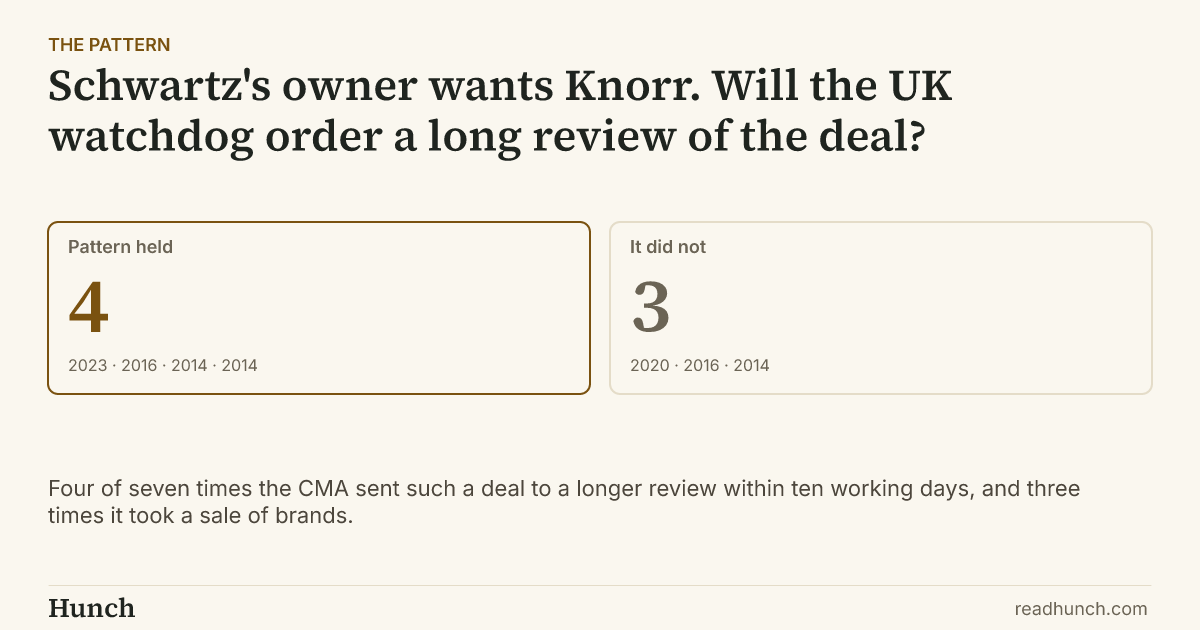
We looked for cases where the CMA found a competition problem at its first check of a deal, only in some of the products both firms sold, and each sold its own brand of it in UK shops. We found seven since 2014. Four times the CMA ordered a longer review within ten working days, and three times it said it might accept an offer to sell magazines. (GOV.UK; GOV.UK)
Show the other 5 cases
The Read
In the three deals the CMA let through after a sale, the problem sat in one or two topics among many. In the three where the firms offered nothing, it covered the main products: pies, children’s tablets, and washing machines and cookers. Here the problem is dry mixes and sauces, a small part of a £33.8bn deal, which points to a fix being offered. Yet in 2014 Reckitt offered one for K-Y and the CMA turned it down, not sure it would solve the problem “in a clear-cut manner”. Its words about McCormick and Unilever are as strong: “the largest supplier” of both “by far”.
There are reasons for doubt. The CMA decided all seven deals, and three were magazine deals with the same publisher, Future, on one side, all ending in a sale. Pies, toys and home appliances went the other way, so the type of product and the result line up closely. In none of the seven did the seller put a brand up for sale before the ruling, as Unilever did with Colman’s. In the CMA began a review of how it handles such fixes, after the last of these deals.
Disclaimer
Hunch works only from sources that are publicly available, and publishes on the basis of analysis of that material. We do not form an editorial opinion or take sides, we give a simpler and wider view of news that already exists. If information in a source we used was inaccurate, distorted, or later disputed but had already entered our analysis, Hunch accepts no liability for that. Predictions are not advice. Phase 1 markets use Hunch Points, not money.
Published by Hunch under the Editorial Code. Complaints and corrections: /contact/.