UK mortgage approvals rose a little in June. Such rebounds usually kept going.
Mortgage approvals for house purchase rose to 58,200 in June from about 56,400 in May. May's 13% fall was the sharpest since November 2022.
What happened
Net mortgage approvals for house purchase increased to 58,200 in , below an average of around 61,400 over the previous six months; net mortgage borrowing rose to £7.7 billion from £3.3 billion in May.
Mortgage approvals, the number of home loans agreed for buying a house, fell sharply before June’s rise. In the figures adjusted for normal seasonal swings, they dropped from 65,044 in April to 56,396 in May, a fall of 13.3 per cent. They then rose to 58,215 in June.
May’s fall was the biggest one-month drop since , after the mini-Budget.
Interest rates have not moved. The Bank of England kept its rate at 3.75 per cent on . The ONS said inflation fell to 2.6 per cent in the year to June, from 2.8 per cent in May.
Approvals come roughly three months before home sales complete. So June’s figure shows decisions made while the rate stayed the same and quoted mortgage prices changed little.
The figures for July come out on . They will show whether June’s rise was the start of a recovery or a pause in a fall. May and June were the first two months in a row below 60,000 since January and , which is why people watch the 60,000 line. The simpler test is whether July comes in above June.
Sources: Bank of England (2, 3), ONS
The Pattern
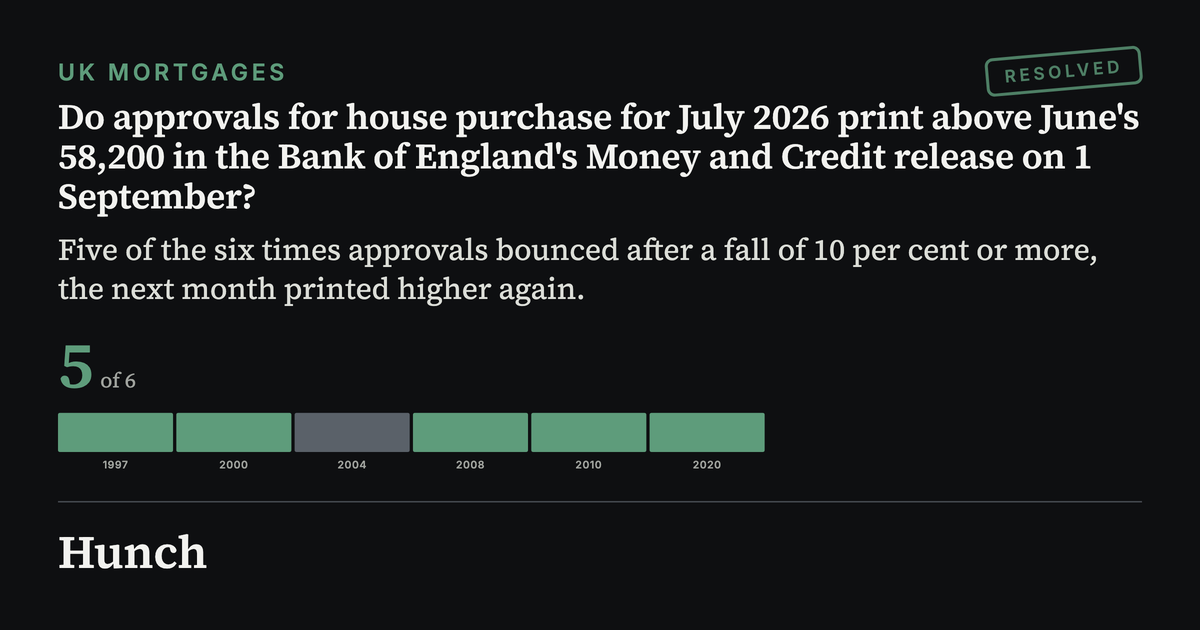
We found six sharp falls followed by a rise since 1993. We looked at the Bank of England’s monthly approvals figures since for every month when approvals fell by 10 per cent or more and then rose the next month, as in May and . Then we checked whether the month after the rise was higher again. May and are the case we are testing, so they are not counted.
Show the other 4 cases
The Read
History points to another rise. In five of the six past cases, the month after the rebound was higher again. The one exception came in the winter of 2004, when approvals were already sliding. June’s rise was small, 3.2 per cent, while the bounces in 2000, 2004, 2008 and 2020 were in double digits. A small rise gives less sign that buyers have come back.
The record has a blind spot on interest rates. After the crisis cases, the Bank cut rates or lending opened up again. This time the rate is steady at 3.75 per cent and inflation is 2.6 per cent, so lenders have little reason to cut mortgage prices.
The July figure on settles it. A figure below June would be the first sign that May was a turning point. It would also leave the 60,000 line, 1,800 above June, out of reach for a third month.
Disclaimer
Hunch works only from sources that are publicly available, and publishes on the basis of analysis of that material. We do not form an editorial opinion or take sides, we give a simpler and wider view of news that already exists. If information in a source we used was inaccurate, distorted, or later disputed but had already entered our analysis, Hunch accepts no liability for that. Predictions are not advice. Phase 1 markets use Hunch Points, not money.
Published by Hunch under the Editorial Code. Complaints and corrections: /contact/.