A court paused UK car loan compensation. Past payout bills mostly ended far higher.
A tribunal paused parts of the regulator FCA's £9.1bn car finance compensation scheme on 2 July. 4 challenges will be heard in December or February.
What happened
The Upper Tribunal suspends parts of the FCA’s motor finance redress scheme while four legal challenges proceed — lenders need not calculate or pay compensation until the cases are resolved.
The pause was agreed on between the Financial Conduct Authority (FCA), the UK’s financial regulator, and four challengers. They are the consumer group Consumer Voice and three car lenders: Volkswagen Financial Services, Mercedes-Benz Financial Services and Crédit Agricole Auto Finance.
The challenges will be heard in December or February. The hearings are listed for 14 to or 16 to .
The FCA confirmed the scheme on . It covers around 12.1 million car finance agreements made between and where the commission paid to car dealers was not properly disclosed.
The FCA puts compensation at £7.5bn, an average of £829 per agreement, and the total cost with administration at £9.1bn. If the scheme is upheld without appeal, payments could start in 2027. If it is overturned, they slip to 2028 or later.
The big banks are not among the challengers. Lloyds, the most exposed lender through its Black Horse car loans arm, chose not to fight the scheme, and so did Barclays, Santander and Close Brothers. They still question whether it pays drivers who lost nothing. The money they set aside for the bill stays in their accounts during the pause.
Bank results will show how boards treat the delay. Barclays reports half-year results on , Lloyds on and NatWest on .
The Pattern
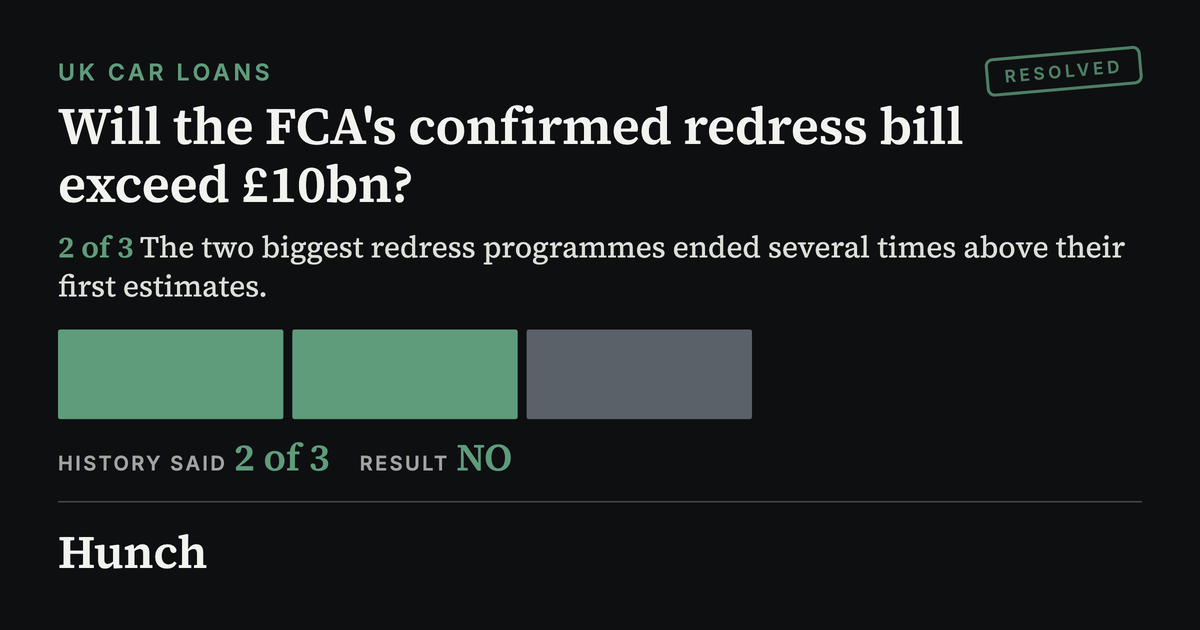
Britain has paid for mis-selling scandals before. In each, banks or firms had sold financial products unfairly, a regulator designed a compensation scheme and the industry gave a first estimate of the cost. We looked at the three large schemes that have finished and compared the final bill with that first estimate. The car finance scheme is shown for context and is not counted.
Show the other 2 cases
The Read
History leans towards a bigger bill. In two of the three finished schemes, PPI and pensions mis-selling, the final cost ended several times above the first estimate. PPI began with bank provisions, money set aside for the bill, of about a seventh of the final £38.3bn. It grew as questions about who was covered were settled in customers’ favour, one group at a time, and that can happen here too. Consumer Voice argues this scheme is too narrow. If the court agrees even in part, £9.1bn becomes the lowest the bill could be.
The record is thin. Only three large schemes have finished, and in the third, compensation to small firms for interest rate hedging products, the bill ended close to early estimates. The big lenders also chose not to challenge this scheme, and the challenge comes mainly from carmakers’ finance arms. For now the pause mostly moves the timetable. Banks set money aside for the scheme the FCA confirmed in March, and accounting rules do not let a board release that money just because payment dates moved.
The court hearings in December or February will decide how wide the scheme is, and with it the size of the bill. Until then the doubt over UK bank shares lasts at least two more results seasons.
Disclaimer
Hunch works only from sources that are publicly available, and publishes on the basis of analysis of that material. We do not form an editorial opinion or take sides, we give a simpler and wider view of news that already exists. If information in a source we used was inaccurate, distorted, or later disputed but had already entered our analysis, Hunch accepts no liability for that. Predictions are not advice. Phase 1 markets use Hunch Points, not money.
Published by Hunch under the Editorial Code. Complaints and corrections: /contact/.