Some Bank of England members voted for a rate rise. Will the rest follow in July?
The Bank of England held its rate at 3.75% in June, but two of nine rate-setters voted for a rise. The next decision on 30 July brings a new forecast.
What happened
The MPC voted 7–2 to hold Bank Rate at 3.75%, with two members preferring an immediate rise to 4% as energy prices stay elevated and unstable.
The vote came from the Monetary Policy Committee, the nine people who set the Bank’s interest rate. The two votes for a rise are the clearest sign yet that part of the committee thinks the energy price shock has not fully worked through. That shock pushed inflation to 3.3 per cent in March. It has since eased to 2.8 per cent.
World energy prices have fallen since the May meeting after events in the Middle East. They are still high and unstable compared with before the conflict. The Bank expects inflation could rise later this year as earlier energy price rises feed through.
The minutes also describe a job market that keeps getting weaker. That is the main reason most members want to wait.
The next decision comes on , with new forecasts. The Bank also publishes its quarterly Monetary Policy Report that day. Committees tend to move at forecast meetings. The meeting gives the members who want a rise their best chance to win more votes, and gives the majority its best cover to wait again with new numbers.
Sources: Bank of England (2)
The Pattern
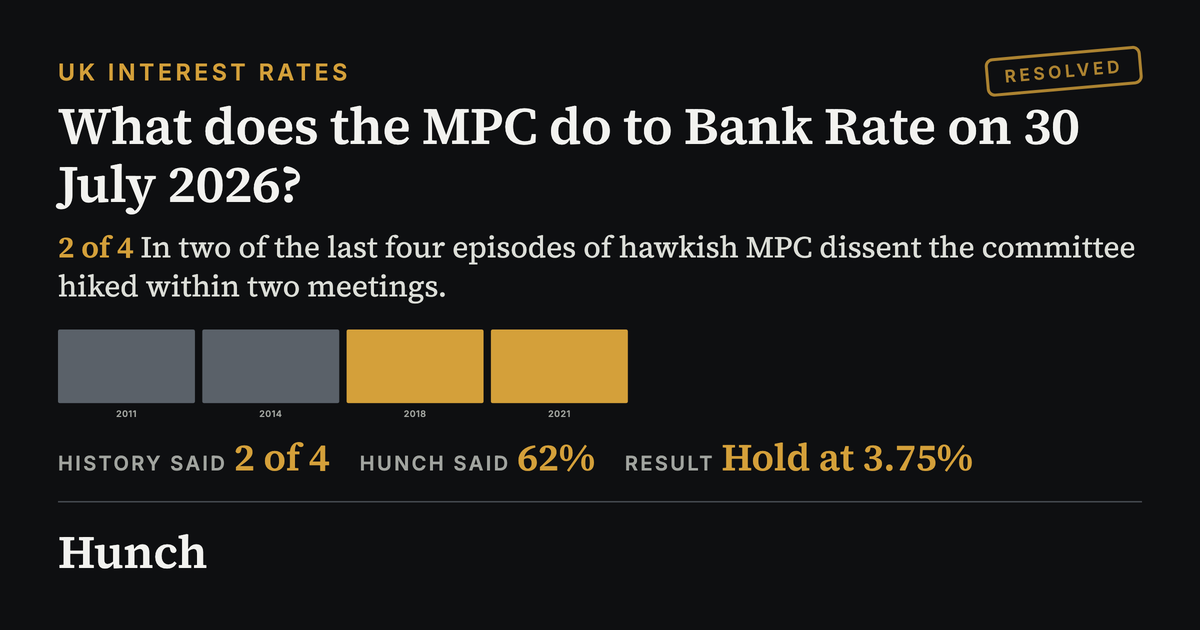
Since 2011 we found four times when a minority pushed for a rise. In each, two or more committee members voted to raise the rate while most kept it the same. We checked whether the committee raised the rate within its next two meetings, which is what the first market asks about . The current vote is the case we are testing and is not counted. Sometimes the minority was early, and the committee followed. Sometimes it never won, and the next move was a cut.
Show the other 2 cases
The Read
History is split. In 2021 and 2018 the committee raised the rate within two meetings, and the members who wanted a rise were proved right. In 2014 and 2011 they kept voting for a rise for months, and the next change in the rate was a cut. What set the two pairs apart was the direction of inflation. In 2018 and 2021 the committee’s own forecast was rising when the minority began voting for a rise. In 2011 and 2014 it was already easing.
This time most signs point to no change on . Seven votes is a clear majority, and inflation at 2.8 per cent is close to target. The minutes describe a weakening job market, and a committee publishing new forecasts into a slowing economy has good reason to wait. The 2014 and 2011 cases show a minority can vote for a rise for months and never win.
The July report is what could change it. If it shows energy costs pushing the inflation forecast above 3 per cent into the autumn, the majority’s own numbers start to support a rise, as in 2021 and 2018.
Disclaimer
Hunch works only from sources that are publicly available, and publishes on the basis of analysis of that material. We do not form an editorial opinion or take sides, we give a simpler and wider view of news that already exists. If information in a source we used was inaccurate, distorted, or later disputed but had already entered our analysis, Hunch accepts no liability for that. Predictions are not advice. Phase 1 markets use Hunch Points, not money.
Published by Hunch under the Editorial Code. Complaints and corrections: /contact/.